Will Rhind is the founder and chief executive of GraniteShares, an ETF issuer whose products span physical gold and amplified daily exposure to individual stocks. Before establishing the company in 2016, he led World Gold Trust Services, the sponsor of SPDR Gold Trust, better known by its GLD ticker. His career connects two different uses of exchange-traded products: making an asset easier to own and giving active traders a more concentrated market position.
That progression explains the appeal of the “leveraged ETF empire” description. It is a description of an expanding business, rather than a verified market-share ranking or an estimate of Rhind’s personal wealth. Understanding his work starts with the distinction between the issuer, the fund and the investment exposure it delivers.
Who Is Will Rhind?
William “Will” Rhind is an ETF entrepreneur with roots in Aberdeen, Scotland. GraniteShares’ official biography identifies him as its founder and describes more than 25 years of industry experience. He studied at the University of Bath and began his finance career as an investment banking analyst at Nomura International in London.
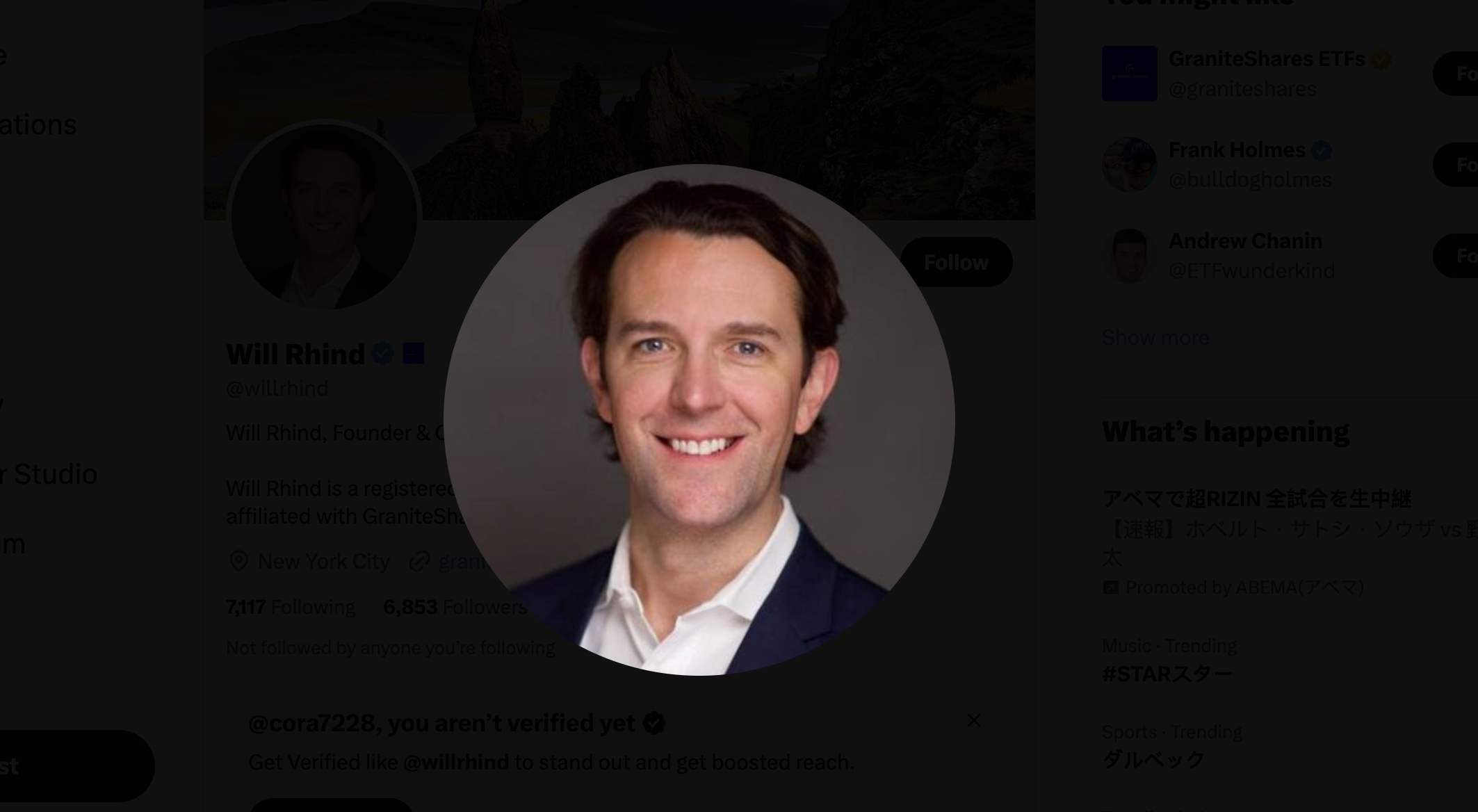
His subsequent roles included iShares and ETF Securities, where he worked on building the U.S. business, followed by the World Gold Council. The user-supplied Will Rhind X profile provides another public reference, but the career details in this article rely on company disclosures and institutional records. His significance lies principally in product development and distribution, rather than a publicly verified personal trading record.
What Was His Role at GLD’s Sponsor?
The World Gold Council’s appointment announcement names Rhind as CEO of World Gold Trust Services, its subsidiary and the sponsor of SPDR Gold Trust. It also records his earlier work at ETF Securities and iShares. GLD had already been established before this appointment, so describing him as its founder would be inaccurate.
A sponsor helps establish and operate a trust’s product structure and business. That differs from personally owning its gold, acting as the custodian or selecting a discretionary stock portfolio. Rhind’s experience at the sponsor put him close to the practical questions behind commodity products: custody, operating costs, investor access and distribution. These concerns later appeared in GraniteShares’ own gold offering.
Building GraniteShares: The Main Milestones
GraniteShares was founded in 2016 with support from Bain Capital Ventures and other investors, according to its company history. Its first U.S. ETFs arrived in 2017, followed by a European business in London in 2019. That sequence matters: the company’s identity was broader than leveraged single-stock trading from the outset.
| Period | Development | Business significance |
|---|---|---|
| Before GraniteShares | Roles at Nomura, iShares, ETF Securities and the World Gold Council | Experience in finance, ETF distribution and commodity products |
| 2016 | GraniteShares founded | Independent platform for developing exchange-traded products |
| 2017 | First U.S. ETFs launched | Established its U.S. product business |
| 2019 | European business launched | Expansion into short and leveraged single-stock ETPs |
The firm’s published company overview reports $10.9 billion in assets under management as of September 19, 2025. This is a historical company figure, not a current September 2026 total. Assets under management also belong to the investment products and their investors; they are not Rhind’s net worth or the company’s revenue.
Gold and Leveraged Stocks Serve Different Investors
The GraniteShares Gold Trust, ticker BAR, seeks to follow gold’s price after trust expenses. Its official product page describes physical bullion held in London, daily publication of the bar list and a prohibition on metal lending and derivatives. The investment case therefore depends primarily on gold and the costs of the trust.
NVDL illustrates a different business line. It seeks twice NVIDIA’s daily percentage change before fees and expenses. The familiar exchange-traded wrapper makes access straightforward, but it does not make the exposure equivalent to owning ordinary NVIDIA shares. European ETPs may also have different legal structures from U.S. ETFs, so a shared issuer or similar name is not enough to establish identical protections.
Why the Daily Reset Matters More Than the Founder’s Reputation
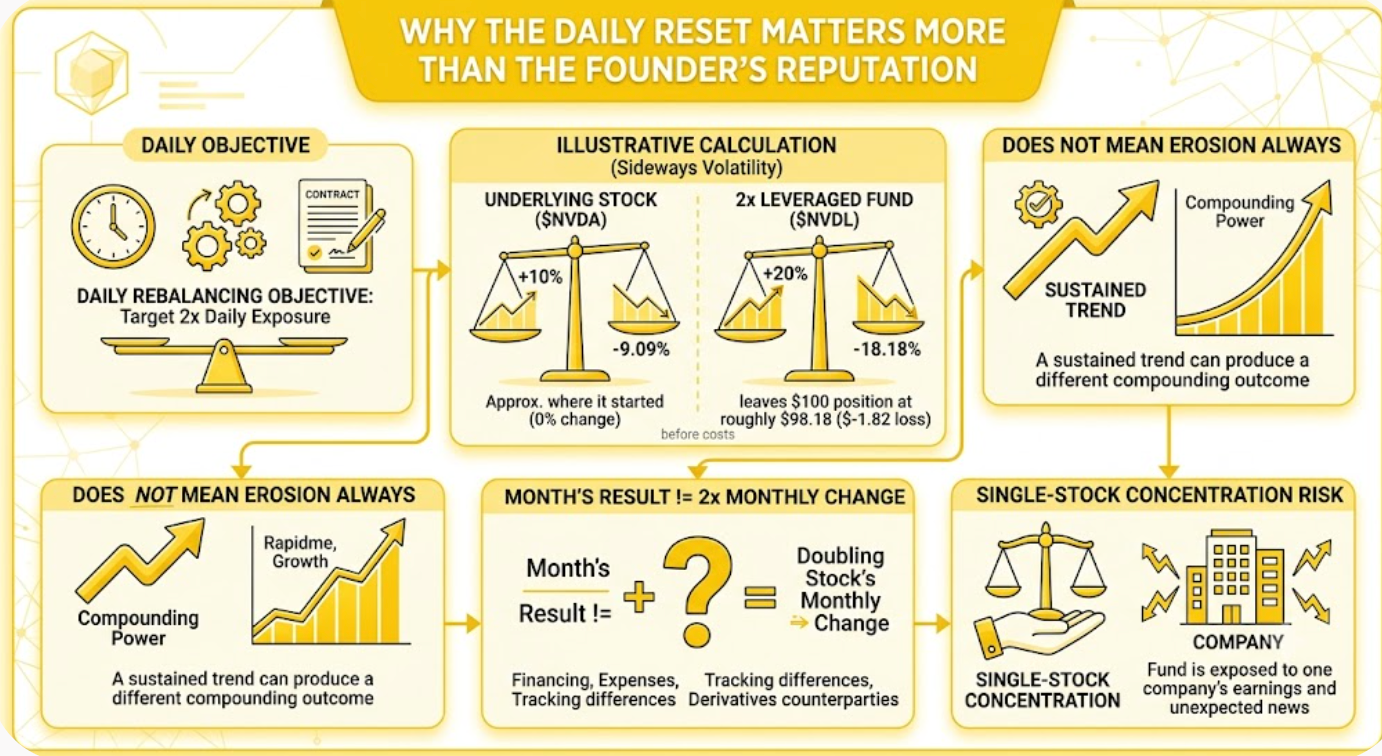
The NVDL product disclosure specifies a daily objective. Returns over several sessions depend on their sequence and on compounding. For an illustrative calculation, suppose a stock rises 10% and then falls 9.09%. It finishes approximately where it started. A hypothetical 2x daily fund gains 20% and then loses about 18.18%, leaving a $100 position at roughly $98.18 before costs.
This does not mean daily leverage always erodes returns. A sustained trend can produce a different compounding outcome. The point is that a month’s result cannot be calculated simply by doubling the stock’s monthly change. Financing, expenses, tracking differences and derivatives counterparties add further variables. Single-stock concentration also leaves the fund exposed to one company’s earnings, guidance and unexpected news.
What His Business Tells Us About Modern Trading
Rhind’s career shows how issuers can compete by changing access to market exposure. A physical gold trust removes some storage logistics for brokerage investors. A daily leveraged ETF packages a tactical position into an exchange-listed security. Both involve product design, but their intended holding periods and risk profiles differ substantially.
For readers familiar with crypto perpetuals, the common feature is amplified exposure. The mechanics are different: a daily leveraged ETF resets within a fund, while a perpetual position has its own margin, funding and liquidation rules. Neither the founder’s experience nor growth in fund assets establishes suitability for an individual investor. The relevant questions remain the product’s objective, cost, trading liquidity and what happens when the market moves against the position.
Conclusion
Will Rhind moved from established ETF businesses and leadership at GLD’s sponsor to founding GraniteShares and expanding its product range. His story is about building investment vehicles and distribution, with physical gold and daily leveraged stock exposure representing distinct parts of that business.
The useful takeaway for investors is to separate the person’s credentials from the product’s mechanics. A credible issuer can offer instruments with very different risks. Read the current prospectus and assess the holding period before investing. This article is for informational purposes only and does not constitute investment advice.
FAQ
Is Will Rhind the founder of GraniteShares?
Yes. He founded GraniteShares in 2016 and is identified by the company as its founder and CEO.
Did Will Rhind create GLD?
No. He previously led World Gold Trust Services, GLD’s sponsor, after the trust had already been established.
Is GraniteShares only a leveraged ETF issuer?
No. Its offerings also include physical gold and other investment strategies. Each product has its own objective and structure.
Does a 2x daily ETF double a stock’s yearly return?
No. Its objective applies to one trading day. Compounding, volatility and costs can cause longer-period returns to differ substantially.


