

Pons is a token launch and trading platform built for Robinhood Chain. It gives users a way to create and trade experimental crypto assets through a connected wallet. PONS is the ecosystem token associated with Pons, but understanding the application matters more than following its ticker: the investment story depends on how tokens are introduced, priced and moved into open-market liquidity.
Three things deserve separate attention: the Pons application, the PONS token and the independent tokens created through the launchpad. Success in one does not automatically guarantee value or safety in the others.
PONS and the Pons Launchpad at a Glance
Pons describes itself as a noncustodial interface for launching and trading tokens on Robinhood Chain. Users connect a compatible wallet, approve transactions and interact with smart contracts. The platform provides the interface, while settlement occurs on the blockchain.
PONS is the ecosystem token associated with the platform. Its price may reflect expectations about adoption and trading activity, but public documentation describes the launch mechanics more clearly than a permanent set of token-holder rights. Buyers should verify current utility rather than assume that ownership includes governance, revenue sharing or guaranteed rewards.
How a Pons Token Launch Works
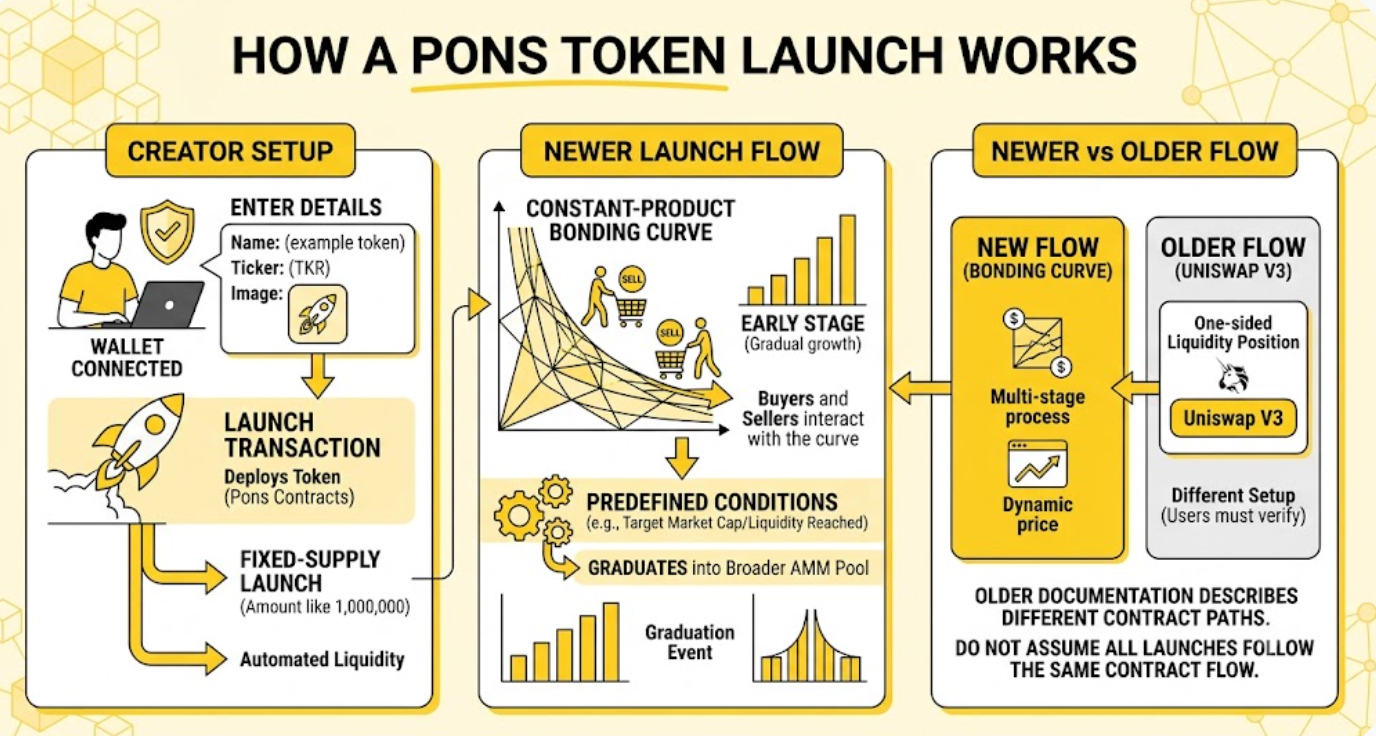
A creator connects a wallet and enters token details such as a name, ticker and image. A transaction deploys the asset using the applicable Pons contracts. Launch rules determine the supply and how trading begins, so a user needs to inspect the particular launch rather than rely on the platform name alone.
Pons documentation and its published repository describe different contract versions. The earlier approach uses fixed-supply tokens and a one-sided Uniswap V3 liquidity position. The newer flow describes a constant-product bonding curve followed by graduation into a locked, full-range Uniswap V4 pool. These differences matter when interpreting fees, launch progress and the liquidity available to buyers and sellers.
What Bonding Curves and Graduation Mean
A bonding curve determines prices through a formula and the assets held in a contract. It does not need to match each purchase against a separate limit sell order. As trades change the pool balances, the next available price changes as well. Buying can move the token up the curve, while selling can move it back down.
The quoted price should not be confused with a guaranteed execution price. A large order, or transactions executed before yours, can change the outcome. Slippage settings limit how much deviation a transaction accepts, but an overly restrictive setting may cause a transaction to fail.
Graduation is the transition from the initial trading mechanism into an automated market maker pool after specified conditions are met. Locked liquidity can restrict withdrawal of a particular liquidity position. It does not stop holders from selling their tokens, prevent a contract exploit or guarantee that enough demand will remain when a trader wants to exit.
What Does Holding PONS Actually Provide?
The key question is whether platform activity creates a specific, verifiable benefit for the token. A busy launchpad can attract attention without creating a proportional increase in demand for its ecosystem token. Traders should distinguish a documented token requirement from a marketing claim about future adoption.
Features such as creator fees, escrow or buyback mechanisms may apply to individual launches or particular contract versions. They should not automatically be treated as income owed to every PONS holder. Current token terms, contract permissions, supply and distribution provide a better basis for evaluation than assumptions about how other launchpads work.
PONS Price and Liquidity on Tapbit
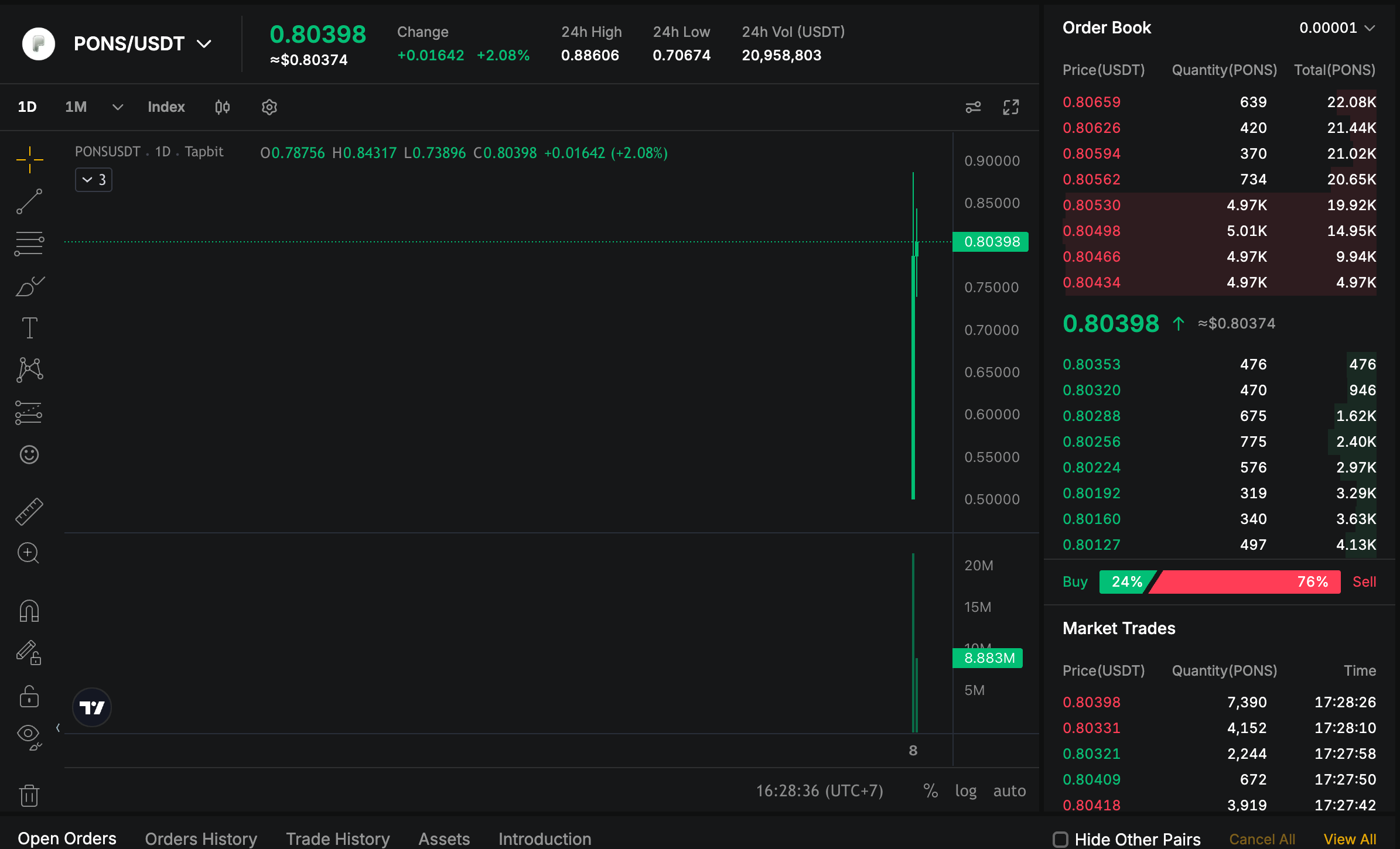
The supplied Tapbit screenshot showed PONS/USDT at approximately 0.80398 USDT, with a displayed 24-hour change of +2.08%. Its reported 24-hour high was 0.88606, the low was 0.70674 and volume was about 20.96 million USDT. These are figures from the supplied snapshot, not a live quote.
Readers can check the PONS/USDT spot market on Tapbit for current quotes, recent trades and available orders. Reported volume measures trading over a period; it does not tell you exactly how much can be bought or sold near the current price. The spread and order-book depth are more useful for estimating immediate execution costs.
A market order prioritizes execution and may fill across multiple prices. A limit order specifies an acceptable price, but it may remain unfilled. Neither order type removes the possibility of a sharp change in the token's market value.
Robinhood Chain, ETH Gas and Official Affiliation
Robinhood Chain is an Ethereum Layer 2 built using Arbitrum technology. Its network documentation identifies ETH as the native gas asset and chain ID 4663. Users interacting with applications on the network need ETH on the correct chain to pay transaction fees.
An independent application can deploy on a public network without becoming a product of the company associated with that network. Pons and tokens launched through its interface should not be described as endorsed by Robinhood merely because they use Robinhood Chain. Any claimed partnership or official status requires a specific first-party confirmation.
The Risks That Matter Before Buying
Token identification comes first. Names, tickers and images can be copied. Confirm the exact contract address against reliable project materials and the market you plan to use. A matching logo or familiar symbol is not sufficient evidence that two listings represent the same asset.
Liquidity and ownership are equally important. A small number of wallets may hold enough supply to overwhelm available demand. A high displayed market capitalization can coexist with a thin trading pool, making the price difficult to realize when selling. Locked liquidity does not remove either problem.
Smart-contract, wallet and infrastructure risks also remain. Noncustodial access means users retain responsibility for their approvals and signatures; it does not mean every transaction is safe. A malicious interface can request harmful permissions, and even a legitimate application can suffer contract or service failures.
PONS is a speculative asset, and the tokens created through a permissionless launchpad may have even less operating history. This article explains the mechanics and risks; it does not establish that a purchase is suitable for a particular investor.
Conclusion
Pons makes token creation and early trading easier to access on Robinhood Chain. Its bonding-curve and liquidity-graduation mechanisms help explain how a launch moves from initial distribution into broader trading. Whether PONS captures lasting value depends on its actual token design, adoption and market liquidity.
Before taking a position, verify the asset, understand the contract version and compare the advertised token benefits with what the documentation actually provides.
FAQ
What is PONS crypto?
PONS is the ecosystem token associated with Pons, a token launch and trading platform on Robinhood Chain. It is separate from independently created tokens launched through the application.
Is Pons an official Robinhood product?
Deployment on Robinhood Chain does not establish official affiliation or endorsement. Check specific first-party announcements before relying on such a claim.
What token is used for gas on Robinhood Chain?
ETH is the network's native gas asset. Users need it on the correct chain when submitting on-chain transactions.
What happens when a Pons token graduates?
Graduation moves a token from its initial launch mechanism into automated market maker liquidity after defined conditions are met. The details depend on the launch contract version.
Does locked liquidity make PONS or a launchpad token safe?
No. A lock can restrict withdrawal of a particular liquidity position, but it does not eliminate selling pressure, concentration, contract vulnerabilities or market losses.


