
The KOSPI Index has become one of the most important Asian equity benchmarks to watch in 2026. South Korea sits directly inside the artificial intelligence supply chain, and investors have been treating the market as a way to gain exposure to memory chips, high-bandwidth memory, data centers, and advanced computing demand.
The rally has been powerful, but the next phase may be more complicated. After a major AI-led move, investors need to ask whether the KOSPI rally can broaden beyond a few semiconductor giants and become a healthier, more durable market advance.
What Is the KOSPI Index?
The KOSPI Index, short for Korea Composite Stock Price Index, is South Korea's main stock market benchmark. It tracks major companies listed on the Korea Exchange and is widely used to measure the performance of Korean equities.
For global investors, KOSPI is more than a local index. South Korea is a major exporter of semiconductors, electronics, batteries, autos, shipbuilding products, and industrial goods. That means the KOSPI often reflects broader views on global trade, technology demand, and Asian market sentiment.
In 2026, the index has gained attention because South Korea sits directly inside the artificial intelligence supply chain. When investors talk about AI infrastructure, memory chips, high-bandwidth memory, and advanced computing, Korean companies are often part of the conversation.
Why the KOSPI Index Is Rallying in 2026
The KOSPI rally has been driven mainly by the AI trade. Investors are looking for companies that can benefit from rising demand for data centers, AI servers, memory chips, and high-performance computing.
South Korea's market is naturally tied to this theme because of its semiconductor giants. SK Hynix has become closely associated with high-bandwidth memory demand, while Samsung Electronics remains a major force in memory, chips, devices, and advanced technology supply chains.
The rally also reflects improving expectations for corporate earnings. After a difficult semiconductor downcycle, investors are watching whether chip pricing, AI-related demand, and global inventory conditions can support a stronger profit recovery.
KOSPI and South Korea's AI Stock Rally
South Korea's AI stock rally is not only about software. It is mostly about infrastructure.
AI models require enormous computing power, and that computing power depends on chips, memory, servers, storage, cooling systems, and advanced manufacturing capacity. Korean companies play important roles in several of these areas.
This makes the KOSPI one of the key Asian indexes for investors who want exposure to the AI hardware cycle. When demand for AI servers rises, memory suppliers can benefit. When global tech spending slows, the same stocks can face pressure.
That is why the KOSPI outlook in 2026 depends heavily on whether AI demand remains strong enough to justify higher valuations.
Can the KOSPI Rally Continue?
The KOSPI rally can continue, but the next phase may be harder than the first.
Early rallies are often driven by a clear theme. In this case, the theme is AI. The next phase usually requires confirmation from earnings, guidance, and broader participation across sectors.
A healthier KOSPI rally would not rely only on Samsung and SK Hynix. Investors will want to see strength spreading into industrials, energy, materials, batteries, financials, and other export-linked sectors. If the rally broadens, the index may look more sustainable.
If gains remain concentrated in a small number of AI-linked mega caps, volatility could rise. A single earnings disappointment or valuation reset in chip stocks could pressure the whole index.
KOSPI 2026 Price Outlook: Key Scenarios
The bullish case for KOSPI is straightforward. AI infrastructure demand stays strong, chip earnings continue to improve, foreign investors keep buying Korean equities, and the Korean won remains stable enough to support confidence.
In that scenario, the index could continue grinding higher through 2026, especially if earnings growth broadens beyond semiconductors.
The neutral scenario is more uneven. AI stocks remain supported, but valuations become harder to justify after a major rally. The index may trade sideways, with sharp rotations between chip stocks, industrials, financials, and consumer names.
The bearish scenario would involve a pullback in AI enthusiasm, weaker memory pricing, slower China demand, stronger U.S. dollar pressure, or foreign investor outflows. In that case, KOSPI could give back part of its AI-driven gains.
Key Drivers for the KOSPI Index in 2026
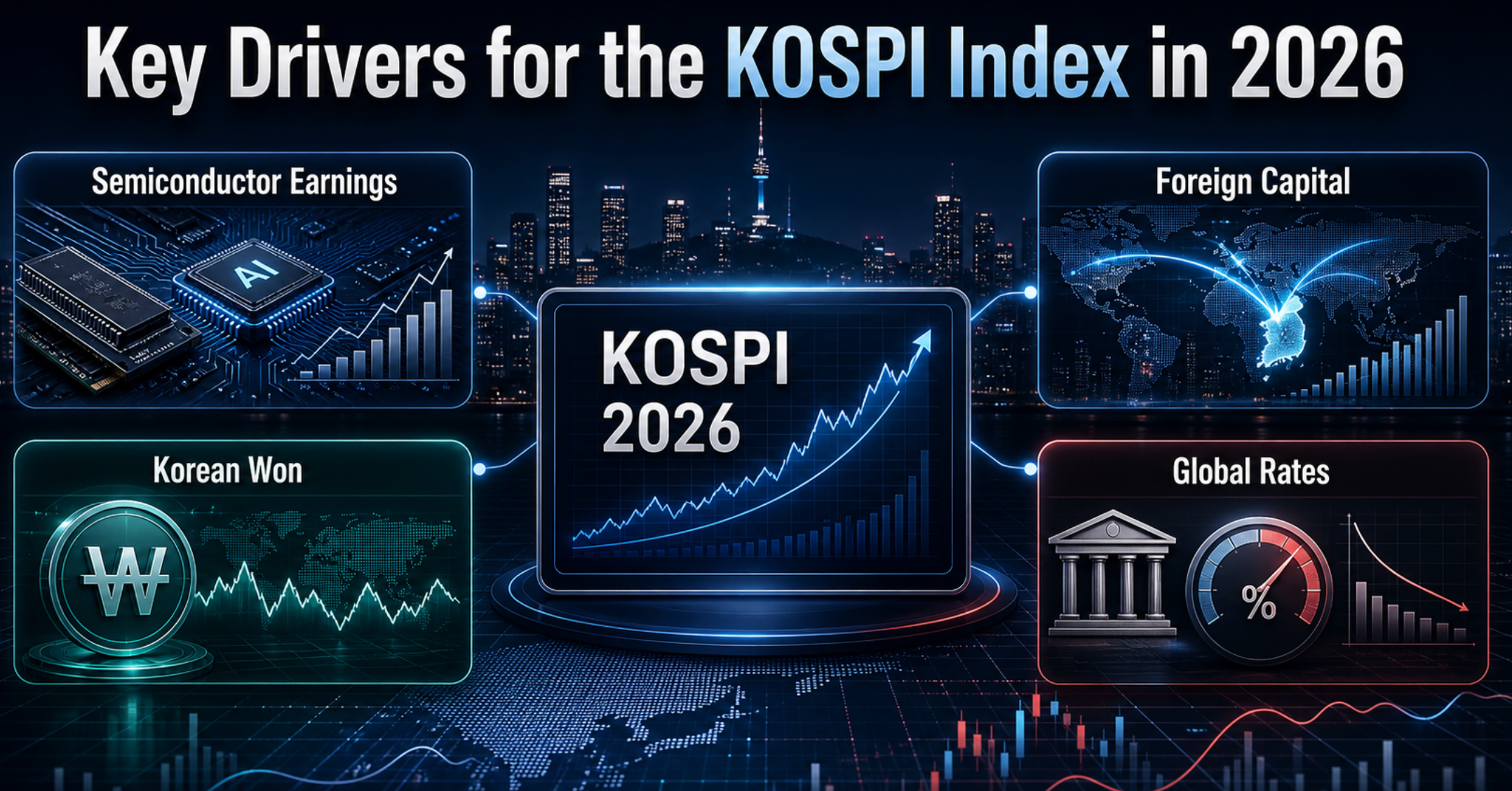
The first driver is semiconductor earnings. If memory prices and AI chip demand remain strong, South Korea's largest technology companies may continue to support the index.
The second driver is foreign capital. KOSPI is sensitive to global investor flows. When foreign investors increase exposure to Korean equities, the index often benefits. When they reduce risk, the market can fall quickly.
The third driver is currency movement. A weaker Korean won can help exporters, but sharp currency weakness may also signal stress and reduce foreign investor returns.
The fourth driver is global interest rates. Lower rate expectations usually support growth and technology stocks, while higher-for-longer conditions can pressure valuations.
Major Risks for KOSPI Investors
The biggest risk is concentration. If too much of the rally depends on a small number of AI and semiconductor names, the index becomes vulnerable to sector-specific shocks.
Another risk is valuation. AI-related stocks can rise quickly when sentiment is strong, but they can also correct sharply if earnings fail to match expectations.
South Korea's export exposure is also important. Weak global demand, slower China growth, or trade tensions could pressure corporate earnings.
Currency volatility adds another layer. Foreign investors do not only care about stock prices. They also care about returns after currency movement.
For users following global markets alongside digital asset trends, the Tapbit registration page provides access to crypto market tools and trading features.
KOSPI Index Investment Outlook
The KOSPI outlook for 2026 remains positive but more selective. The AI story is still powerful, but investors should avoid assuming that every AI-linked rally can continue in a straight line.
The best setup would be a broadening rally where semiconductor strength is joined by industrials, materials, batteries, and financials. That would suggest the market is moving from a narrow AI trade into a wider earnings recovery.
If the rally stays too narrow, investors should be careful. A strong index can still hide fragility underneath the surface.
Final Verdict
The KOSPI Index remains one of the most important Asian equity benchmarks to watch in 2026. South Korea's role in semiconductors and AI infrastructure gives the index a powerful growth narrative.
The rally can continue if AI demand stays strong, chip earnings improve, and foreign inflows remain supportive. But after a sharp move, the market may become more sensitive to valuation risk and earnings surprises.
For investors, the key question is not only whether AI remains popular. It is whether South Korea's AI-driven rally can broaden into a healthier, more durable market advance.
Investment Risk Disclaimer
This article is for informational purposes only and does not constitute financial advice. Equity indexes can move sharply due to earnings, interest rates, currency changes, geopolitical events, and investor sentiment. Users should conduct independent research and consider their own risk tolerance before making investment decisions.
FAQ
What is the KOSPI Index?
The KOSPI Index is South Korea's main stock market benchmark, tracking major companies listed on the Korea Exchange.
Why is the KOSPI rising in 2026?
The rally is largely driven by AI-related demand, semiconductor stocks, stronger earnings expectations, and foreign investor interest in Korean equities.
What stocks drive the KOSPI AI rally?
Samsung Electronics and SK Hynix are among the most important companies because of their exposure to memory chips and AI infrastructure demand.
Can the KOSPI rally continue?
Yes, but the rally may need broader earnings support beyond a few major semiconductor stocks to become more sustainable.
What are the biggest risks for KOSPI investors?
Key risks include AI valuation pressure, semiconductor cyclicality, export dependence, Korean won volatility, China demand, and foreign capital outflows.


