
What Is MiCA Regulation?
MiCA regulation means the Markets in Crypto-Assets Regulation, the European Union's major legal framework for crypto assets. It is designed to create a more consistent set of rules across EU member states instead of leaving each country to build a separate crypto regime.
For users searching mica regulation, the key idea is simple: MiCA defines how many crypto issuers and crypto-asset service providers must operate if they serve the EU market. It covers areas such as authorization, disclosure, stablecoins, market abuse, and consumer protection.
MiCA is important because it is one of the first large, region-wide attempts to regulate crypto with a dedicated rulebook rather than fitting every activity into older financial laws. Instead of treating crypto as a single category, MiCA separates different activities: issuing crypto assets, issuing stablecoin-like tokens, providing custody, operating exchange services, and offering other crypto-asset services.
That structure makes the regulation easier for beginners to understand. MiCA is not simply an anti-crypto law or a pro-crypto law. It is a framework that tries to define who is responsible, what must be disclosed, and which activities require authorization when crypto products are offered in the EU.
Why MiCA Matters for Crypto Users
MiCA matters because it turns crypto compliance into a clearer framework. Before MiCA, crypto companies often faced fragmented rules across Europe. Under MiCA, the EU aims to create a single regulatory standard for many crypto-asset activities.
This can affect:
- Stablecoin issuers, including e-money tokens and asset-referenced tokens.
- Crypto-asset service providers, often called CASPs.
- Token issuers that offer crypto assets to the public in the EU.
- Users, who may receive more standardized disclosures.
Tapbit Learn's what GDPR means in crypto guide is a useful companion because both topics deal with European digital regulation.
For users, the practical value is clearer expectations. If a platform or issuer operates under MiCA, users can expect more formal disclosures about the asset, the issuer, the service provider, and relevant risks. That does not guarantee success, but it helps reduce the information gap between providers and users.
For companies, MiCA changes the cost of serving the EU market. Firms may need authorization, governance procedures, risk controls, complaint-handling processes, and market-abuse monitoring. Smaller projects may find this demanding. Larger institutions may see it as a path toward more mainstream adoption because clearer rules can make compliance easier to plan.
What Does MiCA Cover?
| Area | Simple Meaning |
|---|---|
| Crypto-asset issuance | Rules for offering certain tokens to the public |
| Stablecoins | Requirements for asset-referenced and e-money tokens |
| CASPs | Authorization and conduct rules for service providers |
| Market abuse | Rules against manipulation and insider dealing |
| Disclosures | White paper and information obligations |
The regulation is especially important for stablecoins because stablecoins can be used for payments, trading, and settlement across borders. For broader background, Tapbit Learn's what is USDC article explains how stablecoins work in everyday crypto use.
MiCA also creates a more consistent language for regulators and users. Terms such as white paper, offer to the public, admission to trading, asset-referenced token, e-money token, and crypto-asset service provider become part of the compliance vocabulary. This matters because crypto users often see similar products described in different ways across platforms. MiCA attempts to reduce that ambiguity in the EU.
Another important point is timing. MiCA did not arrive all at once. Stablecoin-related provisions began applying before the broader CASP framework. That phased rollout is one reason users may see more stablecoin compliance headlines first, followed by exchange, custody, and service-provider updates.
MiCA, Stablecoins and CASPs
MiCA uses specific terms. Two of the most important are asset-referenced tokens and e-money tokens. In simple language, these are stablecoin-like assets that reference fiat currencies, baskets of assets, or other value anchors.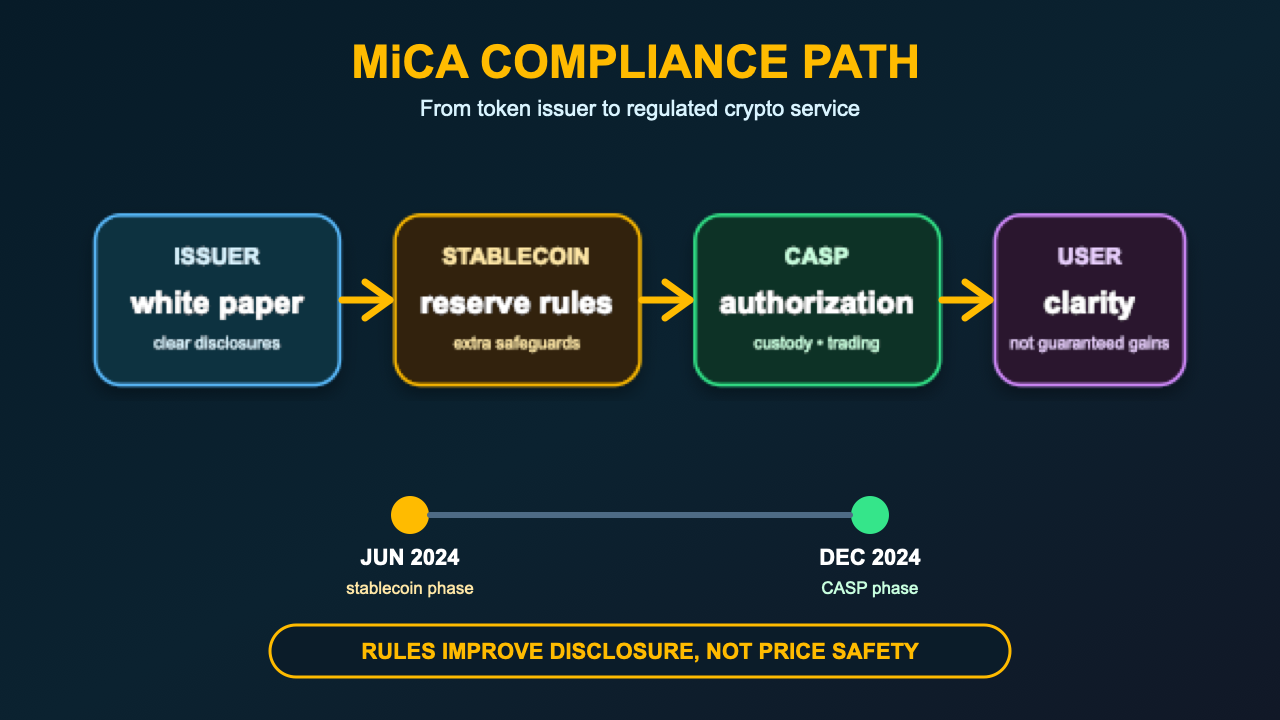
MiCA also regulates crypto-asset service providers, or CASPs. These can include companies that provide custody, trading, exchange, execution, placing, advice, or transfer services for crypto assets within the scope of the regulation.
This does not mean every blockchain activity is regulated in the same way. Fully decentralized systems, certain NFTs, and activities outside the EU may be treated differently depending on structure and facts.
Stablecoins receive special attention because they can scale quickly and connect crypto markets with payments. If a stablecoin is widely used, problems with reserves, redemption, governance, or disclosure can affect many users at once. MiCA therefore focuses heavily on reserve management, issuer obligations, and the distinction between different types of stablecoin-like tokens.
CASPs matter because many users interact with crypto through service providers rather than directly through protocols. A user may not read smart contract code, manage private keys, or evaluate every token issuer. Instead, they rely on trading venues, custodians, and service platforms. MiCA tries to make those intermediaries more accountable when they operate in the EU.
What MiCA Does Not Mean
MiCA does not mean crypto is risk-free. It does not guarantee that a token will rise in price, that every project is high quality, or that users cannot lose money. It is a regulatory framework, not an investment guarantee.
Users should still check project fundamentals, liquidity, custody setup, fees, and platform transparency. On Tapbit, users can review proof of reserves, check the fee structure, or contact customer support when they need platform help. New users can also create an account to explore available tools.
MiCA also does not automatically apply to every token that appears online. Some assets may be outside scope, some may be offered from outside the EU, and some decentralized activities may require a more detailed legal analysis. Users should avoid assuming that a token is safer simply because it uses regulatory language in its marketing.
The best beginner approach is to ask three questions: Is the issuer clearly identified? Is the service provider authorized where required? Are the risks and rights explained in plain language? If those answers are unclear, the user should slow down before committing funds.
FAQ
What does MiCA stand for?
MiCA stands for Markets in Crypto-Assets Regulation.
Does MiCA apply to all crypto assets?
No. MiCA covers many crypto assets and service providers, but some activities and assets may fall outside its scope.
Does MiCA regulate stablecoins?
Yes. Stablecoin-like assets are a major part of MiCA, especially e-money tokens and asset-referenced tokens.
What is a CASP under MiCA?
A CASP is a crypto-asset service provider, such as a company offering certain crypto trading, custody, or transfer services.
Does MiCA make crypto investing safe?
No. MiCA creates regulatory standards, but users still face market, liquidity, technology, and project risks.


