
What Is SOXS?
SOXS stands for Direxion Daily Semiconductor Bear 3X Shares. It is a leveraged inverse ETF built for traders who want short-term bearish exposure to the semiconductor sector. In simple terms, SOXS is designed to move in the opposite direction of a semiconductor stock index on a daily basis, with roughly three times the daily inverse exposure before fees and market effects.
That structure makes SOXS very different from buying a semiconductor stock, a regular ETF, or a long-term technology fund. It is a tactical product. Traders generally watch it when they expect pressure on chip stocks, AI hardware names, memory companies, or the broader semiconductor cycle.
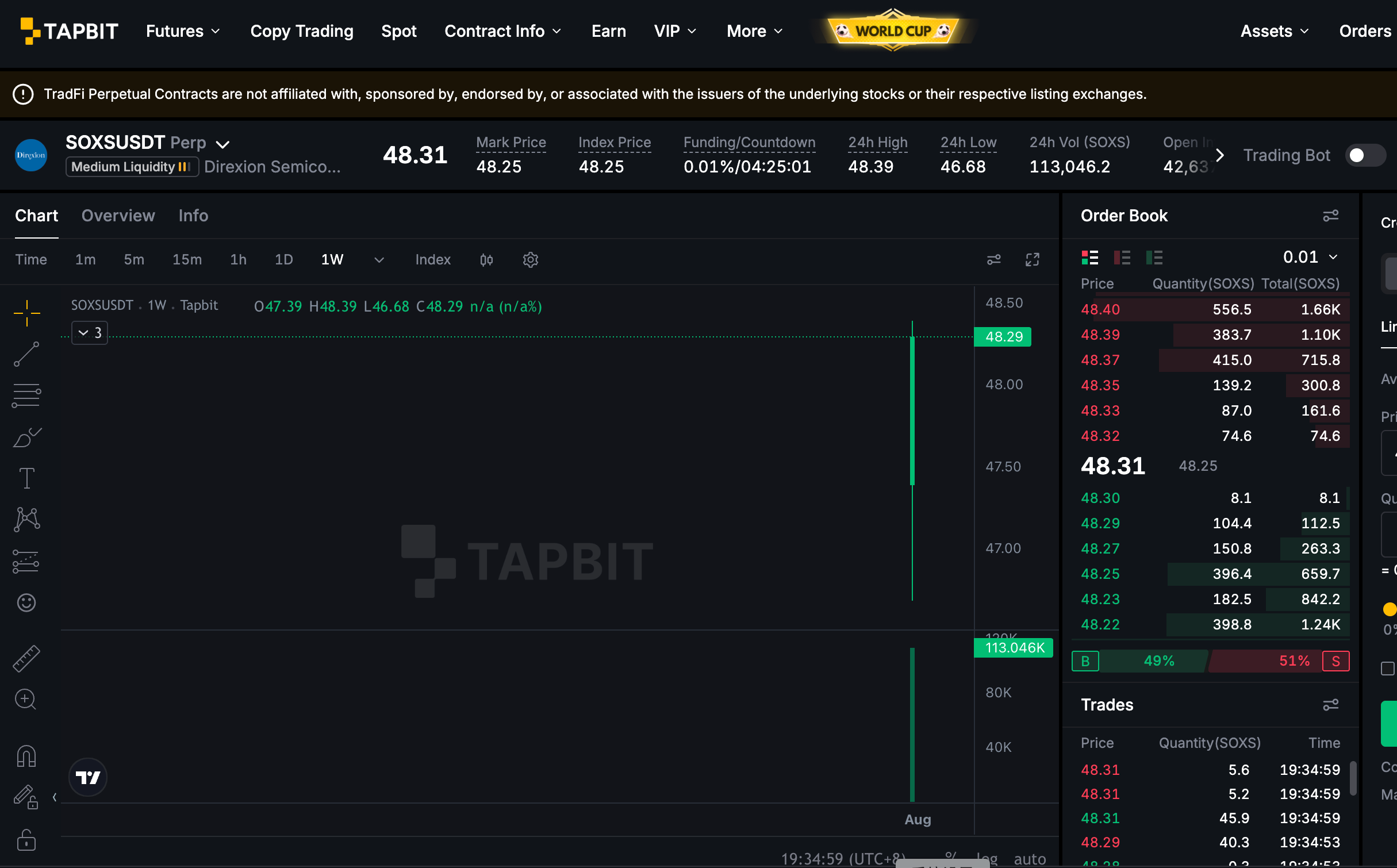
For users who want to follow this market through a crypto-style contract interface, Tapbit provides a SOXSUSDT market. You can Trade SOXSUSDT on Tapbit, but users should review the contract rules and risk controls before opening any position.
How the Semiconductor Bear 3X ETF Works
SOXS is designed to seek daily investment results equal to 300% of the inverse of its benchmark's daily performance. If the tracked semiconductor index falls during a trading day, SOXS may rise sharply. If the semiconductor index rises, SOXS can fall quickly.
The word “daily” is important. Leveraged ETFs reset exposure each trading day. Because of compounding, the fund's return over a week, month, or year may not equal exactly negative three times the index return over that same longer period. In volatile markets, this gap can become large.
SOXS vs Semiconductor Stocks
SOXS is not a claim on companies such as NVIDIA, AMD, Broadcom, Intel, Micron, or TSMC. It is a trading vehicle that reacts to semiconductor sector moves through leveraged inverse exposure. That makes it useful for hedging or short-term bearish trades, but risky for users who misunderstand it as a simple stock substitute.
| Asset | Main Exposure | Typical Use |
|---|---|---|
| Semiconductor stock | Company fundamentals | Long-term investing or stock trading |
| Regular semiconductor ETF | Basket of chip stocks | Sector exposure |
| SOXS ETF | Daily -3x semiconductor exposure | Short-term bearish trading |
| SOXSUSDT | SOXS-linked contract exposure | USDT-based tactical trading |
Why Traders Watch SOXS in 2026
Semiconductors remain one of the most important market themes because of AI chips, cloud computing, data centers, memory demand, and geopolitical supply-chain risk. When the chip sector rallies, bearish products like SOXS can struggle. When valuations look stretched or macro pressure hits technology stocks, SOXS can attract short-term interest.
Traders may watch SOXS around earnings season, AI demand updates, interest-rate shifts, export-control headlines, or sudden corrections in major chip stocks. The product tends to be most relevant when volatility is high and traders expect downside pressure in the semiconductor sector.
What Is SOXSUSDT Trading on Tapbit?
SOXSUSDT refers to a Tapbit trading market that lets users trade SOXS-linked price exposure against USDT. Unlike buying the ETF through a traditional brokerage account, trading SOXSUSDT does not mean holding ETF shares. It is a market product designed for price exposure and trading flexibility.
Before trading SOXSUSDT, users should check available leverage, margin rules, funding or fee conditions, liquidity, order book depth, and liquidation risk. The market may be useful for traders who already follow semiconductor volatility and want a USDT-settled trading route.
SOXS ETF vs SOXSUSDT: Key Differences
| Feature | SOXS ETF | SOXSUSDT on Tapbit |
|---|---|---|
| Market type | Traditional leveraged inverse ETF | USDT-based trading market |
| Exposure | Daily -3x semiconductor index exposure | SOXS-linked price exposure |
| Ownership | ETF shares through brokerage | No ETF share ownership implied |
| Trading focus | Short-term bearish semiconductor view | Short-term trading with platform risk controls |
| Main risk | Leverage decay and sector rebound risk | Leverage, liquidation, liquidity, and contract risk |
SOXS Price Drivers
SOXS price action is mainly driven by the semiconductor sector moving lower or higher on a daily basis. Because it is inverse and leveraged, a strong day for chip stocks can hurt SOXS quickly, while a broad semiconductor selloff can make it rise sharply.
Important drivers include AI chip demand, earnings guidance from major semiconductor firms, inventory cycles, interest-rate expectations, export restrictions, and investor appetite for high-growth technology stocks. SOXS can also react strongly when markets unwind crowded AI or chip-stock trades.
Is SOXS Good for Long-Term Investing?
SOXS is generally not designed as a simple long-term investment. Leveraged inverse ETFs are usually intended for short-term trading or hedging because their daily reset mechanism can create compounding effects over time. Holding SOXS for long periods can be especially risky if semiconductor stocks trend higher or remain volatile without a sustained downside move.
Users considering SOXS should understand that being correct about a long-term sector view is not enough. Timing matters. Volatility, daily resets, and rebounds can all affect the outcome.
Key Risks of SOXS and SOXSUSDT
The biggest risk is leverage. Both leveraged inverse ETFs and leveraged trading products can move fast. A product designed around -3x daily exposure can lose a large amount of value if the underlying sector rallies. In a contract market, leverage can also increase liquidation risk.
There is also tracking risk, compounding risk, liquidity risk, and platform-specific risk. Users should not treat SOXSUSDT as a low-risk way to short semiconductor stocks. It is a tactical trading instrument that requires active risk management.
Conclusion
SOXS is a high-risk leveraged inverse ETF built around bearish daily semiconductor exposure. It can be useful for short-term traders who understand chip-sector volatility, but it is not a normal stock and not a simple long-term investment.
SOXSUSDT on Tapbit gives users a USDT-based way to follow SOXS-linked price action. The CTA is straightforward: Trade SOXSUSDT on Tapbit. Before trading, users should understand leverage, liquidation risk, daily reset effects, and the difference between contract exposure and ETF ownership.
FAQ
What is SOXS?
SOXS is the Direxion Daily Semiconductor Bear 3X Shares ETF, a leveraged inverse ETF focused on daily bearish exposure to semiconductor stocks.
Is SOXS a semiconductor stock?
No. SOXS is not a stock. It is a leveraged inverse ETF that tracks semiconductor sector moves in the opposite direction on a daily basis.
What does SOXSUSDT mean?
SOXSUSDT is a USDT-based Tapbit trading market linked to SOXS price exposure. It does not mean owning ETF shares.
Is SOXS risky?
Yes. SOXS is highly risky because it uses leveraged inverse exposure and daily reset mechanics.
Can SOXS be held long term?
SOXS is generally designed for short-term trading or hedging, not passive long-term investing.
Where can I trade SOXSUSDT?
Users can trade SOXSUSDT through Tapbit's SOXSUSDT market, after reviewing the contract details and risks.


