

BitMine is still buying ETH. That alone explains why the company keeps showing up in crypto market discussions. At a time when Ethereum is under pressure and many investors are cutting risk, BitMine Immersion Technologies is doing the opposite. It has continued to build one of the largest public-company ETH positions in the market, staking a large part of that balance and presenting itself as a serious Ethereum treasury play.
It is a bold strategy. It is also starting to look like a difficult one.
For ETH bulls, BitMine is easy to understand. The company is betting that Ethereum will become more important to the future of finance, tokenization, stablecoins, settlement and onchain infrastructure. If that view proves right, holding millions of ETH could become a powerful balance sheet strategy.
But markets do not only reward conviction. They also test it. BMNR has traded far below its highs. ETH has struggled. Investors are asking whether a company should trade at a premium simply because it holds a large amount of crypto. Preferred stock financing, staking assumptions and balance sheet risk are now part of the conversation.
That is why BitMine is no longer just a “buy the dip” story. It is becoming a real-time test of the Ethereum treasury model.
BitMine’s ETH Position Is No Longer Small Enough to Ignore

BitMine’s ETH holdings have grown to a level that makes the company hard to analyze as a normal crypto-linked stock. The company has reported holding about 5.7 million ETH, close to 4.7% of Ethereum’s total supply. That puts BitMine near its stated 5% accumulation target and gives BMNR a very direct connection to ETH price action.
For investors who are bullish on Ethereum, that can be attractive. BMNR offers stock-market exposure to a company that is not just watching Ethereum from the sidelines, but actively building its balance sheet around it.
For more cautious traders, the same number raises questions. A company with that much ETH is highly exposed to one asset. If ETH rises, the strategy looks smart. If ETH falls, the pressure shows up quickly in the stock, the balance sheet and the market’s confidence in management.
That is the trade-off. BitMine gives investors a way to express a strong Ethereum view, but it also concentrates the risk.
Tom Lee’s Window Dressing Argument Makes Sense — But Only Partly
Tom Lee has argued that recent crypto weakness may be linked to quarter-end window dressing. In simple terms, some investors may sell assets that performed poorly before the end of a reporting period so their portfolios look better on paper.
That can happen. Crypto is sensitive to positioning, liquidity and sentiment. If ETH and BTC have been weak going into quarter-end, extra selling pressure from portfolio adjustments would not be surprising.
Still, traders should be careful not to treat that explanation as the whole story.
If weakness were only about quarter-end positioning, the market might quickly look through it. But BMNR’s decline suggests investors are also thinking about deeper questions. How much should a treasury company be worth if its main asset is falling? Can staking revenue meaningfully offset ETH price risk? Does new financing help shareholders, or does it add another layer of complexity?
Those are not temporary questions. They are structural ones.
Why BitMine’s Ethereum Bet Still Has a Bull Case
The bullish argument for BitMine starts with Ethereum itself. Ethereum remains one of the most important networks in crypto. It supports stablecoins, DeFi, tokenized assets, smart contracts and a large developer ecosystem. If more financial assets move onchain, Ethereum could remain one of the core settlement layers behind that shift.
That is the long-term vision BitMine is leaning into.
The company is not simply holding ETH as a passive treasury asset. It is also staking a large share of its holdings, which can generate rewards over time. That gives the strategy a different flavor from a pure buy-and-hold position. BitMine can argue that ETH is a productive asset, not just a volatile one.
This is why some investors continue to watch BMNR closely. If Ethereum recovers and institutional interest in tokenization grows, a company holding and staking ETH at scale could become more appealing again.
But that scenario depends on more than belief in Ethereum. It depends on execution, timing and market trust.
Staking Helps, But It Does Not Solve Everything

Staking is one of the strongest parts of BitMine’s pitch. A large ETH position can produce staking rewards, and that makes the treasury look more active than a simple crypto hoard. In a favorable market, those rewards can support the company’s narrative and add an income component to the balance sheet.
But staking should not be confused with protection from downside.
If ETH falls sharply, staking rewards will not fully offset the drop in the value of the underlying holdings. The rewards are also tied to ETH itself, which means their dollar value moves with the asset. On top of that, large-scale staking requires reliable infrastructure, custody controls, validator performance and operational discipline.
So yes, staking makes BitMine’s ETH position more interesting. It does not make it risk-free.
That distinction matters because investors sometimes focus on the projected income number without asking a harder question: how much asset-price risk is the company taking to earn that yield?
BMNR’s Stock Price Shows the Market Is More Skeptical Now
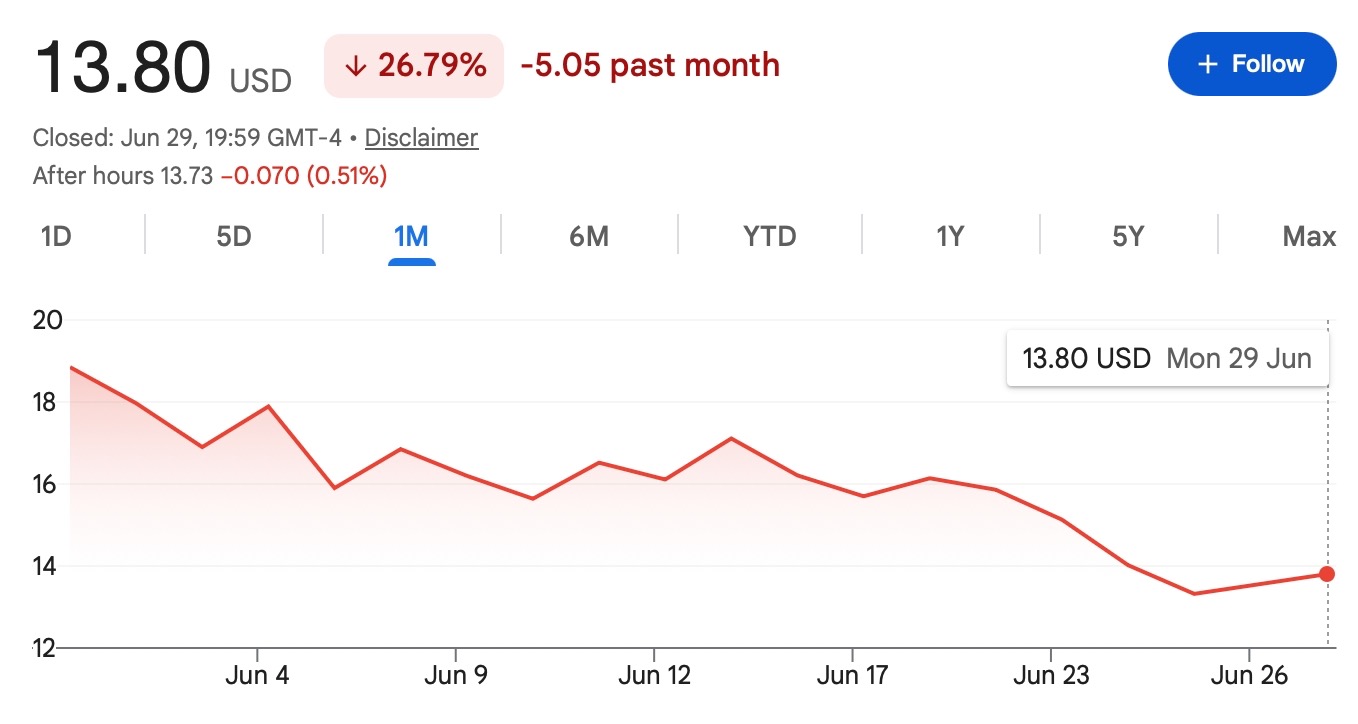
The clearest sign of pressure is BMNR itself.
If investors were fully convinced by the Ethereum treasury story, the stock would likely be holding up better. Instead, BMNR has remained under heavy pressure, even as the company continues to buy and stake ETH.
That tells us something important. The market is not rejecting Ethereum outright. It is questioning the stock-market wrapper around the ETH exposure.
During strong crypto cycles, treasury companies can trade above the value of their holdings. Investors may pay a premium for management, access, leverage to the asset, and the possibility that the company will keep accumulating more crypto.
But when the cycle weakens, that premium can shrink quickly. Investors begin to focus on net asset value, financing costs, dilution, unrealized losses and whether the strategy improves value per share.
That is where BitMine now finds itself. The company may still have a powerful ETH thesis, but the market wants proof that the structure works under stress.
Preferred Stock Financing Adds Pressure to the Math
BitMine’s preferred stock financing is another part of the story traders should not ignore.
The company raised capital through a 9.50% Series A Perpetual Preferred Stock offering. The proceeds can support ETH purchases, staking infrastructure, working capital, strategic investments and other corporate purposes.
That gives BitMine flexibility, but it also creates a cost. A 9.50% preferred dividend is not cheap. If ETH rises meaningfully, the financing may look reasonable. If ETH stays weak, investors may become more focused on whether the company is taking on expensive capital to increase exposure to a volatile asset.
This is why BMNR is more complicated than spot ETH.
Buying ETH directly gives a trader ETH exposure. Buying BMNR means taking exposure to ETH, staking execution, corporate decisions, financing costs, stock-market sentiment and the possibility that the company trades at a premium or discount to its holdings.
That can create opportunity. It can also create risk that does not exist in ETH itself.
The Real Question: Does the Market Still Want Treasury Premiums?
The debate around BitMine is really part of a larger question in crypto equities.
Should public companies that hold large amounts of crypto trade at a premium to their assets?
In a bull market, the answer often looks like yes. Investors like simple stories. A company that keeps buying a major crypto asset can become a popular proxy trade. The stock may rise faster than the underlying asset because investors price in future accumulation and market enthusiasm.
In a weaker market, the answer becomes less obvious. If the underlying crypto asset falls, the company’s balance sheet weakens. If the stock falls, raising new capital becomes harder. If financing costs rise, the strategy becomes more expensive. If the market starts valuing the company closer to its net asset value, the premium that made the model attractive can fade.
That is the pressure facing Ethereum treasury companies now. BitMine is not just betting that ETH will rise. It is betting that investors will continue to value a public company holding and staking ETH at scale.
Those are related bets, but they are not the same.
What This Means for Tapbit Users
BitMine’s strategy is one of the clearest examples of how crypto treasury companies are being tested in this market.
The company keeps buying ETH. It holds a massive Ethereum position. It stakes much of that balance. It has a strong long-term narrative around tokenization, onchain finance and Ethereum’s role in future settlement infrastructure.
But BMNR’s stock price shows that investors are not simply rewarding the story anymore. They are asking harder questions about ETH downside, financing costs, staking assumptions, treasury premiums and whether the strategy creates value per share. That is what happens when a market moves from excitement to scrutiny.
BitMine may still be right about Ethereum over the long run. But the stock now has to prove more than conviction. It has to prove that the Ethereum treasury model can work when ETH is weak, capital is expensive and investors are less willing to pay for hype.
Users can visit Tapbit to explore supported crypto markets and educational resources. Existing users can log in, while new users can register here.
Frequently Asked Questions (FAQ)
What is BitMine?
BitMine Immersion Technologies is a public company that has become closely watched because of its large Ethereum holdings. The company has positioned itself as an Ethereum treasury play, meaning its balance sheet and market narrative are heavily tied to ETH.
What is BMNR?
BMNR is the stock ticker for BitMine Immersion Technologies. Traders often follow BMNR as a public-market way to gain exposure to BitMine’s Ethereum treasury strategy.
Why is BitMine buying ETH?
BitMine is buying ETH because it believes Ethereum could become a major infrastructure layer for tokenized finance, stablecoins, settlement, smart contracts and onchain capital markets. By holding ETH at scale, the company is trying to position itself for long-term Ethereum adoption.


