
The phrase “JEPQ stock dividend” usually refers to the monthly cash distribution paid by the JPMorgan Nasdaq Equity Premium Income ETF. Technically, JEPQ is an ETF rather than a company stock, so “distribution” is the more accurate term. The payment is generally monthly, but the amount can change from one month to the next.
Recent fund materials showed a 12-month rolling distribution yield around 11.16% and a 30-day SEC yield near the 11.6%-12% range. Those figures are attractive, but they measure different things and should not be treated as a fixed future return.
What Is the JEPQ Stock Dividend?
JEPQ seeks current income while maintaining exposure to large-cap U.S. growth companies. The monthly cash payment can include income from portfolio dividends, option premium and other realized fund income. It is not a guaranteed coupon.
The distribution can rise when option premiums are high or fall when market conditions change. Investors should use the official distribution notice and fund page for the latest amount rather than annualizing one unusually large month.
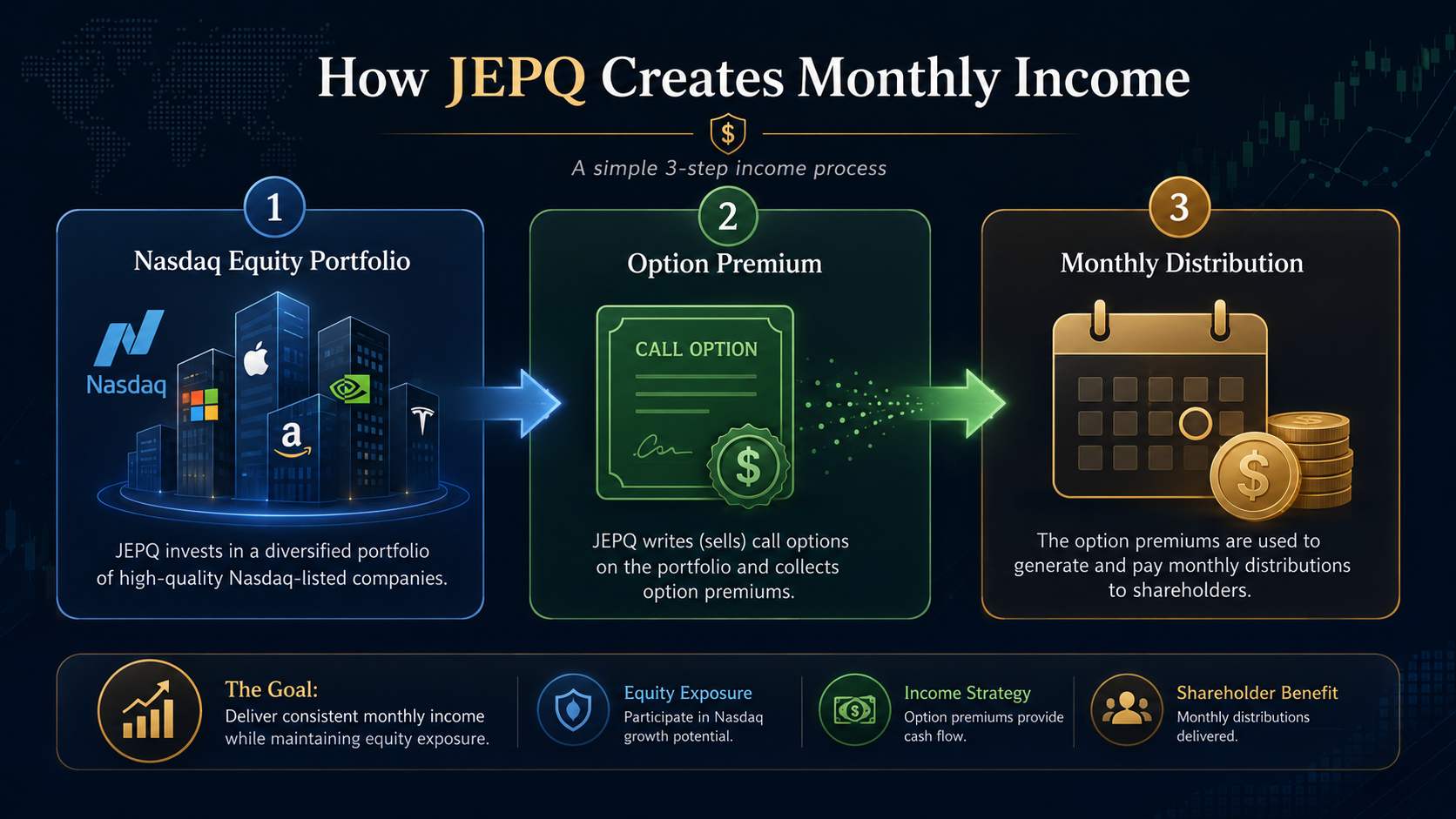
How JEPQ Generates Monthly Income
Dividends From the Equity Portfolio
JEPQ owns large-cap growth stocks, some of which pay ordinary dividends. These payments contribute to fund income, but many Nasdaq-oriented companies have relatively low dividend yields. Portfolio dividends alone do not explain JEPQ's headline distribution rate.
Option Premium From the Nasdaq-100 Overlay
The strategy also sells out-of-the-money call exposure linked to the Nasdaq-100. In exchange, the fund receives option premium. That premium can support monthly distributions and reduce some volatility.
The trade-off is capped upside. If the Nasdaq rises sharply beyond the option strike, part of the portfolio's gain may be surrendered through the options structure. JEPQ therefore exchanges some growth potential for current income.
Why the Monthly Payment Changes
Option prices depend on volatility, market direction, time to expiration and interest rates. Portfolio income, realized gains, expenses and tax treatment also vary. As a result, monthly distributions are not stable in the same way as a bond coupon.
JEPQ Dividend Yield: Which Number Should Investors Use?
| Metric | Meaning | Main Limitation |
|---|---|---|
| 12-Month Rolling Distribution Yield | Cash distributed over the past 12 months relative to current NAV or price. | It describes the past and does not predict future payments. |
| 30-Day SEC Yield | A standardized estimate of recent net investment income. | It may differ materially from the actual cash distribution rate. |
| Forward Annualized Yield | The latest monthly payment multiplied by 12. | One month's payment may not be representative. |
| Latest Distribution | The most recent per-share cash payment. | The next payment can be higher or lower. |
Different websites can therefore show different yields without one necessarily being wrong. The user should identify the methodology before comparing JEPQ with another ETF.
JEPQ Dividend History and Payment Schedule
JEPQ generally follows a monthly schedule with an ex-dividend date, record date and payment date. A recent market listing showed a distribution around $0.64 per share with an early-July ex-date and payment date, but the official J.P. Morgan calendar should be checked before publication because dates and amounts change.
On the ex-dividend date, the ETF price usually adjusts downward by approximately the cash distribution, all else equal. Receiving a distribution does not create free value; part of the fund's assets is being paid out to shareholders.
JEPQ Dividend Example
Assume an investor owns 100 JEPQ shares and the latest monthly distribution is $0.64 per share. The estimated cash payment would be $64 before tax. If the next month's payment falls to $0.44, the same 100 shares would generate $44.
This example shows why investors should not budget future income using one month's payment. The distribution is variable and can change with market conditions.
JEPQ Dividend Risks
The first risk is variability. A double-digit trailing yield can decline if option premium or realized income falls. The second risk is capital loss. JEPQ can decline with the Nasdaq even while paying monthly cash.
The third risk is opportunity cost. During a powerful technology rally, the options strategy can cause JEPQ to lag an uncapped Nasdaq fund. Tax treatment can also be complex because distributions may contain different income components.
JEPQ Dividend vs Total Return
Total return combines price change and distributions. An investor who receives an 11% cash yield but experiences a 15% price decline has not earned a positive 11% total return. Conversely, reinvesting distributions can improve long-term compounding when the fund's NAV is stable or rising.
JEPQ should therefore be evaluated as an income-and-equity strategy, not as a substitute for a guaranteed deposit or bond coupon.
Can Users Buy JEPQ on Tapbit?
JEPQ is not currently supported on Tapbit. Users can create an account to review confirmed crypto and stock-linked markets, but the platform should not be described as offering JEPQ or its monthly distributions.
What Can Cause a High JEPQ Yield to Mislead Investors?
A high displayed yield can look like evidence of a bargain, but yield often rises when the ETF price falls. If the annualized distribution stays similar while the market price declines, the calculated percentage increases even though the investor may be facing larger capital losses.
- Price effect: a lower share price mechanically raises the quoted yield.
- Annualization effect: multiplying one unusually high monthly payment by 12 can overstate expected income.
- Tax effect: the after-tax value may differ depending on how the distribution is classified.
- Total-return effect: a double-digit yield can coexist with a negative overall return.
For that reason, investors should compare the current distribution with the fund's one-year history, NAV trend and reinvested total return. The most useful question is not “How high is the yield?” but “How much of that yield comes from sustainable income, and how much risk is being accepted to generate it?”
It is also helpful to compare the rolling distribution yield with the 30-day SEC yield. A large gap may indicate that part of the cash distribution comes from sources beyond current portfolio income, such as option premium or realized gains.
Final Assessment
JEPQ's monthly distribution can be useful for income-focused investors, but the headline yield is only one part of the decision. Payment variability, Nasdaq risk, capped upside and total return all matter. The correct question is not only how much JEPQ pays, but what risk the investor accepts to receive that income.
Frequently Asked Questions
Does JEPQ pay monthly dividends?
JEPQ generally makes monthly distributions, but the amount is variable.
Is the JEPQ dividend guaranteed?
No. Payments depend on portfolio income, option premium and fund results.
Why does the JEPQ dividend change?
Market volatility, option pricing, portfolio income, expenses and realized gains change over time.
Is JEPQ a stock or an ETF?
JEPQ is an exchange-traded fund.
Does JEPQ sacrifice growth for income?
The options overlay can limit some upside in exchange for current income and lower volatility.


