

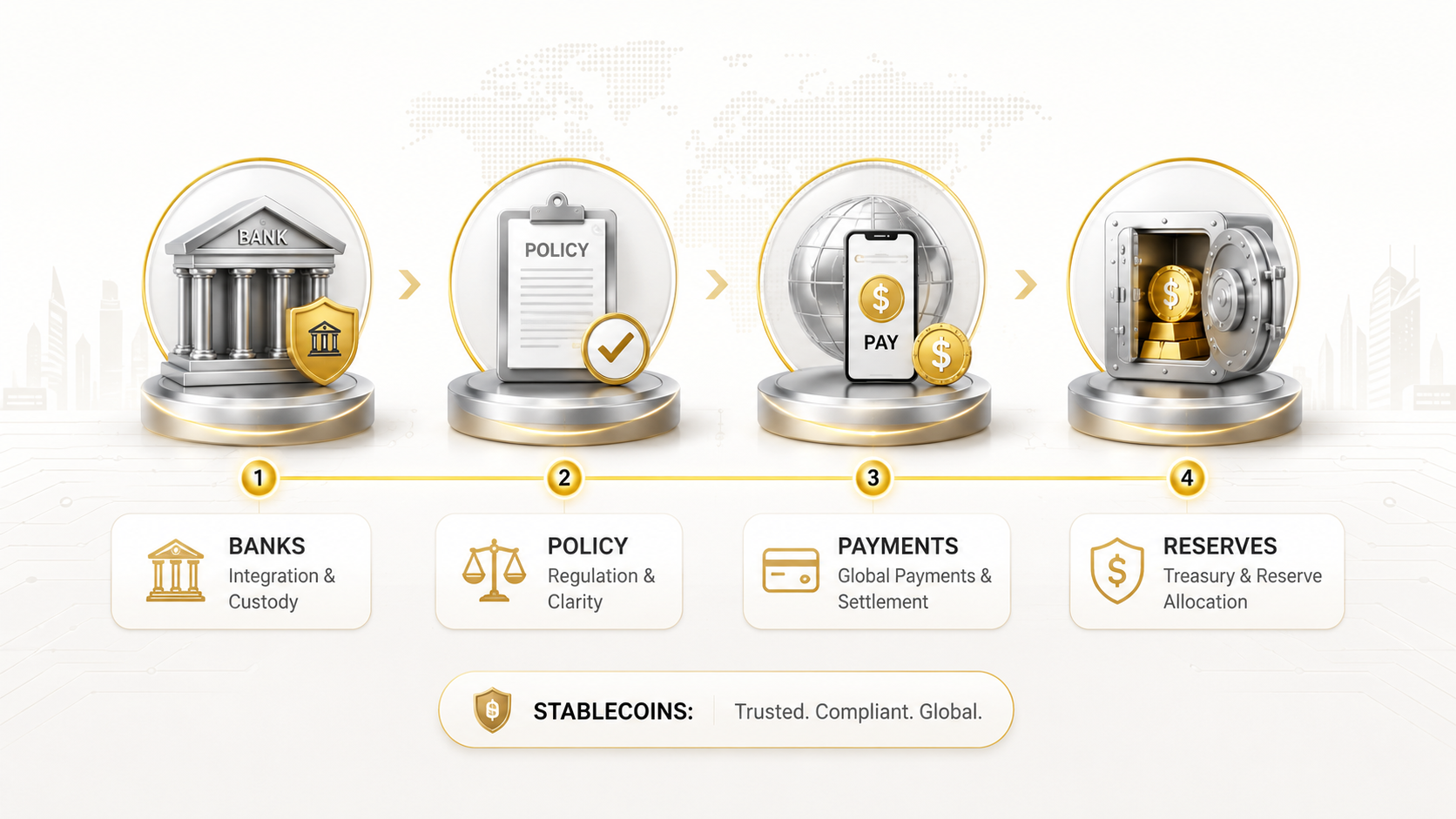
Stablecoin news is no longer only about crypto exchanges or dollar-pegged tokens. It is becoming a banking, payments, and regulation story. Recent developments show large financial institutions, lawmakers, and payment companies paying closer attention to stablecoin rails.
The current news cycle points to three linked themes: Japan’s banking sector exploring stablecoin issuance, U.S. debate around digital-asset rules, and rising demand for faster settlement. That makes stablecoin news important for traders because stablecoins are often the liquidity layer behind crypto markets.
Quick context table:
| Development | Why It Matters | Market Question |
|---|---|---|
| 🏦 Bank adoption | Large banks are testing stablecoins as settlement rails. | Can regulated tokens reduce payment friction? |
| ⚖️ Policy debate | Rules can shape reserves, redemption, and issuer access. | Will regulation help or slow adoption? |
| 📈 Transaction volume | Higher usage makes stablecoins part of market infrastructure. | Will demand stay strong outside crypto trading? |
What Happened in Stablecoin News Today?
The points below break the topic into the main signals readers should review before drawing a conclusion.
Japan megabanks and FY2026 stablecoin plans
One of the strongest institutional signals comes from Japan. Major Japanese banking groups have been working on stablecoin-related initiatives that aim to support live transactions within FY2026. This matters because bank-linked stablecoins could move the conversation from crypto-native use to regulated financial infrastructure.
If large banks build stablecoin payment systems, the market may treat stablecoins less like a niche crypto tool and more like a settlement rail for institutions.
U.S. stablecoin policy debate
The United States remains a central policy arena. Lawmakers and regulators continue debating how stablecoin issuers should hold reserves, verify customers, and manage redemptions. The Federal Reserve has also requested comment on a proposal that would require certain payment stablecoin issuers to maintain an effective customer identification program.
That shows regulators are focusing not only on reserves but also on user identification, compliance, and financial-crime controls.
Institutional payment adoption
The broader trend is institutional adoption. Banks, fintech firms, card networks, and payment companies are evaluating stablecoins because they can support fast settlement, programmable payments, and cross-border transfers.
Why Stablecoin Adoption Is Accelerating
The drivers below work together, so the cleaner view comes from comparing momentum, liquidity, and risk conditions rather than one headline alone.
Faster settlement
Stablecoins can settle value faster than some traditional banking rails, especially across borders or outside normal banking hours. This makes them attractive for businesses that need continuous payment access.
Cross-border payments
Cross-border payments are often slow, expensive, and complex. Stablecoins can reduce some friction by moving tokenized dollars across networks. However, compliance, custody, and consumer protection issues remain important.
Banking and fintech integration
When banks and fintech firms explore stablecoin infrastructure, the market changes. Stablecoins become less about isolated token trading and more about financial infrastructure. That is why institutional stablecoin news can influence market sentiment.
What the Clarity Act Debate Means for Stablecoins
The points below break the topic into the main signals readers should review before drawing a conclusion
Why banks care
Banks care because stablecoins can compete with deposits, payment services, and treasury-management products. If stablecoins can pay rewards or function like bank-like accounts, traditional institutions may see them as direct competition.
Why issuers care
Stablecoin issuers care because regulation determines what assets they can hold, how they must verify users, and how quickly they must redeem tokens. Clearer rules can increase trust, but they may also raise compliance costs.
Why traders care
Traders care because stablecoins sit at the center of crypto liquidity. Stronger rules may reduce blow-up risk, but they can also change which stablecoins dominate trading pairs, collateral markets, and settlement flows.
Stablecoin Transaction Volume and Market Demand
The points below break the topic into the main signals readers should review before drawing a conclusion.
Payment use cases
Stablecoins are increasingly discussed as payment tools rather than only trading tools. Payment use cases include merchant settlement, remittances, business-to-business transfers, and internal treasury movement.
Liquidity use cases
In crypto markets, stablecoins help traders move between volatile assets and dollar-denominated liquidity. When stablecoin supply and transaction volume grow, it often signals more active market infrastructure.
Reserve and redemption trust
Stablecoins depend on trust. Users need confidence that one token can be redeemed for one dollar, or another promised reference asset. That confidence depends on reserve quality, audits, custody rules, and redemption mechanics.
What This Means for Crypto Markets
The points below break the topic into the main signals readers should review before drawing a conclusion.
Stablecoins as market infrastructure
Stablecoins are often the base layer for trading liquidity. They support spot markets, derivatives collateral, cross-border transfers, and treasury operations. As institutions enter, stablecoins could become more embedded in the broader financial system.
Stablecoins as payment rails
The payment-rail story is different from the trading story. A trading stablecoin needs liquidity and exchange support. A payment stablecoin needs compliance, user protection, integration with merchants, and reliable redemption.
Stablecoins as regulatory test case
Stablecoins are also a test case for crypto regulation. If policymakers can build stablecoin rules that balance safety and innovation, the same approach may influence future rules for tokenized securities, crypto payments, and digital-asset custody.
What to Watch Next
The next signals matter because they can confirm whether the market is building momentum or simply reacting to short-term headlines.
Japan rollout timeline
The market should watch whether Japanese bank-linked stablecoin projects move from pilots to real transactions within the expected timeline.
U.S. policy progress
The next U.S. policy steps matter because they may define customer identification, reserve custody, redemption, and issuer supervision.
Issuer reserve disclosures
Reserve disclosures remain essential. Traders should examine whether stablecoins publish transparent information on reserve assets, liquidity, audits, and redemption terms.
Stablecoin adoption may expand, but adoption alone does not remove risk. Users can start with broader market data, review stablecoin-related market conditions, and create an account when they are ready to compare supported markets. For users exploring broader crypto liquidity before specific stablecoin products are available, BTC spot and BTC futures markets can serve as general starting points.
For more context, readers can compare this topic with GENIUS Act stablecoin markets, MiCA regulation, and crypto market structure bill.
FAQ
The points below break the topic into the main signals readers should review before drawing a conclusion.
What is the latest stablecoin news?
Recent stablecoin news focuses on institutional adoption, Japan banking projects, U.S. policy debates, and stronger rules for issuer reserves and customer identification.
Why are banks interested in stablecoins?
Banks are interested because stablecoins could support faster settlement, cross-border payments, and new digital-money products.
Are stablecoins safe?
Stablecoins can reduce crypto volatility compared with non-pegged tokens, but they still carry reserve, redemption, regulatory, and operational risks.
What does stablecoin regulation cover?
It can cover reserves, issuer licensing, customer identification, redemption rights, custody, disclosures, and compliance controls.
Can users trade a Japan bank stablecoin on Tapbit?
Do not assume that. Bank stablecoins may not be listed for trading. Users should verify supported markets before trading any asset.


