
LayerZero introduced ATLAS on August 25, 2026, giving the ZRO token a new market-infrastructure story beyond cross-chain messaging. ATLAS stands for Aggregated Trading Liquidity and Settlement. LayerZero describes it as a universal backend for trading venues that want matching, clearing, settlement and risk management in one system.
ZRO reacted quickly. The token traded near $1.20 in the latest snapshot, with roughly $226 million in 24-hour volume and a market capitalization near $423 million. The 24-hour gain was about 8.6%, while the seven-day gain exceeded 50%. Some reports described an intraday jump of more than 30%, which refers to a shorter measurement window rather than the current daily change.
What Is LayerZero ATLAS?
ATLAS is a headless exchange engine built on Zero, LayerZero’s multi-core blockchain. “Headless” means ATLAS does not operate a consumer trading app that competes with the businesses using it. Instead, another venue can build the user interface and distribution while ATLAS runs the market infrastructure underneath.
The design aims to combine the performance of a centralized exchange with the auditability and self-custody features associated with decentralized systems. LayerZero says ATLAS can support spot markets, perpetual futures, stocks, bonds, commodities, prediction markets and other programmable assets.
How Does ATLAS Connect the Market?
ATLAS connects three main groups:
- Trading venues bring users, operate the frontend and choose whether to create an open or institutionally controlled environment.
- Market creators define the assets and rules for the markets being offered.
- Market makers provide bids, offers and liquidity so orders can execute efficiently.
Traditional markets often use different organizations and systems for matching a buyer and seller, clearing the trade, settling ownership and managing risk. Every handoff adds time, cost and reconciliation work. ATLAS attempts to collapse these steps into one technology stack, with Zero serving as the final source of truth.
Open ATLAS vs Institutional ATLAS
Open ATLAS is intended for crypto-native applications, prediction markets and other open financial products. A venue can connect its frontend, choose markets and serve users without building the underlying exchange engine from scratch.
Institutional ATLAS uses the same base engine but allows an institution or exchange to apply its own market rules. That could include permissioning, product restrictions or compliance controls. The official announcement describes the model, but it does not prove that a particular bank or exchange has adopted ATLAS. Named adoption should be reported only after an official confirmation.
What Role Does ZRO Play in ATLAS?
Network Security, Gas and Governance
ZRO secures Zero through delegated proof of stake and acts as the network’s gas asset. Holders can delegate ZRO to validators, while the token also participates in governance for protocol upgrades and changes to Zones.
Venue Staking and Fee Rebates
ATLAS trading venues can stake ZRO to qualify for larger fee rebates. LayerZero says venue rebates can range from 20% to 65%, depending on aggregate volume and ZRO stake. The highest tier may require up to 1% of ZRO supply, creating a potential demand source if large venues participate.
Trading Fees and ZRO Buy-and-Burn
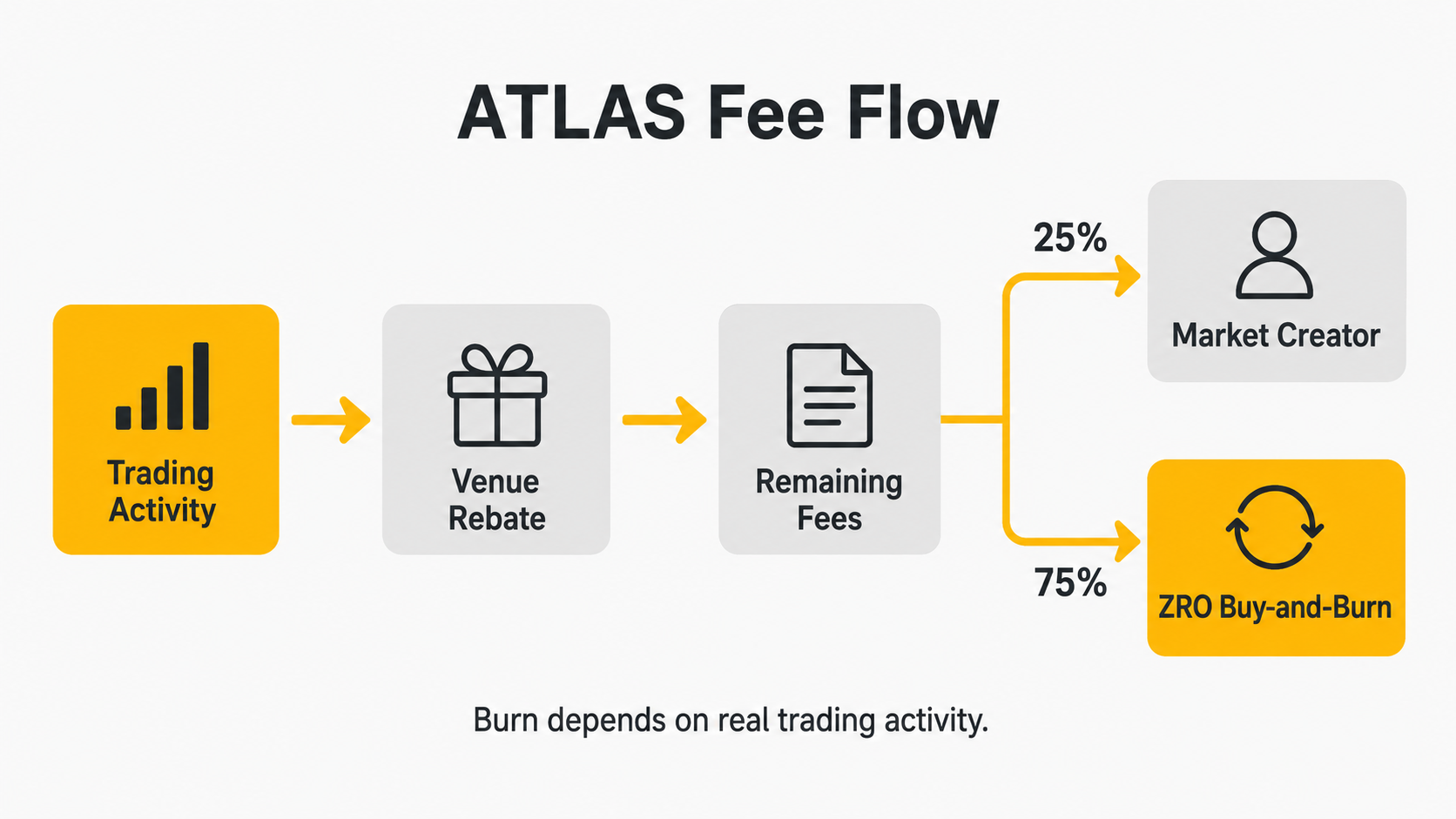
ATLAS charges one all-in trading fee. After the venue receives its rebate, 25% of the remaining economics goes to the market creator. The other 75% is used to buy and burn ZRO, according to LayerZero. This connects trading activity to token supply, but the effect depends on real volume. A buy-and-burn formula without active markets produces little economic demand.
Why Did ZRO Price Rise?
The announcement expanded the market’s view of ZRO in three ways. First, it added venue-staking demand. Second, it connected market fees with ZRO buybacks and burns. Third, it placed LayerZero inside the growing tokenized-markets and RWA narrative.
Short-term momentum also mattered. ZRO began the session near $1 before moving sharply higher, so traders chasing the announcement amplified the reaction. The current 24-hour gain is smaller than the intraday peak, which is normal after a fast event-driven move.
What Is Confirmed and What Still Needs Proof?
LayerZero’s announcement confirms the intended architecture, the three participant roles and the ZRO fee design. The company also reports sub-millisecond median latency in an environment designed to mirror public deployment and says ATLAS will initially be provisioned for 200,000 transactions per second.
Those performance figures are project claims from a test environment. Public production reliability, live liquidity, institutional adoption and sustained trading volume remain unproven. Traders should also watch whether venue staking creates genuine long-term demand or only temporary speculation.
How to Trade ZRO-USDT on Tapbit
No verified Tapbit ZRO futures page was found during the current product audit, so the appropriate route is the confirmed ZRO-USDT spot market. Spot trading means buying or selling ZRO itself, not equity in LayerZero Labs and not ownership of the ATLAS infrastructure.
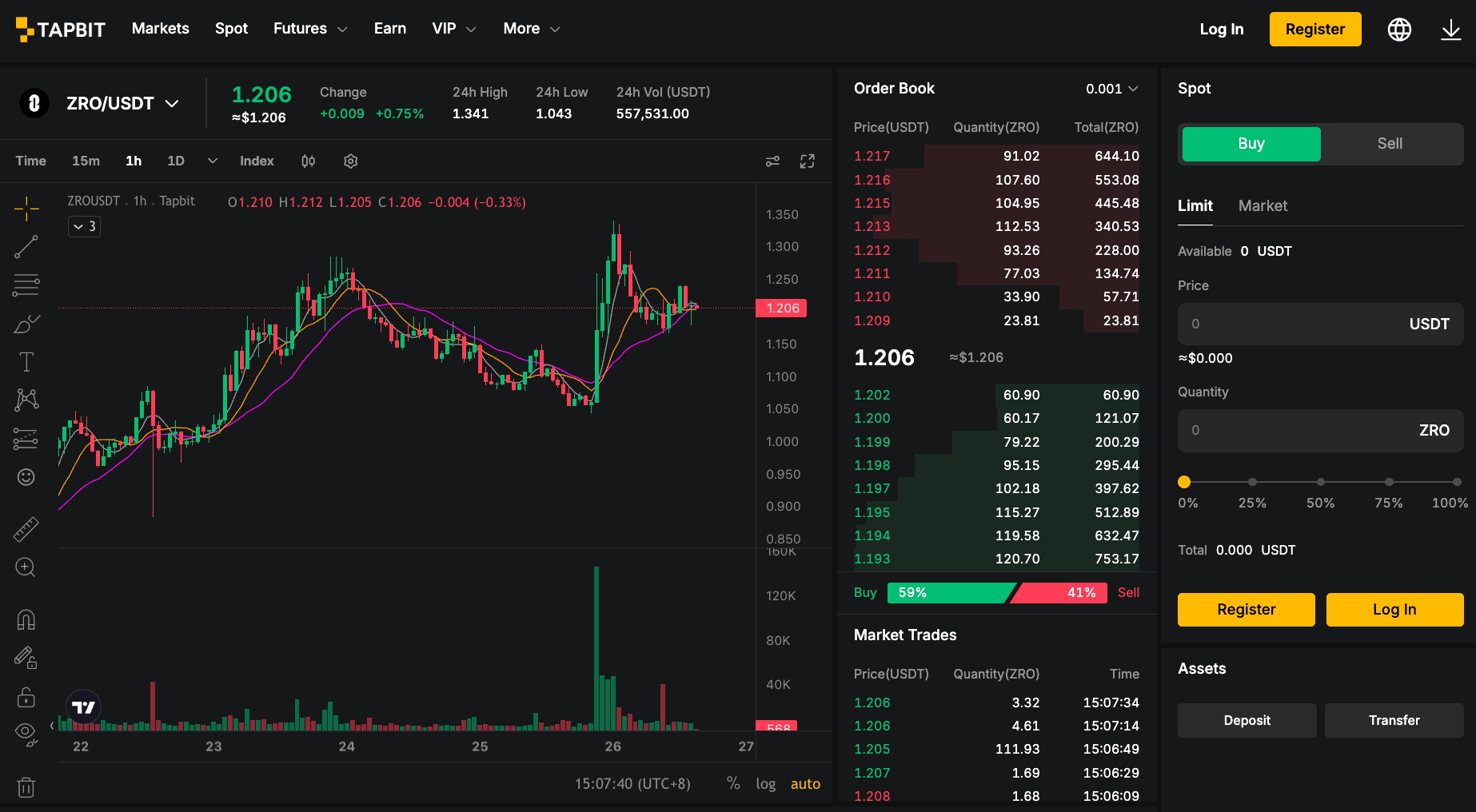
Users can create an account, open the ZRO-USDT market, check order-book depth and choose a Limit or Market order. Because event-driven tokens can reverse quickly, order size, spread and slippage matter. Thin depth can cause a large order to execute across several prices.
Readers new to this topic can also review Tapbit Learn material on tokenized assets and ownership models before assuming every on-chain market provides the same legal rights.
Bottom Line
ATLAS gives ZRO a clearer role in market infrastructure: security, gas, governance, venue staking and fee-funded buy-and-burn demand. That is a meaningful expansion of the token story. The next test is execution. Real venues, reliable production performance and sustained fee volume must turn the design into measurable economic activity.
FAQ
What does ATLAS stand for in LayerZero?
ATLAS stands for Aggregated Trading Liquidity and Settlement.
Is ATLAS a new crypto exchange app?
No. ATLAS is designed as a headless backend. Trading venues build the user-facing experience on top of it.
How is ZRO used by ATLAS?
ZRO secures Zero, pays gas, supports governance, qualifies venues for rebate tiers and is bought and burned using part of ATLAS fee economics.
Why did ZRO price rise after the announcement?
Traders reacted to the new utility, venue-staking and buy-and-burn design, as well as LayerZero’s entry into tokenized market infrastructure.


