
Tapbit provides several protections expected from a centralized cryptocurrency exchange in 2026, including proof-of-reserves reporting, two-factor authentication, withdrawal controls and published fee information. These measures make the platform more transparent and give users practical ways to protect their accounts.
That does not mean Tapbit—or any exchange—is completely risk-free. Regulatory registration is not the same as deposit insurance, proof of reserves is not a full audit of every liability, and leveraged futures can create losses even when the platform operates normally.
Users who have reviewed these limitations can create a Tapbit account and enable all available security controls before depositing significant funds.
Is Tapbit Regulated in 2026?
Tapbit states that its operating entity, Tapbit LLC, is incorporated in the United States and lists registrations or licenses connected with the United States, Canada and Saint Vincent and the Grenadines. Its published compliance information includes a U.S. Money Services Business registration, an NFA identification number and a Canadian MSB registration.
These claims should be interpreted carefully. A U.S. FinCEN MSB registration primarily concerns anti-money-laundering and reporting obligations. FinCEN explicitly says that inclusion in its MSB database is not a recommendation, certification of legitimacy or government endorsement. It also does not provide the same prudential supervision or customer protection associated with an insured bank.
An NFA record should likewise be checked for the entity name, current status and approved activities. The presence of an NFA identification number does not automatically mean every exchange product is regulated by the CFTC or available in every jurisdiction.
Tapbit Proof of Reserves Explained
Tapbit’s Proof of Reserves page states that the platform maintains user funds at a 1:1 reserve ratio. It identifies Hacken as the independent auditor responsible for verifying custodial on-chain assets and says reports will be updated regularly.
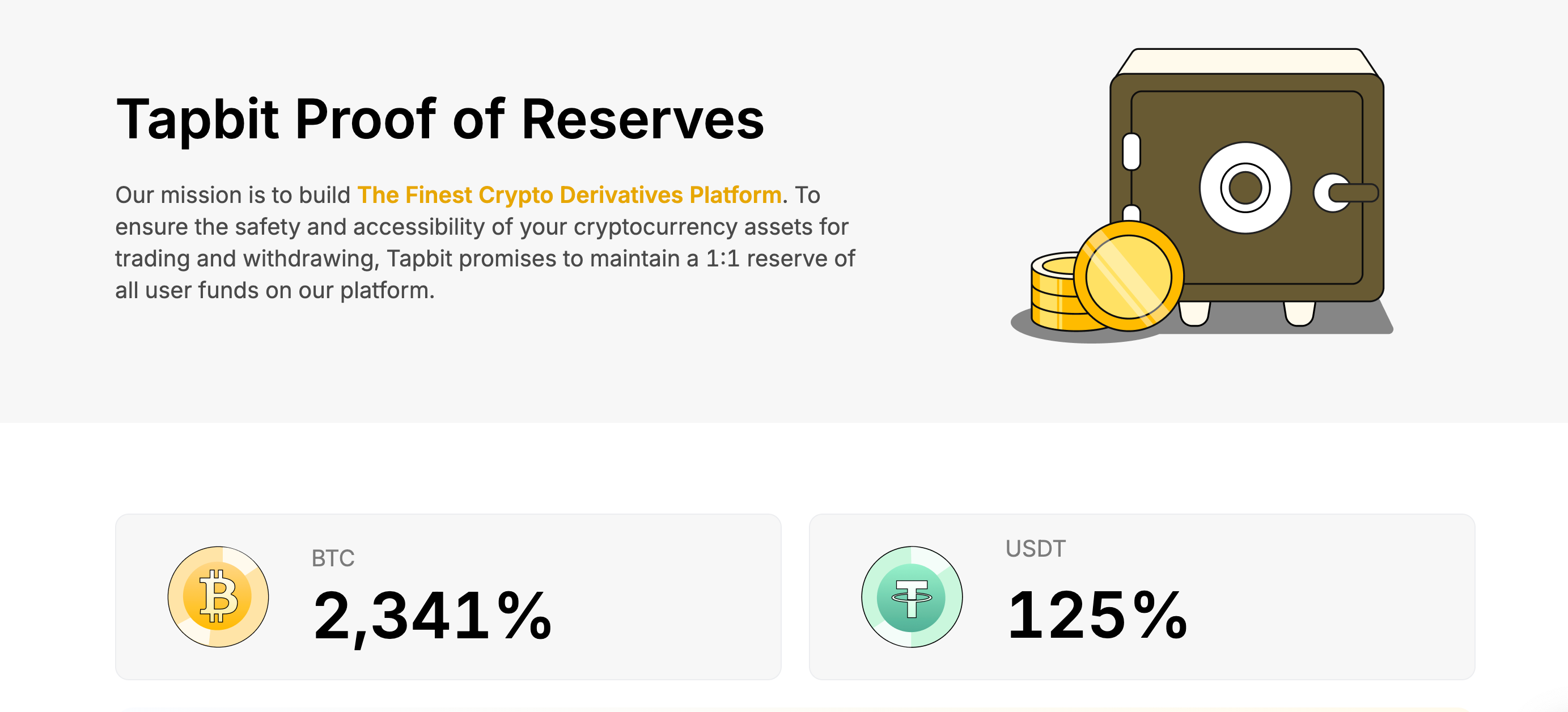
PoR nevertheless has limits. A reserve snapshot may not reveal every corporate liability, off-chain obligation, encumbrance or operational risk. Its value depends on the audit date, asset coverage, verification method and whether customer liabilities are accurately included.
| Safety signal | What it can show | What it does not guarantee |
|---|---|---|
| Proof of reserves | Custodial assets existed at the audit time | Complete solvency or future liquidity |
| MSB registration | Registration under applicable AML rules | Government endorsement or deposit insurance |
| Insurance fund | A stated pool for defined losses | Coverage for every incident |
| Two-factor authentication | Additional account-access protection | Protection from every phishing or device attack |
Tapbit also states that it maintains a 50 million USDT insurance fund. Users should review the current terms to understand which events qualify, how claims are assessed and whether coverage has exclusions.
How Tapbit Protects User Accounts
Tapbit supports Google Authenticator-based two-factor authentication, email verification and withdrawal PINs. These controls make it harder for someone with only a stolen password to access an account or withdraw assets.
According to Tapbit’s account-security guidance, Google Authenticator generates time-based codes that are separate from the login password. Tapbit also sends email alerts and confirmation codes for security-sensitive actions.
- Create a unique password with a password manager.
- Enable Google Authenticator before depositing.
- Set a separate withdrawal PIN.
- Whitelist trusted withdrawal addresses.
- Verify the official Tapbit domain and application.
- Make a small test withdrawal before transferring a large balance.
Tapbit applies a 24-hour withdrawal lock after changes to a password, 2FA method or bound contact details. The delay can be inconvenient, but it is designed to stop an attacker from changing security settings and immediately removing funds.
Tapbit Trading Fees in 2026
Tapbit’s standard spot fee has been published as 0.1% for makers and 0.1% for takers. Some pairs or limited promotions may have zero trading fees, so users should check the live fee display rather than assuming a promotion covers every market.
For USDT perpetual contracts, Tapbit’s support documentation lists a 0.02% maker fee and a 0.06% taker fee. A maker order adds liquidity to the order book, while a taker order executes against existing liquidity.
Futures traders must also consider funding payments and liquidation costs. Tapbit says funding is exchanged directly between long and short positions rather than retained as a platform fee. The amount varies with the funding rate and position value.
Are Tapbit Withdrawals Safe and Reliable?
Tapbit offers on-chain withdrawals to external wallets and internal transfers between Tapbit accounts. Its withdrawal guide says users must configure a withdrawal PIN and 2FA before initiating an external transfer.
Internal transfers are described as immediate and free. On-chain withdrawals require a network fee, which varies by blockchain and congestion. Deposits are listed as free, although users may still pay transaction fees charged by the sending wallet or network.
Users should always match the withdrawal network with the receiving wallet. Sending USDT through an incompatible network can cause permanent asset loss even if both platforms function correctly.
What Are the Main Risks of Using Tapbit?
- Assets remain under platform custody until withdrawn.
- Proof-of-reserves reports are point-in-time assessments.
- Regulatory protection varies by country and product.
- Withdrawal reviews or network maintenance can temporarily limit access.
- Futures leverage can cause rapid liquidation.
- Phishing and compromised email accounts can bypass careless users.
- Fees, available markets and jurisdictional restrictions can change.
How to Test Tapbit Before Depositing More
- Confirm that the official website and application are being used.
- Enable Google Authenticator and create a withdrawal PIN.
- Complete any required identity verification.
- Deposit a small amount through the correct network.
- Place a small trade and compare the charged fee with the published schedule.
- Withdraw a test amount to a personal wallet.
- Record the processing time, network fee and support response if assistance is needed.
This process cannot eliminate platform risk, but it verifies that the user understands the account, fee and withdrawal workflow.
Conclusion
Tapbit has several positive safety signals in 2026: published proof-of-reserves information, an identified third-party auditor, account-level security controls, withdrawal protections and transparent standard fee rates. These measures support a stronger assessment than relying only on marketing claims.
The balanced answer is that Tapbit can be used with appropriate precautions, but “safe” should not mean guaranteed. Users should independently verify regulatory records, review the latest PoR report, enable every security control, test withdrawals and avoid keeping more assets on any centralized exchange than necessary.
Frequently Asked Questions
Is Tapbit a regulated exchange?
Tapbit publishes information about several registrations and licenses. Their scope differs by jurisdiction, and an MSB registration should not be confused with bank regulation, deposit insurance or government endorsement.
Does Tapbit have proof of reserves?
Yes. Tapbit publishes a proof-of-reserves page and identifies Hacken as its independent auditor. Users should check the date and coverage of the latest available report.
What are Tapbit’s spot trading fees?
The standard spot fee is generally listed as 0.1% for makers and takers. Selected pairs or promotions may have different rates.
How much does Tapbit charge for futures?
Tapbit lists standard USDT perpetual fees of 0.02% for makers and 0.06% for takers. Funding payments and VIP rates may also affect total trading costs.
Why is my Tapbit withdrawal locked?
A 24-hour withdrawal lock may follow a password, 2FA, email or phone change. Withdrawals can also be delayed by compliance checks, network congestion or wallet maintenance.
Should I keep all my crypto on Tapbit?
Keeping only the amount needed for active trading reduces custodial exposure. Long-term holders may prefer a personal wallet for funds they do not need on the exchange.


