

You don’t need a full-blown bull market to trigger FOMO in crypto. One coin, one headline, or one sector catching fire out of nowhere—that’s often enough.
That’s worth keeping in mind right now. On August 8, the Fear & Greed Index sat at 30, still in "Fear" territory. Sure, it’s up from last month’s “Extreme Fear,” but euphoria it is not. Yet despite the muted macro vibe, individual names are ripping. And when you watch those green candles stack up on your feed, the urge to chase can get dangerously loud.
This is the FOMO most traders will actually run into today: not a manic rally across the board, but a skittish market punctuated by sudden pumps, fleeting narratives, and a timeline full of gains that make you feel like you’re the only one missing out.
What Is Crypto FOMO?
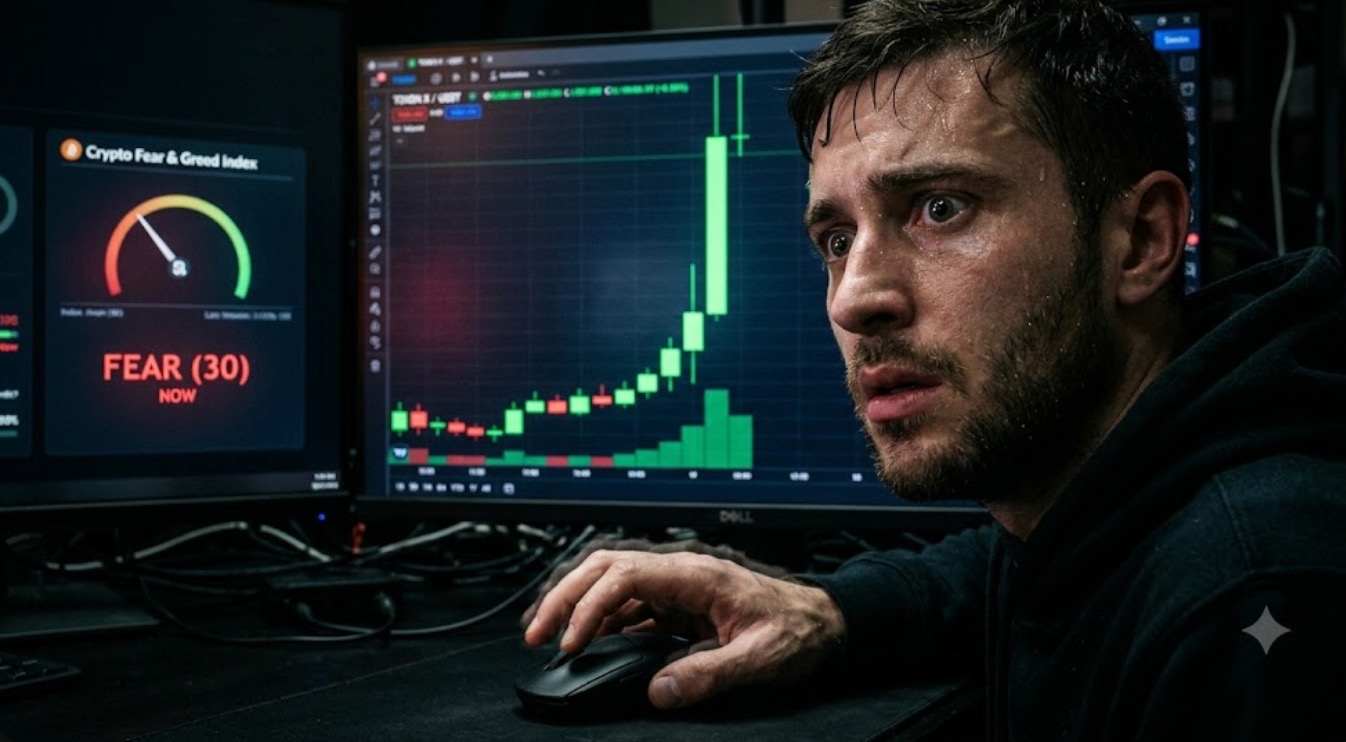
FOMO stands for “fear of missing out.” In trading, it describes the urge to enter a position because an asset is already rising and the trader is afraid of being left behind.
The emotion usually becomes strongest after a large part of the move has already happened. A token rises quickly, trading volume jumps and social media fills with bullish predictions. The trader stops asking whether the price offers a reasonable entry and starts worrying about how much money could be missed by waiting.
That change in focus is important. The decision is no longer based primarily on expected return and acceptable risk. It is being driven by urgency.
FOMO can lead traders to buy after a steep rally, use more leverage than planned or enter markets they have not properly researched. It can also make them abandon an existing strategy because another asset appears to be moving faster.
Why FOMO Can Appear in a Fearful Market
The Crypto Fear & Greed Index combines factors such as volatility, market momentum, social media activity, Bitcoin dominance and search trends. It is useful for understanding broad sentiment, but it does not describe every corner of the market.
A market can remain fearful while one memecoin, AI token or DeFi project rises sharply. In fact, limited market confidence can make these moves feel even more powerful because traders see fewer alternatives producing strong returns.
Capital may concentrate around a new listing, protocol update, partnership, token buyback or popular narrative. Once the price starts moving, short-term traders follow the volume. Social media accounts publish charts and profit screenshots, while search interest increases. The rally then begins attracting attention beyond the project’s existing community.
None of this proves that the asset is overvalued. It does mean that traders need to separate the original catalyst from the attention generated by the price increase itself.
The Crypto Fear & Greed Index is therefore better treated as context than as a trading instruction. A low reading does not make every asset cheap, just as a high reading does not mean every rally must immediately reverse.
Social Media Makes Urgency Feel Like Evidence
Social media has become a major source of market information, especially for younger investors. It can provide fast access to announcements, community discussions and on-chain research. It can also compress the time between seeing an idea and feeling pressured to trade it.
Research published by the FINRA Investor Education Foundation in 2026 found that 60% of investors aged 18 to 34 used social media for investment information. Among the same age group, 61% said they had made an investment decision based on content from a social media personality.
The research also identified a gap between confidence and knowledge. Social media users and followers of financial influencers answered an average of 42% of objective investment knowledge questions correctly, while 63% described their own knowledge as high.
That does not mean social media should be ignored. The same research found that social media users often consulted more information sources. The problem arises when repetition, popularity and confidence are mistaken for independent confirmation. Ten accounts repeating the same claim may still be relying on one unverified source.
How FOMO Changes Trading Decisions
FOMO rarely announces itself clearly. It usually appears as a series of small changes in behavior.
A trader who normally waits for confirmation suddenly enters immediately. A planned position becomes larger because the move “looks certain.” A stop-loss is moved farther away to avoid being shaken out. After the price declines, the trader continues holding because selling would mean admitting that the entry was emotional.
Leverage can make this cycle more dangerous. A trader may correctly identify a strong trend but still lose money because the entry was late, the position was too large or normal volatility triggered liquidation.
FOMO can also produce excessive switching. Instead of following a defined strategy, the trader repeatedly moves toward whichever token is currently gaining the most attention. Fees, slippage and poorly timed entries accumulate even when the overall market is rising.
A 2026 study of 403 active retail crypto investors found a positive relationship between FOMO and investment behavior. The researchers also identified social media use, confidence and greed as relevant factors. Because the study focused on investors in Türkiye and used survey responses, its results should not be treated as universal. Still, it offers useful evidence that FOMO is not simply a market slogan; it can influence how retail participants make decisions.
Momentum Trading Is Not the Same as FOMO

Buying an asset that is already rising is not automatically irrational. Momentum traders deliberately look for established trends and may enter after a breakout rather than trying to predict the bottom.
The difference is preparation. A momentum trade should have a defined setup, entry condition, invalidation level and position size. The trader knows what evidence supports the trade and what market change would prove the idea wrong.
A FOMO trade usually begins with the price move itself. The trader enters because the asset is rising and decides how to manage the position afterward.
One useful question is: “Would I still take this trade if I had not seen anyone else’s profit?”
If the answer is no, the trade may be responding more to social pressure than to the underlying market setup.
Five Ways to Control Crypto FOMO
The most effective time to manage FOMO is before a fast-moving market appears.
Start by defining what must be true before entering a trade. This could include a confirmed breakout, sufficient liquidity, a specific volume pattern or a verified catalyst. Entry rules create a pause between noticing an opportunity and acting on it.
Position size matters just as much. A trade can be well researched and still fail. Keeping each position within a predetermined risk limit makes one incorrect decision less likely to damage the entire account.
It also helps to separate research time from execution time. Constantly refreshing charts and social media can make every price movement feel urgent. Scheduled market reviews allow traders to evaluate information without reacting to every post.
Before chasing a rally, check what has actually changed. Was there a protocol upgrade, new listing, partnership or measurable increase in adoption? Or did the conversation begin only after the price moved? Trading volume, liquidity, funding rates, open interest and token concentration can provide useful context, but none of them guarantees what happens next.
Finally, accept that missing a rally is part of trading. A market with thousands of assets will always produce moves that were not captured. Avoiding a poor entry can be more valuable than participating in every pump.
Turning FOMO Into a Research Signal
FOMO itself does not have to be useless. A sudden feeling of urgency can indicate that something in the market deserves investigation.
Instead of treating that feeling as a buy signal, traders can use it as a prompt to ask better questions. What started the move? Has liquidity improved? Is the catalyst confirmed by a primary source? Are a small number of wallets controlling supply? Has leverage risen faster than spot demand? What would invalidate the current narrative?
This approach does not eliminate emotion. It changes what happens next.
Traders can use Tapbit to follow crypto markets and evaluate opportunities, but the decision to enter a position should still be based on personal research, a defined strategy and appropriate risk controls. New users can create a Tapbit account, while existing users can log in here.
Frequently Asked Questions
What does FOMO mean in crypto?
FOMO means “fear of missing out.” It describes the pressure to buy a cryptocurrency because its price is rising quickly and other traders appear to be making money. Decisions driven by FOMO are often made before the trader has reviewed the asset, entry price or potential downside.
Can crypto FOMO happen when the overall market is fearful?
Yes. The wider market may remain cautious while individual tokens, sectors or narratives rally sharply. A new listing, project announcement or sudden increase in trading volume can create localized FOMO even when broader sentiment indicators remain in the “Fear” range.
Is buying a rising cryptocurrency always a FOMO trade?
No. Momentum traders intentionally enter established trends, but they normally use predefined entry conditions, position limits and exit rules. A trade is more likely to be driven by FOMO when urgency replaces analysis and the trader has no clear plan for managing the position.


