

Orchid is one of crypto’s older privacy plays—a marketplace where users buy bandwidth and providers stake OXT to participate.
The project is still alive and has since stretched its pitch beyond VPNs to include bandwidth, storage, and even AI services. But OXT? Still trading near the bottom of its multi-year range—despite a sharp spike in July.
That gap raises a more practical question than whether OXT can bounce back: is Orchid’s actual product usage creating real token demand?
What Is Orchid?

Orchid is an open-source platform built around a decentralized marketplace for digital services. Its original product is a pay-as-you-go decentralized VPN, often described as a dVPN.
A conventional VPN routes a user’s traffic through servers operated by one company. The user must trust that company to manage the connection responsibly. Orchid takes a different approach by allowing users to purchase bandwidth from providers through a marketplace supported by Ethereum smart contracts.
The system uses probabilistic nanopayments to handle small payments without recording every unit of bandwidth as a separate Ethereum transaction. Rather than settling each tiny payment individually, the protocol sends payment tickets that occasionally produce a larger redeemable payment. This is intended to make usage-based billing practical despite blockchain transaction costs.
OXT is the ERC-20 token associated with this system. It is better described as a utility token for decentralized services than as a conventional privacy coin. Unlike Monero or Zcash, OXT does not provide transaction privacy through a privacy-focused blockchain.
How OXT Works in the Orchid Network
OXT has two main roles in Orchid’s original bandwidth marketplace.
First, service providers stake OXT in an Ethereum directory contract. Orchid’s selection system uses the relative size of each provider’s stake when routing users to available services. A larger stake can increase a provider’s chance of receiving traffic, although it does not guarantee customers or revenue.
Second, OXT can be used within Orchid accounts to pay providers for bandwidth. Users fund an account, connect through the Orchid application and pay according to their usage.
Orchid staking should not be confused with proof-of-stake rewards. Providers do not receive newly issued OXT simply for locking tokens. The only underlying source of provider income is customer spending on services.
This distinction matters. OXT demand is supposed to grow when users purchase services and providers compete for that business. If marketplace activity remains limited, the staking system alone does not create sustained demand.
Why Is OXT Still Trading Near Its Long-Term Lows?
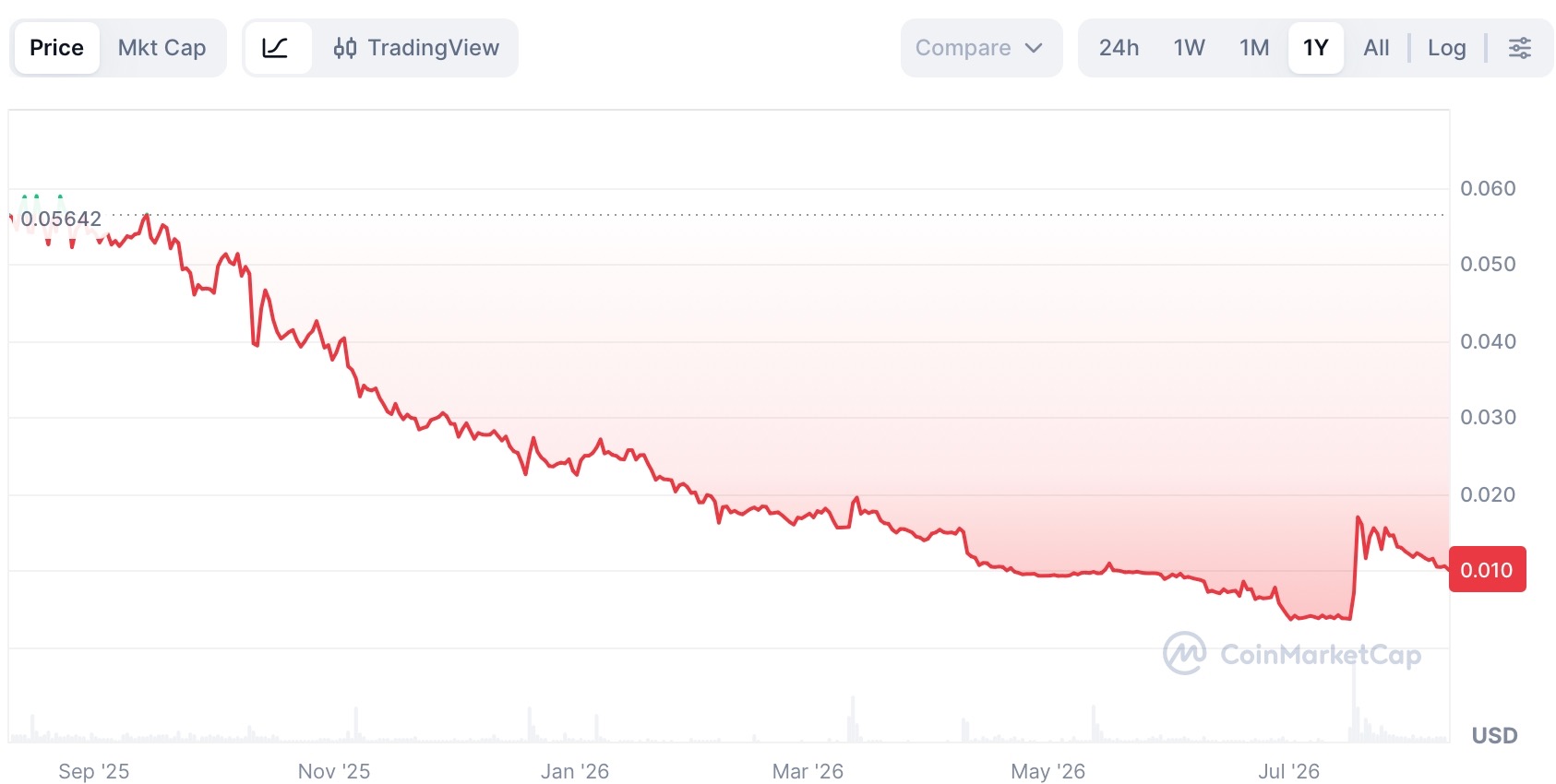
OXT reached an all-time high of about $1.03 in April 2021. By July 1, 2026, it had fallen to a record low near $0.0034. The token later recovered to around one cent, but it remained roughly 99% below its historical peak as of August 10.
The decline cannot be explained by one event. Orchid has spent years competing in a market where centralized VPNs are already inexpensive, familiar and easy to use. A decentralized alternative must persuade users that greater control and flexible billing are worth the additional complexity of blockchain accounts, tokens and network fees.
The larger problem is that Orchid does not publish enough current operating data to show how quickly its marketplace is growing. Public information explains how the protocol works, but clear figures for active users, paid service volume, provider revenue and recurring demand are difficult to find.
Without those figures, traders have limited evidence that product usage is translating into OXT purchases or additional provider staking.
Korean Delistings Added to the Pressure
One of the most important recent developments was the removal of OXT from two major South Korean exchanges.
Upbit placed OXT under trading caution on May 12, 2026, before ending support for its OXT/BTC and OXT/USDT markets on June 29. Its notice cited shortcomings related to important disclosures, the substance and sustainability of the business, and the project’s actual progress. Upbit said the concerns had not been resolved during its review.
Bithumb also announced the termination of OXT trading support. The exchange said the project’s submitted explanation had not sufficiently addressed the reasons for its caution designation and that its business progress did not meet the requirements for continued support.
An exchange delisting does not prove that a protocol has stopped working. However,it reduces users’ access to the asset and can weaken liquidity, particularly when two large platforms in the same market act at the same time. It also places greater importance on transparent communication from the project.
The Korean delistings are therefore an essential part of the OXT story. Any explanation of its recent price performance that ignores them is incomplete.
Orchid Is Expanding Beyond VPN Services
The Orchid website now describes the platform as a decentralized marketplace for AI, storage and bandwidth.
Its GenAI product offers access to multiple AI models through one interface and uses Orchid’s nanopayment architecture for usage-based billing. The service is designed to let users switch between models and tools without relying on a single provider or subscription.
This gives Orchid a broader DePIN and decentralized AI story. The same payment technology originally created for bandwidth could, in theory, support AI inference, storage and other digital services sold in small units.
However, product expansion is not automatically an OXT catalyst.
Orchid accounts can be funded with different tokens, and the available public information does not establish how much GenAI usage is settled in OXT. There are also no widely published figures showing substantial AI revenue, independent provider growth or a measurable increase in token demand.
The AI expansion is worth monitoring, but it should be presented as a developing business direction rather than proof that OXT’s fundamentals have already changed.
What Could Change the Outlook?
A durable improvement would need more than another high-volume trading day. The clearest signal would be measurable growth in Orchid’s service marketplace.
That could include rising paid usage, more active providers, greater OXT staking tied to customer demand, or transparent data showing that AI and storage services are generating recurring activity. A substantive response to the concerns raised by Korean exchanges would also help the market evaluate the project more confidently.
Privacy, decentralized infrastructure and pay-as-you-go AI remain relevant themes. Orchid has technology that connects with all three. The unanswered question is whether it can turn those themes into a market that people use regularly.
Orchid’s Next Test
Orchid is not simply an abandoned token attached to an old VPN idea. Its software remains available, its code is public, and the project is attempting to apply its nanopayment system to AI, storage and bandwidth services.
Still, the case for OXT remains unproven.
The July rally was not accompanied by a clearly verified fundamental catalyst. Upbit and Bithumb have removed the token from trading, while public evidence of user growth and service-driven OXT demand remains limited.
The next important signal will not be another short-lived price spike. It will be evidence that Orchid’s expanding service marketplace is attracting users, providers and recurring payments.
Readers can follow broader crypto market developments and educational coverage through Tapbit. Existing users can log in here, while new users can create an account.
Frequently Asked Questions
What is OXT?
OXT is the ERC-20 utility token used by the Orchid ecosystem. It supports provider staking and can be used for payments within Orchid’s decentralized service marketplace.
Is OXT a privacy coin?
Not in the conventional sense. OXT does not operate a privacy blockchain like Monero or Zcash. It is a utility token connected to Orchid’s privacy and bandwidth services.
Why is OXT trading near its long-term lows?
OXT has struggled with limited evidence of large-scale adoption, competition from established VPN providers, weak service-driven token demand and reduced liquidity following exchange delistings. Broader altcoin market conditions have also influenced its price.


