
DeXe (DEXE) has drawn attention after a dramatic price move shown in the latest chart provided by the user. The chart shows a rapid spike, followed by a heavy reversal that pushed the token back toward the $4-$5 area. For searchers asking why DEXE is down so much, the short answer is that the chart looks like a classic high-volatility unwind after an overheated rally.
For users who want to follow crypto market moves more broadly, the Tapbit registration page provides access to market tools, trading features, and a wide range of digital asset markets. DEXE-specific availability should still be checked directly on the relevant market page before making any trading decision.
DeXe Price Crash: What the Chart Shows
The provided one-week TradingView chart shows an open near $34.63, a weekly high near $46.13, a low around $4.22, and a close near $4.71. The visible weekly change is approximately -86.38%, with reported volume around 832.992 million. That combination suggests not just a normal pullback, but a major market reset after an aggressive upward move.
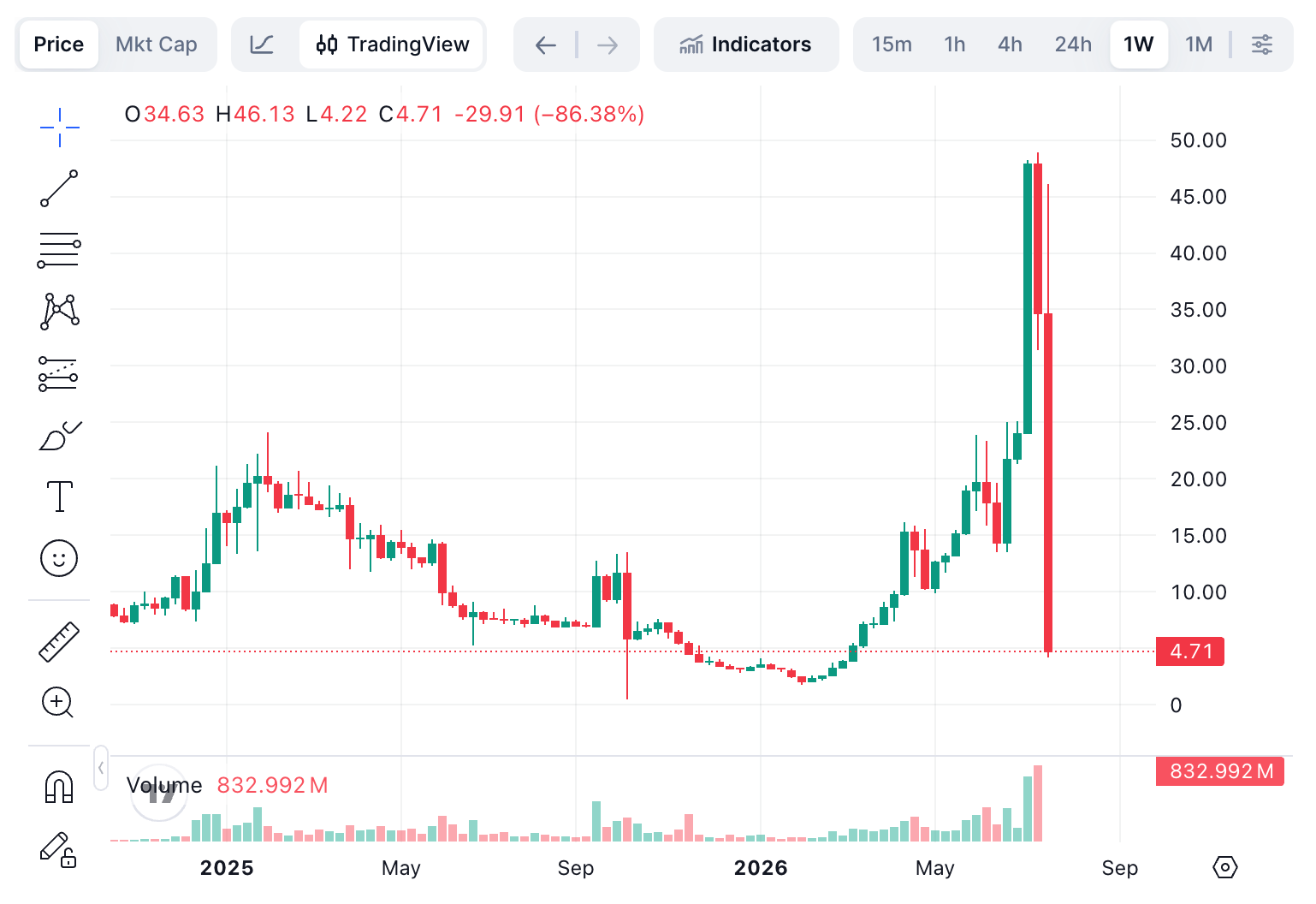
The most important detail is the shape of the candle. Price moved sharply higher first, then reversed with a large red candle and heavy volume. In market structure terms, that often means buyers chased the move near the top while larger sellers, early holders, or short-term traders used the liquidity to exit.
Why Is DEXE Down So Much?
There is rarely one single reason behind an 80%+ move. In most crypto markets, especially mid-cap or narrative-driven tokens, a crash like this usually comes from several pressures arriving at the same time.
First, the rally looked extended. When a token rises quickly from lower levels into a vertical move, late buyers often enter after the easiest upside has already happened. Once momentum slows, even a small wave of selling can trigger a much larger reversal because many traders are positioned in the same direction.
Second, volume appears to have surged during the breakdown. High volume on a red candle usually points to aggressive selling, forced exits, or a sudden repricing of risk. It can also mean that market makers and short-term participants widened spreads, making each sell order more damaging to price.
Profit-Taking After a Parabolic DEXE Rally
The chart suggests DEXE had already moved strongly before the crash. In crypto, fast gains often create a fragile setup: early buyers sit on large unrealized profits, while new buyers enter at much higher prices. If the token cannot continue making higher highs, profit-taking can become self-reinforcing.
Once price starts falling, some holders sell to protect gains. That selling pushes price lower, which then pressures other holders to exit. If leveraged positions are involved, liquidations can add another wave of market orders. The result can look extreme on the chart even when the initial catalyst is simply exhaustion after a sharp rally.
Liquidity and Whale Selling: The Biggest DEXE Risk Factor
Liquidity matters more than many retail traders realize. A token can have a strong narrative and still fall sharply if order books are thin or if a small number of large wallets control meaningful supply. When liquidity is shallow, large sell orders do not need to be enormous to move price dramatically.
For DEXE, traders should not focus only on the headline percentage decline. The better question is whether the market had enough real depth to absorb selling. If the order book was thin during the move, the crash may have been amplified by poor liquidity rather than a complete change in long-term project fundamentals.
| Possible Driver | How It Could Affect DEXE Price |
|---|---|
| Parabolic rally exhaustion | Late buyers enter near the top, making the market vulnerable to a reversal |
| Whale or early-holder selling | Large wallets can pressure price if liquidity is limited |
| Leveraged liquidations | Forced selling can accelerate a decline once support breaks |
| Weak order-book depth | Price gaps lower because there are not enough buyers at each level |
| Narrative cooldown | Trader attention shifts away after momentum fades |
Did DeXe Fundamentals Change?
A price crash alone does not prove that DeXe fundamentals changed. DeXe is generally known as a DAO governance and decentralized asset-management-focused crypto project. Its long-term thesis depends on governance tools, treasury coordination, staking mechanics, ecosystem adoption, and real protocol usage.
However, investors should separate protocol fundamentals from token market behavior. A project can continue building while its token price falls sharply. At the same time, a real protocol does not eliminate trading risk, liquidity risk, or the possibility that market expectations were simply too aggressive.
DEXE Technical Analysis: Key Price Levels to Watch
Based on the chart, the $4-$5 zone is the immediate area to watch. If DEXE can hold above the recent low and volume begins to normalize, the token may attempt to stabilize. If price loses that zone, the market may look for lower liquidity pockets before forming a new base.
| DEXE Price Area | Why It Matters |
|---|---|
| $4.20-$5.00 | Recent low and immediate stabilization zone |
| $7.00-$8.00 | Potential recovery area if buyers return |
| $12.00-$15.00 | Former trading range that may become resistance |
| $30.00-$46.00 | Blow-off rally zone where trapped buyers may sell into rebounds |
A quick bounce after a crash is possible, but traders should be careful with the difference between a relief rally and a real trend reversal. A stronger recovery would usually require improving volume quality, tighter spreads, and follow-through above former support levels.
Is DEXE Still a Good Investment After the Crash?
DEXE may still attract attention from traders interested in DAO governance tokens, but a sharp 86% drawdown changes the risk profile. After a move like this, the investment case depends less on the old rally and more on whether the token can rebuild trust, liquidity, and demand.
For long-term investors, the key questions are whether DeXe continues to show real ecosystem activity, whether token incentives remain sustainable, and whether governance participation supports the value of DEXE. For short-term traders, the key questions are simpler: can price hold support, can volume recover without another sell wave, and are spreads tight enough to enter and exit positions efficiently?

What Traders Should Check Before Buying DEXE
Before buying a token after a major crash, investors should verify the market from several angles. Check the official project channels for updates, compare prices across major trackers, inspect trading pairs and liquidity, and review whether any token unlocks, wallet movements, or exchange-specific events may have influenced the decline.
It is also important to avoid assuming that a lower price automatically means better value. A token that falls 80% can still fall further if liquidity dries up or if demand does not return. In volatile crypto markets, risk management often matters more than price prediction.
Conclusion
The provided chart shows a severe DEXE price decline, with price falling sharply after a fast rally and heavy trading volume. The most likely explanation is a mix of profit-taking, weak liquidity, possible liquidation pressure, and cooling market sentiment rather than one confirmed single event.
DEXE is not automatically a failed project because of one crash, but the chart clearly shows high risk. Investors should treat any rebound scenario cautiously and focus on verifiable liquidity, official updates, holder behavior, and whether the token can rebuild market structure above the $4-$5 area.
FAQ
Why did DEXE price crash?
Based on the provided chart, the crash appears linked to an overheated rally, heavy selling volume, weak liquidity, and possible forced exits after support broke.
Does the DEXE crash mean DeXe is a scam?
No. A price crash does not automatically prove that a project is a scam. However, it does show that the token carries significant market risk and should be researched carefully.
What price level matters most for DEXE now?
The $4-$5 area appears important because the provided chart shows price stabilizing near that zone after the sharp decline.
Can DEXE recover after an 86% drop?
A recovery is possible if liquidity returns, selling pressure fades, and buyers regain confidence. But a rebound is not guaranteed, especially after such a large drawdown.
Should beginners buy DEXE after the crash?
Beginners should be cautious. It is better to verify liquidity, market depth, official project updates, and risk exposure before buying any token after a major crash.


