
Oil prices are back near the center of the global market conversation. After months of volatility, traders are asking whether Brent crude can return to $100 a barrel in 2026 and whether WTI could follow.
The short answer: yes, oil can reach $100 in 2026, but it likely requires a clear supply shock, not just normal demand growth. The biggest risk is the Middle East, where shipping disruptions, tanker security concerns, and conflict around key export routes can quickly add a geopolitical premium to crude prices.
For users tracking broader market volatility across crypto, commodities, and TradFi narratives, the Tapbit registration page provides access to market tools and trading features.
Oil Price Outlook 2026: Why $100 Is Back in Focus
The provided Brent crude chart shows oil at about $94.14 on July 22, 2026, up $3.13, or 3.32%, on the day. More importantly, the one-month chart shows a strong climb from the low-$70s area toward the mid-$90s. That kind of move tells traders that the market is no longer treating supply risk as a distant concern.
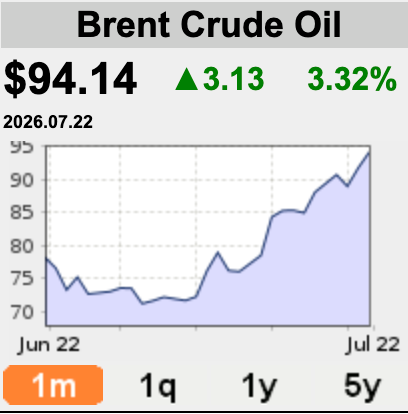
When Brent is already trading in the mid-$90s, the path to $100 becomes much shorter. A few more days of risk premium, a fresh disruption in tanker flows, or a stronger-than-expected inventory draw could be enough to test the psychological level.
The bigger question is whether oil can hold near or above $100. A short spike is easier than a sustained breakout. For oil to stay above $100, the market likely needs a combination of disrupted supply, tight refined-product markets, and limited spare capacity that can be brought online quickly.
Brent vs WTI: Which Oil Benchmark Could Hit $100 First?
Brent is more likely to reach $100 first because it is more exposed to international supply disruptions. Brent reflects global seaborne crude markets, so it reacts directly when traders worry about Middle East exports, tanker availability, or insurance costs.
WTI could also rise, but it may lag unless U.S. export demand strengthens or domestic inventories tighten sharply. A Brent move to $100 does not automatically mean WTI must trade at the same level. In a geopolitical shock, the Brent-WTI spread can widen.
| Benchmark | What It Represents | 2026 $100 Risk |
|---|---|---|
| Brent crude | Global seaborne oil benchmark | Higher |
| WTI crude | U.S. crude benchmark | Moderate |
| Dubai/Oman crude | Middle East and Asian pricing reference | High if Gulf flows are disrupted |
Middle East Supply Risks: The Main Bullish Catalyst
The most important reason oil could reach $100 is supply risk in the Middle East. The region remains central to global crude exports, and several key shipping routes are difficult to replace quickly.
The Strait of Hormuz is especially important because it handles a large share of global oil and LNG flows. Even a partial disruption can increase insurance costs, delay cargoes, reduce tanker availability, and force buyers to secure barrels from elsewhere.
The Red Sea and Bab el-Mandeb route also matter. If vessels avoid these routes, shipping times increase, freight costs rise, and supply chains become less efficient. That does not always remove oil from the market, but it can make delivery slower and more expensive.
The IEA July 2026 Oil Market Report noted that oil market normalization depends on tanker flows through the Strait recovering and producers restarting output smoothly. That means the $100 question is less about demand alone and more about whether supply logistics remain stable.
Could Oil Reach $100 If the Strait of Hormuz Is Disrupted?
Yes. A meaningful disruption around the Strait of Hormuz would be one of the clearest paths toward $100 Brent.
Markets do not need a full closure to move higher. Even reduced traffic, higher war-risk insurance, delayed loadings, or attacks near shipping lanes can create a risk premium. Traders often price oil based on what could happen next, not only what has already happened.
If Brent is already in the mid-$90s, a few additional risk points can push it toward $100 quickly. The move could be even faster if refiners are short crude, inventories are falling, or governments hesitate to release strategic reserves.
Why Oil Might Fail to Reach $100
The bearish case is still important. Oil does not move on geopolitics alone.
If supply normalizes, tanker traffic improves, and OPEC+ production recovers, the market may shift back toward balance or surplus. Demand can also weaken if high fuel prices pressure consumers, airlines, shipping, and industrial activity.
Higher oil prices can create their own resistance. Consumers reduce discretionary travel, companies adjust fuel use, and central banks may become more cautious if energy-driven inflation returns. That feedback loop can slow the rally even when headlines remain tense.
Oil Price Prediction 2026: Bull, Base, and Bear Scenarios
A practical oil forecast should use scenarios rather than a single number. The current chart makes $100 look reachable, but the durability of the move depends on whether supply risk becomes an actual volume loss.
| Scenario | Brent Outlook | What Would Drive It |
|---|---|---|
| Bull case | $100-$115 | Gulf disruption, Red Sea risk, low inventories, strong refinery demand |
| Base case | $85-$100 | Volatile geopolitics but no lasting major supply loss |
| Bear case | $70-$85 | De-escalation, supply recovery, weaker demand, inventory rebuild |
The $100 level is realistic in the bull case. It becomes less likely if supply routes remain open and the market sees signs of oversupply later in the year.
What Traders Should Watch Next
The most important indicators are not only daily price candles. Traders should watch shipping flows, tanker insurance rates, OPEC+ production updates, inventory data, refinery margins, and the Brent-WTI spread.
A widening Brent-WTI spread may suggest global supply stress. Rising refinery margins can signal tight product markets. Falling inventories can make the market more vulnerable to headlines.
If Brent breaks above the mid-$90s with rising volume and no quick diplomatic de-escalation, $100 becomes a more realistic short-term target. If Brent fails near $95 and supply headlines cool, the market may treat the latest move as a risk-premium spike rather than a lasting trend.
How $100 Oil Could Affect Markets
A move toward $100 oil would not only affect energy traders. It could also pressure inflation expectations, airline stocks, shipping costs, consumer spending, and central-bank policy discussions. Energy producers may benefit from higher crude prices, while transport-heavy businesses may face margin pressure.
For crypto and risk assets, the impact can be mixed. On one hand, geopolitical stress can boost demand for alternative assets and market hedges. On the other hand, higher oil can revive inflation concerns, strengthen the U.S. dollar, and reduce risk appetite.
Conclusion
Oil can reach $100 a barrel in 2026, especially Brent crude, if Middle East supply risks continue to build. The clearest path is a sustained disruption around the Strait of Hormuz, Red Sea shipping routes, or major Gulf export infrastructure.
However, $100 is not guaranteed. If tanker flows normalize, supply recovers, and demand weakens under higher fuel prices, oil may remain below that level or retreat after a short-lived spike.
The best view is that $100 oil is a credible geopolitical risk scenario for 2026, not a base-case certainty.
FAQ
Will oil reach $100 a barrel in 2026?
Oil could reach $100 in 2026 if Middle East supply risks worsen or tanker flows are disrupted. Brent is more likely than WTI to reach that level first.
Why is Brent usually higher than WTI?
Brent reflects global seaborne crude markets, while WTI reflects U.S. crude pricing. Global shipping risks usually affect Brent more directly.
What could push oil above $100?
A Strait of Hormuz disruption, Red Sea shipping problems, falling inventories, strong refinery demand, or escalating conflict could push oil above $100.
What could stop oil from reaching $100?
De-escalation in the Middle East, higher supply, weaker demand, and inventory rebuilding could keep oil below $100.
Is $100 oil bullish for energy stocks?
It can support energy producers, but it may also increase inflation pressure and hurt demand-sensitive sectors. Investors should evaluate company costs, balance sheets, and hedging exposure.


