

Crypto markets often move fast after a breakout.
When Ethereum moves above a key price level, traders may quickly shift from caution to optimism. That is what happened after ETH recovered from the $1,560 area and returned above $1,700. The move improved short-term sentiment and brought the $1,900 level back into market discussion.
But a rebound is not the same as a confirmed trend reversal.
At the time of writing, CoinGecko showed ETH trading around $1,751, up about 2.2% over 24 hours, with a 24-hour range between roughly $1,749 and $1,808. The same page showed a seven-day range between about $1,564 and $1,827, confirming that ETH has recovered meaningfully but is still testing a difficult resistance area.
For traders, the key question is simple: can ETH hold the rebound, or is this only another short-term bounce?
Ethereum’s Rebound Is Important
Ethereum remains one of the most important assets in crypto because it is more than a token.
Ethereum is a decentralized blockchain platform that supports smart contracts, decentralized applications and on-chain financial activity. Ethereum.org describes Ethereum as “a blockchain with a computer embedded in it,” powered by the Ethereum Virtual Machine, or EVM. ETH is the native asset used to pay for computation and secure the network through proof of stake.
This gives ETH a different market profile from many purely speculative tokens. Its price is tied not only to market sentiment, but also to network activity, DeFi demand, staking, gas usage, institutional access and broader Layer 1 competition.
That is why ETH rebounds often attract attention quickly.
When ETH climbs back above a major psychological level such as $1,700, traders do not only see a price move. They see a possible change in market structure.
Why $1,800 Matters
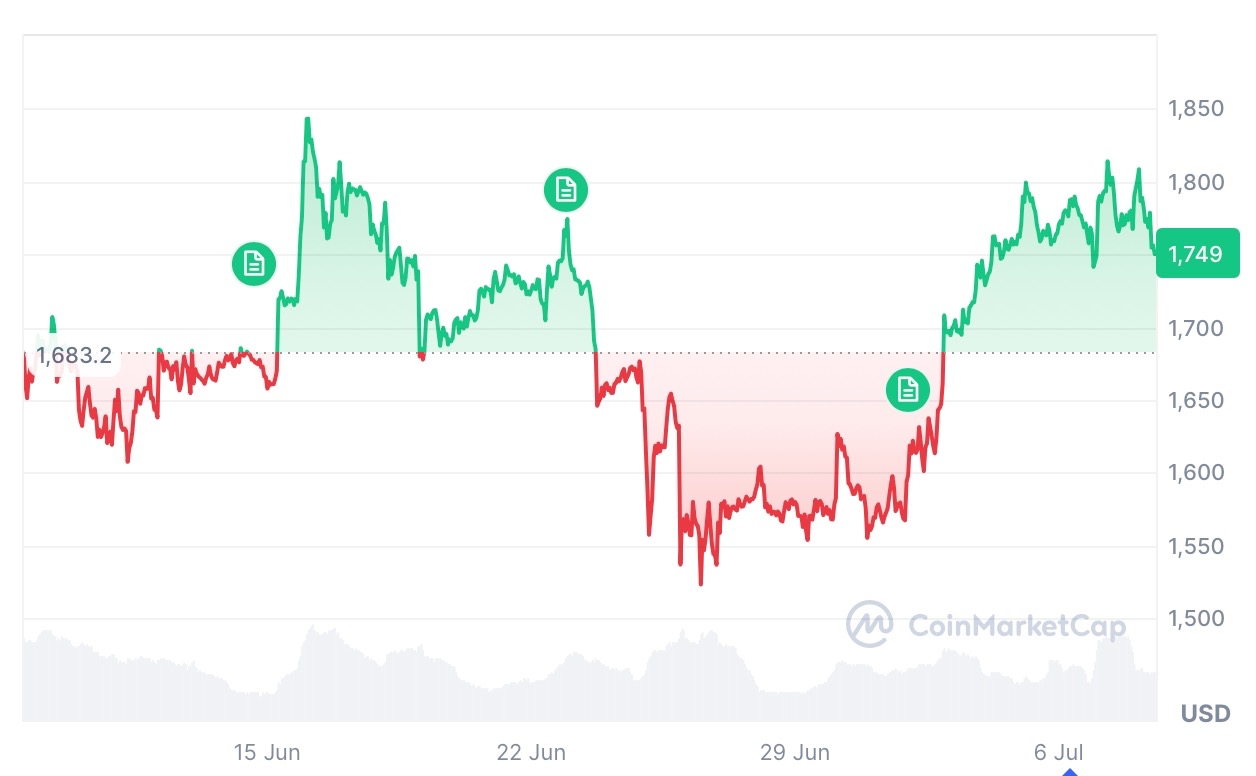
The current rebound is encouraging, but ETH still needs confirmation.
The $1,750–$1,800 area is important because recent price action shows selling pressure near that zone. CoinGecko’s 24-hour high around $1,808 and seven-day high around $1,827 suggest that ETH has already tested the area but has not clearly turned it into support.
A clean breakout above resistance usually requires more than a single candle.
Traders typically want to see ETH hold above the breakout zone, avoid a sharp rejection, and show follow-through through volume, market breadth or derivatives positioning. Without that confirmation, a move above resistance can become a false breakout.
This is why the market is watching $1,800 so closely.
If ETH can hold above $1,750 and break through $1,800 with strength, the path toward $1,900 becomes more realistic. If ETH fails near $1,800 again, the market may shift back into range-trading mode.
The $1,900 Question
The $1,900 level is now one of the most visible upside targets.
CoinGecko’s market page showed Polymarket data assigning about a 49% probability that ETH could hit $1,900 in July, compared with a lower probability for $2,000. That means traders are seriously considering a move toward $1,900, but the market is not treating it as guaranteed.
This is a useful signal.
A probability near 50% suggests uncertainty. The market sees a possible upside path, but also recognizes that resistance, liquidity, macro sentiment and broader crypto market conditions could still block the move.
For Tapbit users, this is the right way to read ETH’s current setup. The question is not whether $1,900 is possible. It is what needs to happen first.
ETF Flows and Institutional Access Still Matter

Ethereum is also being watched through the lens of institutional access.
Spot Ethereum ETF products allow investors to gain ETH exposure through traditional brokerage accounts without directly managing wallets or private keys. This has made ETF flows an important sentiment indicator for ETH, especially when traders are trying to understand whether institutional demand is strengthening or weakening.
CoinGecko’s ETH page recently highlighted institutional adoption and ETF inflows as part of the explanation for Ethereum’s price movement.
However, ETF flows should not be used alone. ETF inflows can support the market narrative, but they do not automatically confirm a breakout. A strong ETH move usually needs alignment between price action, spot demand, derivatives positioning, on-chain activity and broader risk sentiment.
In other words, ETF flows can support the story, but price still has to confirm it.
On-Chain Activity Adds Context
Ethereum’s value is closely connected to its network utility.
Smart contracts allow developers to build decentralized applications, financial instruments, marketplaces and other services on Ethereum. Ethereum.org explains that smart contracts are reusable programs deployed into EVM state, and users can execute them through transactions by paying network fees.
This is why ETH traders often watch more than price.
They may look at gas fees, DeFi activity, stablecoin settlement, staking trends, Layer 2 usage and exchange flows. These indicators help show whether Ethereum demand is supported by real network activity or mainly by short-term speculation.
A price rebound backed by stronger activity usually looks healthier than a rebound driven only by leveraged trading.
Why Traders Should Avoid Chasing Every Breakout
The biggest mistake after a breakout is assuming the move has already been confirmed.
Crypto markets often create false signals. A token can break above resistance briefly, attract late buyers, then fall back into the previous range. This can happen when liquidity is thin, leverage is high, or early buyers take profit near resistance.
ETH is not immune to that pattern. For the current rebound to become more convincing, traders may want to watch whether ETH can:
hold above the $1,700–$1,750 support area, break and sustain above $1,800, avoid a sharp rejection from the recent high zone, show healthy volume during the move, and maintain positive sentiment without excessive leverage.
These are confirmation signals. They help traders separate a real trend shift from a temporary bounce.
What Could Support ETH Next
Several factors could support ETH if the rebound continues.
First, stronger ETF inflows could improve institutional sentiment.
Second, broader crypto market strength could help ETH follow Bitcoin and other large-cap assets higher.
Third, rising DeFi or Layer 2 activity could strengthen Ethereum’s network narrative.
Fourth, reduced exchange selling pressure could help spot demand absorb supply more easily.
Fifth, a clean technical break above $1,800 could trigger renewed momentum toward $1,900.
But the opposite is also true. If ETF demand weakens, Bitcoin loses momentum, derivatives leverage becomes crowded, or ETH fails again near resistance, the rebound could stall.
Tapbit View
Ethereum’s rebound above $1,700 is a constructive signal, but it should not be treated as a complete trend reversal yet.
The market has improved. ETH is trading well above its recent seven-day low, and traders are again watching the $1,900 level. Institutional access through ETF products also remains an important part of the ETH narrative.
But confirmation still matters.
For Tapbit users, the key lesson is that markets do not move in straight lines. A breakout can be meaningful, but only if price action continues to support it. ETH needs to hold key support, break resistance and show stronger follow-through before traders can call the move more durable.
In crypto, patience often matters as much as speed. The first breakout gets attention. The confirmation determines whether the market can trust it.
Users can visit Tapbit to explore supported crypto services. Existing users can access their accounts through Tapbit Login, while new users can start through Tapbit Register.
Frequently Asked Questions (FAQ)
Why is ETH above $1,700 important?
ETH moving above $1,700 shows that short-term market sentiment has improved, especially after its recent rebound from the $1,560 area.
Is ETH already in a confirmed uptrend?
Not necessarily. ETH still needs to hold support and break through the $1,750–$1,800 resistance area with stronger follow-through.
Why is $1,800 a key level?
Recent ETH price action shows resistance near the $1,800 area. A sustained move above it could improve the case for a move toward $1,900.


