

Market confidence in a 2026 U.S. crypto market-structure law has deteriorated sharply. A supplied Polymarket snapshot shows the contract asking whether the CLARITY Act, H.R. 3633, will be signed into law in 2026 trading at a 24% chance, down 51%, with approximately $5.22 million in cumulative volume. The decline follows renewed Senate scheduling uncertainty as lawmakers approach a narrower legislative window.
The move does not mean the bill is dead. It means traders now assign a much lower probability to Congress completing every remaining step before the end of 2026. For readers tracking how regulatory developments affect digital assets, it may also be useful to create a Tapbit account and follow crypto markets as policy expectations change.
Why CLARITY Act Odds Fell to 24%
The main pressure is time. The Senate must settle policy disagreements, secure enough support for floor procedure, pass legislation, reconcile any differences with the House version and send a final bill to the president. Each delay makes that sequence harder to complete before the prediction market’s January 1, 2027 resolution deadline.
Recent reporting indicates that the CLARITY Act became a sticking point as Senate leaders managed a crowded pre-recess agenda. Democrats were reluctant to support an initial procedural vote without further bipartisan negotiation, while debate continued around ethics provisions and the balance between industry, banking and consumer-protection priorities. A delayed vote preserves the bill, but it removes valuable calendar space.
What the Polymarket Chart Shows
The supplied all-time chart shows expectations spending much of the spring around 50% to 70%, with several short-lived moves near or above 75%. The market then weakened through June and July before falling abruptly toward 24% in early August. The displayed contract volume of $5,219,002 suggests meaningful interest, although volume alone does not guarantee deep liquidity or accurate forecasting.
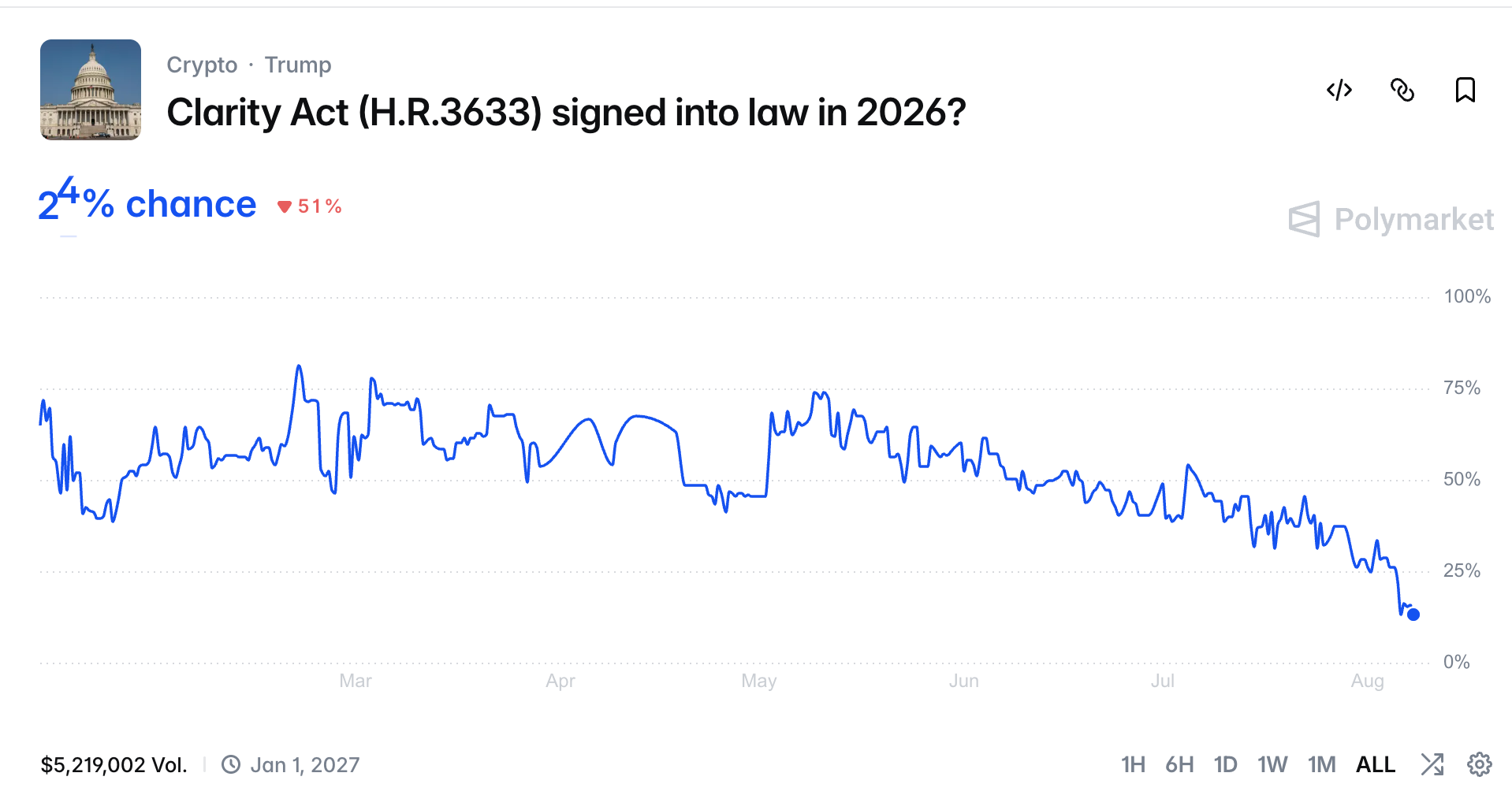
This is a market-implied probability, not a survey. A “Yes” share priced near $0.24 is commonly interpreted as roughly 24% odds, but the price can be influenced by liquidity, large traders, breaking headlines and the contract’s resolution rules. It is best read as a real-time measure of positioning.
Where H.R. 3633 Stands
The Digital Asset Market Clarity Act of 2025 passed the House and was received in the Senate in September 2025. The official record shows it was referred to the Senate Committee on Banking, Housing, and Urban Affairs.
Senate work continued in 2026. Banking Committee leaders released market-structure text in May, and Reuters reported that the committee advanced the legislation on May 14. That committee action was significant, but it was not final Senate passage. The full chamber still needs to act, and any Senate text that differs from H.R. 3633 would have to be reconciled with the House.
What the CLARITY Act Would Change
The legislation seeks to establish a federal framework for digital-asset markets and clarify regulatory jurisdiction. At a high level, it addresses when a digital asset is treated as a commodity or security, how intermediaries register, and how the Commodity Futures Trading Commission and Securities and Exchange Commission divide oversight.
Supporters argue that clearer rules could encourage compliant product development and reduce regulation through enforcement. Critics and some Democratic lawmakers have raised questions involving illicit finance, consumer protection, decentralized finance and political ethics. Those disagreements matter because a durable framework is more likely to require bipartisan support in the Senate.
Why the Delay Matters for Crypto Markets
The direct market impact is mainly about expectations. Companies building exchanges, tokenization products and custody services must make decisions about licensing, product design and capital before the final rules are known. Another delay extends uncertainty over which regulator will supervise particular activities and what compliance path will apply.
That does not mean Bitcoin or the broader crypto market must fall whenever legislative odds decline. Prices are also driven by liquidity, monetary policy, institutional flows, technology and risk appetite. The 24% reading is better understood as a policy-confidence indicator than as a standalone trading signal.
What Could Lift the Odds Again?
- A confirmed floor schedule: a leadership commitment would reduce timing uncertainty.
- A bipartisan procedural agreement: cooperation on debate and amendments could unlock a vote.
- Compromise on ethics and consumer protection: narrowing the most contentious issues may attract additional support.
- House-Senate coordination: early agreement on major differences could shorten reconciliation.
- A clear presidential path: confirmation that a final compromise would be signed would support the “Yes” case.
The opposite signals would include an extended recess without a timetable, public withdrawal of bipartisan support or a decision to restart the process in a new Congress. Because the contract requires enactment in 2026, even a bill that remains politically viable could resolve “No” if it misses the deadline.
How to Interpret Prediction-Market Odds
Prediction markets compress information into a single price, which makes them useful for tracking changes in collective expectations. They also have limitations. Traders can be wrong, liquidity can be uneven and contract wording may differ from the broader political question people think they are trading.
For the CLARITY Act market, the relevant outcome is not whether the Senate debates crypto regulation or passes a related bill. The named legislation must satisfy the market’s specific resolution criteria by the deadline. Readers should check those rules before treating 24% as a general probability for all U.S. crypto legislation.
Conclusion
The CLARITY Act’s slide to 24% on Polymarket captures a sharp loss of confidence that H.R. 3633 can complete the legislative process in 2026. The House has acted and the Senate Banking Committee has advanced market-structure work, but floor procedure, policy disputes, reconciliation and the calendar remain substantial hurdles. The decline is a warning about timing rather than proof of defeat. A scheduled vote or bipartisan compromise could move the odds quickly, while continued delay would make the year-end deadline increasingly difficult.
FAQ
What are the current CLARITY Act odds?
The supplied Polymarket snapshot shows a 24% chance that H.R. 3633 will be signed into law in 2026. Prediction-market prices can change rapidly.
Has the CLARITY Act passed the House?
Yes. H.R. 3633 passed the House and was received in the Senate in September 2025.
Did the Senate pass the CLARITY Act?
No. Senate committee progress is not the same as final passage by the full Senate.
Why does the Senate delay matter?
Less calendar time remains for a floor vote, House-Senate reconciliation and presidential signature before the 2026 deadline.
Does a 24% prediction-market price mean the bill has a 24% official chance?
No. It reflects trader pricing under the market’s rules, not an official forecast, poll or government estimate.


