
XRP price analysis in early August 2026 points to a clear relative-strength problem: XRP is participating in the crypto market, but it has often gained less than Bitcoin, Ethereum and Solana during recovery sessions. XRP recently traded near $1.06 after beginning 2026 around much higher levels. The lag does not mean the XRP Ledger has stopped developing. It means investors are assigning more immediate value to Bitcoin's liquidity, Ethereum's onchain economy and Solana's high-growth activity.
Ripple has continued expanding payments, custody and stablecoin services, while XRP Ledger adoption has grown across tokenization and settlement. Yet company progress and token demand are not identical. Traders comparing major assets can create a Tapbit account and track spot-market strength before considering leveraged exposure.
How XRP Is Lagging the Major Crypto Market
The underperformance is most visible on risk-on days. In several July rebounds, Bitcoin stabilized first, while Ethereum and Solana delivered stronger percentage moves. XRP often followed the direction but with lower upside beta. That behavior suggests buyers are willing to hold XRP, but new capital is not chasing it as aggressively.
Bitcoin remains the market's institutional benchmark and the main destination when macro uncertainty rises. Ethereum benefits when investors rotate toward smart contracts, stablecoins, tokenization and decentralized finance. Solana often attracts speculative flows because its network activity, consumer applications and memecoin ecosystem can create rapid trading demand. XRP's payments narrative is credible, but its demand loop is less visible to short-term traders.
Why XRP Price Has Not Matched Ripple's Progress
Ripple and XRP are connected, but they are not interchangeable. Ripple can grow custody, payments or RLUSD services without every transaction requiring meaningful XRP purchases. RLUSD adoption may strengthen the XRP Ledger ecosystem, yet stablecoin users can settle in RLUSD rather than hold XRP as an investment.
Ripple's official 2026 updates report expanding institutional products, XRP exchange-traded funds and more XRPL activity. The company also says daily ledger transactions reached 3 million in March, supported by automated market makers, tokenized assets and RLUSD settlement. Those are constructive indicators. The missing link is evidence that this activity creates sustained net demand for XRP beyond transaction fees and bridge liquidity.
Supply and Market Structure Still Matter
XRP has a large circulating supply and a long history of holders waiting to sell into rallies. Ripple's published figures for June 30, 2026 show more than 62.3 billion XRP distributed and 32.6 billion held in on-ledger escrow. Escrow improves visibility around supply, but it does not remove the market's sensitivity to future releases or large-holder activity.
When price returns to levels where earlier buyers accumulated, overhead supply can slow momentum. Bitcoin has a capped issuance schedule and a strong store-of-value narrative. Ethereum combines fee demand, staking and application activity. Solana's price is closely tied to a fast-moving onchain ecosystem. XRP needs a clearer marginal buyer to absorb selling pressure and turn ecosystem growth into relative performance.
Bitcoin, Ethereum and Solana Have Clearer Trading Narratives
| Asset | Current Market Narrative | Why Capital Rotates There |
|---|---|---|
| Bitcoin | Macro reserve asset | Deep liquidity, institutional benchmark status and simpler supply story |
| Ethereum | Settlement and tokenization layer | Stablecoins, DeFi, staking and institutional applications |
| Solana | High-throughput consumer chain | Trading activity, applications and high-beta speculation |
| XRP | Payments and institutional settlement | Fast transfer, bridge liquidity and regulatory progress |
Ethereum traders can compare the ETH/USDT spot market with the ETH/USDT futures market to see whether spot demand or leveraged positioning is driving a move. The same principle applies to XRP analysis: rallies supported by spot volume are generally more durable than moves dominated by short liquidations or temporary leverage.
What Could Help XRP Catch Up?
XRP does have credible upside catalysts. Sustained inflows into regulated XRP investment products could create a more consistent institutional bid. Growth in RLUSD, tokenized real-world assets and permissioned finance on XRPL may also increase demand for bridge liquidity. Ripple's expansion into regulated markets can improve confidence around long-term use.
For price, the first constructive signal would be a decisive recovery above the recent $1.10-$1.15 zone with expanding spot volume. Reclaiming the wider $1.30-$1.40 area would suggest that buyers are absorbing overhead supply. More important than a single dollar level is relative strength: XRP/BTC and XRP/ETH need to stop making lower lows when the market rallies.
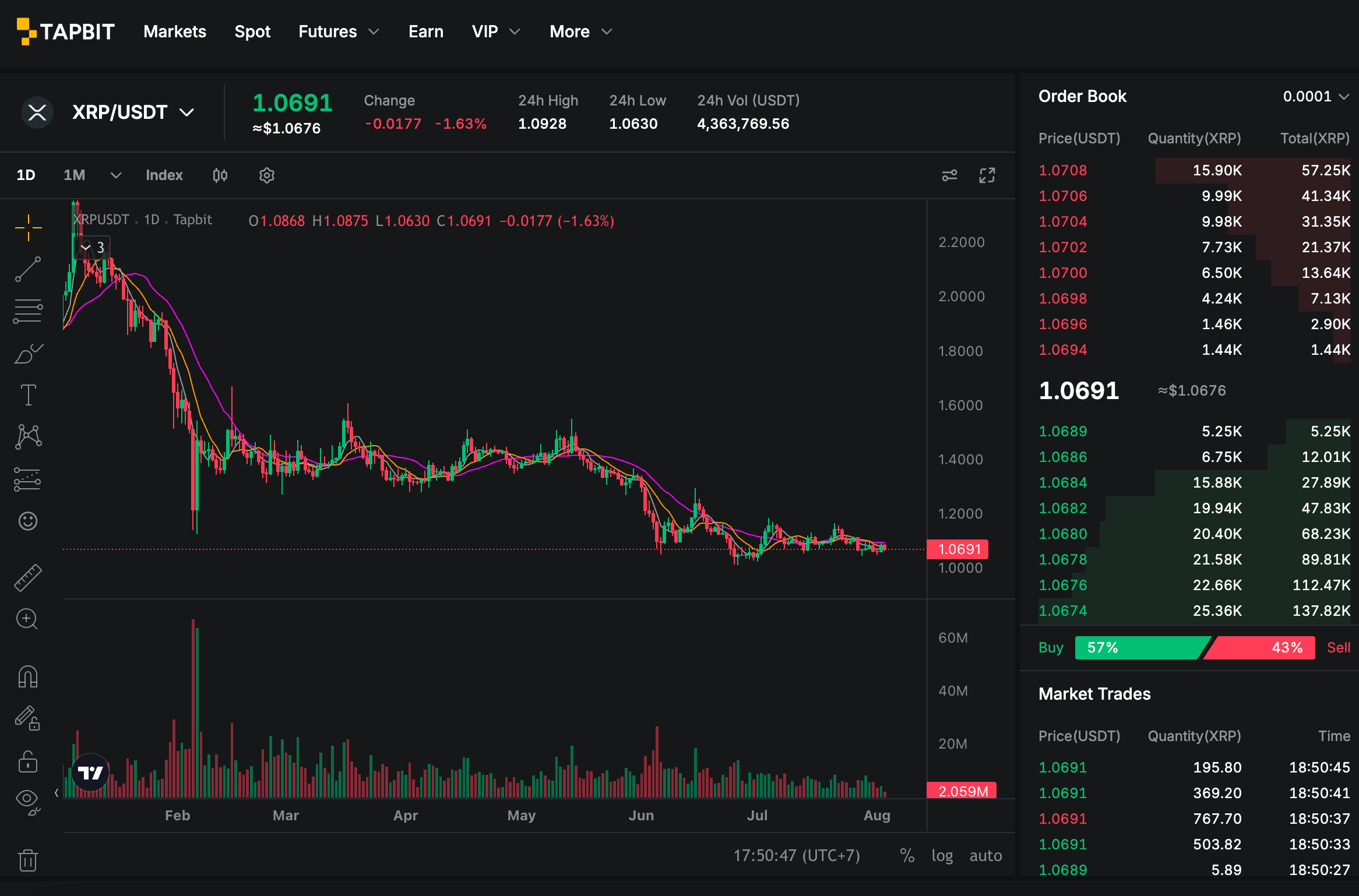
The supplied Tapbit XRP/USDT daily chart shows XRP near $1.0691, with price consolidating close to the $1.00 area after a prolonged decline.
What Could Keep XRP Under Pressure?
The main downside risk is continued narrative separation. Ripple may announce partnerships while XRP remains weak if those products do not require substantial token demand. Delays in U.S. market-structure legislation could also postpone a catalyst that traders have already anticipated. A broader risk-off move would probably favor Bitcoin over large-cap altcoins.
XRP would look structurally weaker if it lost the $1 psychological area and failed to recover quickly. Thin follow-through after positive news, falling spot volume and further weakness against BTC or ETH would reinforce the view that capital prefers other large-cap networks.
Conclusion
This XRP price analysis shows that the token's lag is not simply a verdict on Ripple or the XRP Ledger. It reflects stronger competing narratives, slower price transmission from ecosystem growth and persistent supply overhead. XRP can catch up if institutional flows, XRPL usage and spot demand reinforce one another. Until relative strength improves against Bitcoin and Ethereum, however, rallies may continue to trail the market's fastest-moving large-cap assets.
XRP Price Analysis FAQ
Why is XRP lagging Bitcoin?
Bitcoin has deeper liquidity, a clearer scarcity narrative and stronger benchmark demand during uncertain markets. XRP remains more dependent on altcoin risk appetite and asset-specific catalysts.
Why are Ethereum and Solana sometimes rising faster than XRP?
Ethereum and Solana have visible onchain demand from applications, stablecoins, trading and token issuance. These activities can attract speculative and institutional capital more quickly.
Does Ripple's growth guarantee a higher XRP price?
No. Ripple's business can expand without creating equivalent spot demand for XRP. Investors should examine how each product uses XRP rather than assuming every partnership is a token catalyst.
What would confirm an XRP recovery?
Improving spot volume, higher lows above key support and stronger XRP/BTC and XRP/ETH ratios would provide better confirmation than a short-lived price spike.
Is XRP still relevant for institutional finance?
Yes. XRPL supports payments, tokenization and settlement, while regulated XRP products broaden access. The market question is how quickly that adoption translates into incremental XRP demand.


