
XRP is back at a level where the market needs to pick a direction.
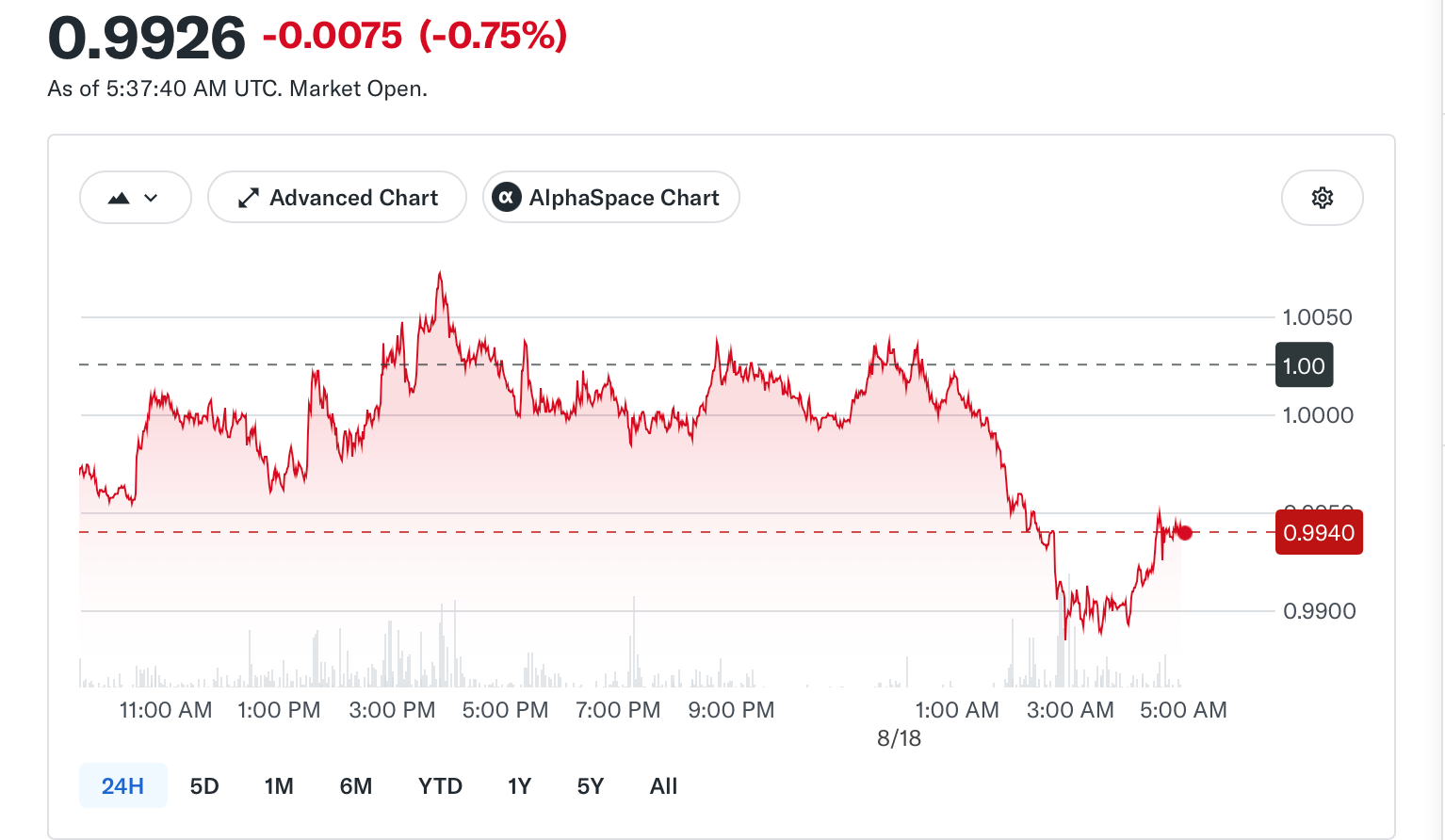
The token is trading near $0.99 after testing the $1.00 zone — well below the $3.65 all-time high from July 2025. That gap is striking. A return to the peak from here would require a gain of roughly 245%.
Sounds appealing, but past highs aren't targets just because they exist. The more immediate question is whether XRP can hold $1.00, break through resistance near $1.10, and rebuild the sort of structure that supports a sustained recovery.
On the fundamental side, things have actually moved in the right direction. XRP investment products are now available in the US. Ripple has strengthened its regulatory position in Europe. And XRPL recently released a major upgrade focused on institutional use cases.
Yet the price hasn't responded accordingly. That disconnect — better fundamentals, stagnant price — is what makes XRP interesting at this stage.
XRP Is Still Far From Its $3.65 High
XRP reached an all-time high of approximately $3.65 in July 2025.
At around $0.99, the token is still roughly 70% below that level. The percentage can be misleading. A 70% decline does not mean XRP only needs to rise 70% to return to the top. From roughly $1.06, XRP would need to gain more than 240% to reach $3.65 again.
That is an important distinction for traders who view the previous ATH as an automatic recovery target.
Markets do not move back to old highs simply because an asset looks cheaper than it used to.
XRP would need new demand, improving liquidity and a sustained change in market structure before a return to $3.65 becomes a realistic technical objective.
$1.00 Has Become the First Line of Defense
The most important short-term level is no longer the all-time high. It is $1.00.
XRP recently tested the psychological level and managed to remain above it. That gives buyers some room, but it does not confirm a reversal.
For now, $1.00 should be treated as the dividing line between consolidation and a deeper breakdown. If buyers continue defending it, XRP has another opportunity to challenge the resistance overhead. If the market loses $1.00 decisively, sentiment could deteriorate quickly because round-number support tends to attract stop orders, leveraged positions and short-term buyers.
The market therefore has a much simpler job before anyone starts discussing $3.65 again: prove that $1.00 can hold.
Why Volume Matters More Than the Headline Price
One of the biggest mistakes traders make during a recovery is focusing only on the price level.
A breakout with weak participation often fails. For XRP to move from a short-term rebound into a stronger trend, rising prices should be accompanied by higher spot volume and broader market participation.
That would show that demand is coming from more than a small group of short-term traders.
A low-volume move through $1.10 could easily reverse back into the range. A high-volume breakout followed by a stable retest would carry much more weight.
This is why traders should watch how XRP trades around resistance rather than simply waiting for a number to appear on the screen.
XRP ETFs Have Changed the Market Structure
One of the biggest differences between the current XRP market and previous cycles is access. US investors now have several exchange-traded products that provide XRP exposure through traditional brokerage accounts.
That is a real structural change.
Previously, investors who wanted XRP exposure generally needed to use a crypto exchange or custody the token directly. Exchange-traded products make access easier for investors who prefer securities-market infrastructure.
However, ETF availability should not be confused with automatic demand. The existence of a product solves the access problem. It does not guarantee that institutions will allocate meaningful capital to it.
Recent fund flows have been positive but relatively modest compared with the size of the XRP market.
That means the next phase will depend less on ETF announcements and more on whether those products begin attracting sustained inflows.
Ripple’s European Expansion Is Another Positive Development

Ripple has also continued building its regulatory footprint. The company received authorization under Europe’s MiCA framework through Luxembourg, giving it a clearer route to provide digital-asset services across the European Union.
For Ripple, this is strategically important. Banks, asset managers and payment companies are unlikely to adopt blockchain infrastructure at scale if the regulatory framework is unclear. Licenses and authorizations therefore make it easier for Ripple to pursue institutional business.
But there is a distinction that XRP investors should keep in mind.
Ripple’s business growth does not automatically create the same amount of demand for XRP.
Ripple is building around several products, including RLUSD, custody infrastructure, payments and tokenized financial assets. Some of those services can use the XRP Ledger without requiring clients to buy large amounts of XRP directly.
That does not make Ripple’s expansion irrelevant to XRP. It simply means the relationship is indirect.
Ripple Is Moving Deeper Into Tokenized Finance
Ripple has also increased its exposure to institutional capital markets through investments in companies involved in fund administration, digital-asset issuance and collateral infrastructure.
That direction is important because it shows where Ripple expects blockchain adoption to grow.
Instead of relying only on cross-border payments, the company is positioning XRP Ledger infrastructure around tokenized funds, digital collateral and settlement. This could become a stronger long-term use case for XRPL if institutions begin moving more assets on-chain.
The key question for XRP holders is how much of that activity eventually creates demand for the native asset.
If usage grows but most settlement occurs through stablecoins such as RLUSD, the effect on XRP could be smaller than some investors expect. If XRP becomes more important to liquidity, collateral or transaction activity, the relationship could be stronger.
That remains something the market has to observe rather than assume.
XRPL 3.3.0 Adds Institutional-Focused Features
The XRP Ledger also received a significant software update in August. Version 3.3.0 introduced support for several features aimed at improving institutional transactions and application design.
Among them are confidential transfers, batch transactions, permission delegation and sponsored transaction fees.
Confidential transfers are particularly relevant for financial institutions because public blockchain transparency can be a problem when transaction amounts contain commercially sensitive information.
The Sponsor functionality could also improve user experience by allowing businesses to cover transaction fees or account reserve requirements for customers.
This can make blockchain applications feel more like conventional financial apps, where users do not need to understand network fees before completing a transaction.
However, software release does not mean every feature becomes active immediately. XRPL amendments still need to pass the network’s validator approval process before activation.
XRP’s Fundamentals and Price Are Moving in Different Directions
The most interesting part of the current setup is the divergence. Ripple has expanded its regulatory footprint. Institutional XRP investment products are available. XRPL has introduced new infrastructure aimed at tokenization and institutional finance.
However, XRP is still trading near $1.00 rather than approaching its former highs.
There are two possible interpretations. One is that the market is undervaluing the long-term effect of these developments. The other is that many of Ripple’s achievements do not translate directly into enough XRP demand to justify a much higher token price.
It may be too early to know which interpretation is correct. For now, the chart is giving a clearer answer than the narrative: buyers have not yet established control.
Final Thoughts
XRP has more institutional infrastructure around it today than it did during previous cycles. US-listed investment products have expanded access. Ripple continues to build regulated financial infrastructure. XRPL is adding features aimed at tokenized assets, institutional privacy and easier transaction management.
Those developments strengthen the long-term story. However They have not yet created a new bull market in XRP.
The token remains near $1, roughly 70% below its $3.65 all-time high. Returning to that level would require a gain of more than 240%.
That kind of move is possible in crypto, but it cannot be assumed. XRP needs to defend $1.00, reclaim $1.07–$1.08 and break through $1.10–$1.12 with stronger participation.
If it can do that, the discussion can begin moving toward higher targets.
Traders who want direct XRP exposure can use the XRP/USDT spot market on Tapbit. Those who prefer to trade both upward and downward price movements can access the XRP/USDT perpetual futures market.
Users who want to explore digital asset markets can visit the Tapbit homepage. Existing users can access their accounts through the Tapbit login page, while new users can create an account through the Tapbit registration page.
Frequently Asked Questions
How far is XRP from its all-time high?
At around $1.06, XRP is roughly 70% below its $3.65 ATH.
How much would XRP need to rise to reach $3.65 again?
From approximately $1.06, XRP would need to gain around 245% to return to $3.65.
What is the most important XRP support level right now?
The $1.00 area is currently the most important short-term support. Losing it on a sustained basis would weaken the current market structure.


