
Shiba Inu returned to the center of the crypto market after a sudden weekend rally pushed SHIB up about 36% to roughly $0.0000057.
The move stood out because it was not accompanied by a major Shibarium upgrade, new exchange listing or product announcement. Instead, trading data pointed to a more immediate explanation: concentrated buying in South Korea, limited market depth and a wave of short liquidations that followed the initial price breakout.
The rally has already lost some momentum. As of July 27, 2026, SHIB was trading near $0.00000511, down about 8.6% over 24 hours but still up more than 22% over seven days. That pullback is part of the story. It shows how quickly a flow-driven rally can reverse when fresh demand slows.
What Happened to the SHIB Price?
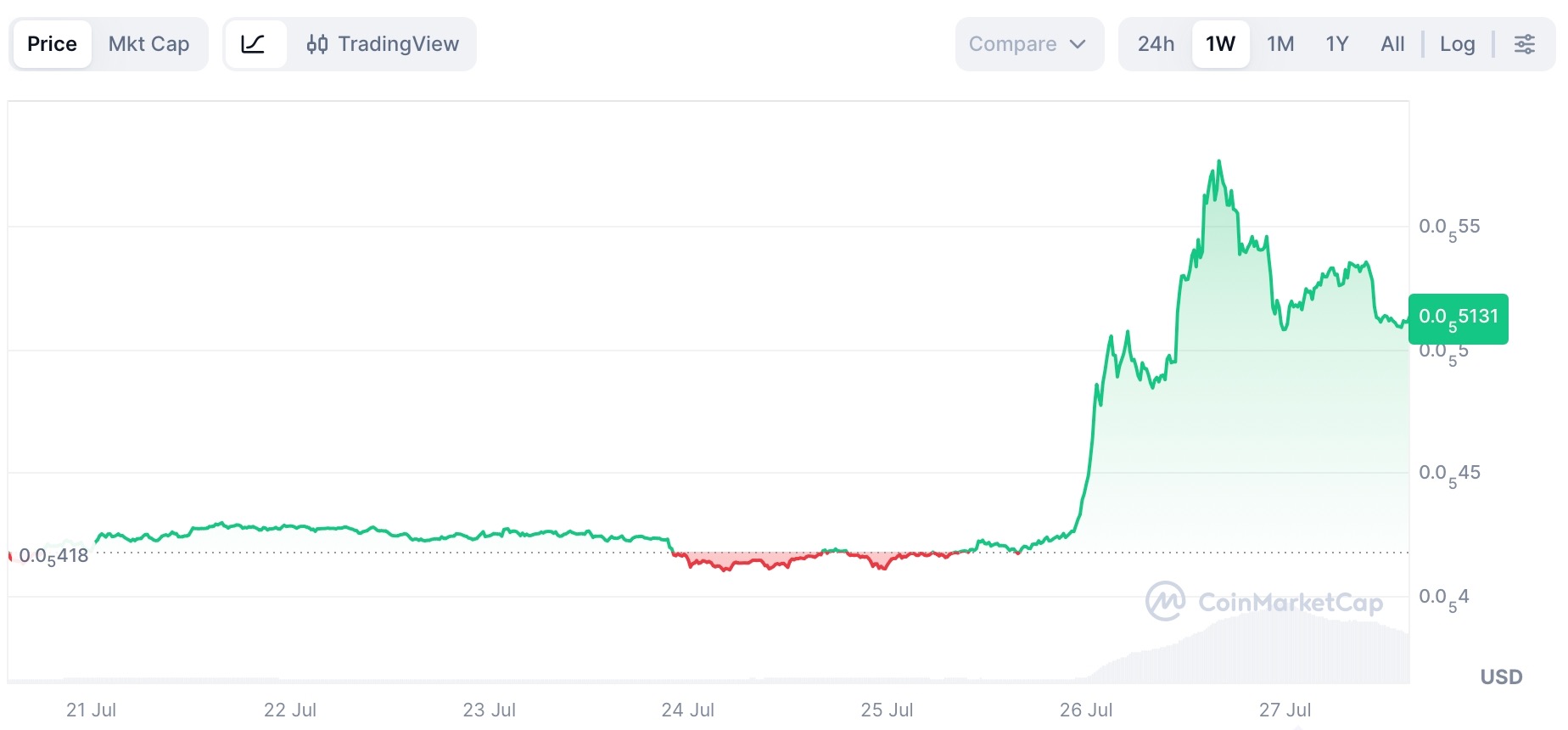
SHIB entered the weekend near $0.0000049 before climbing to approximately $0.0000057. The move added close to $1 billion to its market value at its peak and lifted daily trading volume to its highest level in months.
CoinGecko currently places SHIB’s market capitalization near $3.02 billion, with approximately 589.5 trillion tokens in circulation. Its 24-hour trading volume has remained close to $400 million, although activity has declined from the peak of the rally.
In this case, there was no clear project-level announcement behind the breakout. Shibarium did not release a major upgrade during the rally window, and the broader Shiba Inu ecosystem did not announce a development large enough to explain a 36% daily move.
The strongest evidence instead came from exchange trading data.
South Korean Trading Led the Rally
Upbit’s SHIB/KRW market became the main center of activity during the rally.
According to CoinDesk, the pair generated around $62 million in volume and accounted for more than 10% of global SHIB trading. It also traded at a slight premium to several dollar-denominated markets, suggesting that Korean buyers were paying more aggressively than traders elsewhere.
That matters because price discovery does not always begin on the largest global exchange. When one regional market attracts a large share of trading volume, buying pressure from that venue can influence prices across other exchanges.
The latest CoinGecko market data still shows Upbit’s SHIB/KRW pair among the largest individual SHIB markets. At the time of writing, it had generated approximately $37 million in 24-hour volume, ahead of several major SHIB/USDT markets.
South Korea has a highly active retail crypto market, and KRW pairs can become important sources of momentum when local traders concentrate on the same asset. In SHIB’s case, the size and timing of the Upbit volume suggest that Korean spot demand helped start the move.
This does not mean every purchase came from a retail trader or that South Korean demand will continue. It simply identifies where the most visible buying pressure appeared during the rally.
Why Liquidity Made the Move Larger
High trading volume does not always mean a market has deep liquidity. Volume measures how much an asset changed hands over a period. Market depth measures how much capital is available close to the current price before a large order begins to move the market.
CoinGecko’s current data shows that the Upbit SHIB/KRW market had roughly $415,000 of buy-side depth and $244,000 of sell-side depth within 2% of the market price. Those figures can change quickly, but they are modest compared with the tens of millions of dollars traded through the pair each day.
When buy orders arrive faster than sellers can replenish the order book, price can move sharply even if the token already has a multibillion-dollar market capitalization. Once the breakout attracts momentum traders, the move may accelerate further.
The same process can work in reverse. If buyers step back while holders begin taking profits, limited depth can turn an orderly pullback into a much faster decline.
SHIB’s rally and subsequent retreat are both consistent with this kind of market structure.
Did a Short Squeeze Cause the SHIB Rally?
Short liquidations contributed to the rally, but they do not appear to have started it.
CoinDesk, citing CoinGlass data, reported that approximately $6 million in SHIB and 1000SHIB positions were liquidated across roughly 2,300 traders. Around $5 million of those liquidations involved short positions.
When a leveraged short position is liquidated, the exchange closes it by buying the asset or settling the related contract. A cluster of short liquidations can therefore add buying pressure to an existing rally.
The timing is important. The largest liquidation activity arrived after SHIB had already begun climbing. Korean spot buying appears to have provided the initial push, while short covering helped extend the second part of the move.
The liquidation total was also small relative to the change in SHIB’s market value. It was large enough to intensify the rally, but not enough to explain the entire 36% increase.
Describing the move as a pure short squeeze would therefore miss the role of spot demand and market depth.
Was This a Wider Meme Coin Rally?
Other meme coins moved higher, but they did not match SHIB’s performance.
Dogecoin gained around 6% during the same period, while several smaller tokens in the sector rose by roughly 10%. That is a positive backdrop, but it does not look like a broad meme coin rally in which most major assets moved together.
SHIB’s much larger gain, combined with the concentration of volume on Upbit, points to an asset-specific trading event.
The distinction matters because sector-wide rallies can draw support from capital rotating across an entire category. A rally concentrated in one token may depend more heavily on local demand, social attention and short-term positioning.
Did the SHIB Burn Rate Drive the Price Higher?

Several reports highlighted a sharp increase in SHIB’s burn rate during the rally. More than 400 million tokens were reportedly transferred to burn addresses over a 24-hour period, producing a percentage increase of more than 5,000% from the previous period.
The percentage sounds significant, but the absolute amount needs context.
SHIB has a circulating supply of approximately 589.5 trillion tokens. A burn of 401 million SHIB represents only about 0.000068% of that supply.
Token burns permanently remove assets from circulation, but a single daily increase of this size does not materially change SHIB’s supply structure. It may support community sentiment, yet there is not enough evidence to treat it as the main cause of the rally.
For SHIB burns to have a lasting valuation impact, traders would need to examine the absolute number of tokens removed over a much longer period, not just the daily percentage change.
Why Has SHIB Pulled Back?
The pullback does not require a separate negative announcement.
SHIB rose quickly without a clear fundamental catalyst. Once the initial Korean buying slowed, traders who entered earlier had an incentive to lock in profits. The decline in short exposure may also have removed some of the forced buying that supported the rally.
This is common in momentum-driven markets. A price can move far above its previous range as buyers compete for limited liquidity, then fall back when order flow becomes more balanced.
The current decline does not erase the weekly gain, but it does show that the market has not yet established a stable price after the breakout.
Bottom Line
SHIB’s 36% rally appears to have started with concentrated buying in South Korea. Upbit’s SHIB/KRW market carried an unusually large share of global volume and traded at a modest premium, while limited market depth made the price more responsive to aggressive orders.
Short liquidations added momentum after the rally was already underway, but they were not large enough to explain the move on their own. The widely reported increase in SHIB burns was also too small relative to the token’s circulating supply to serve as a convincing primary catalyst.
The subsequent pullback reinforces the same conclusion. This was largely a flow- and liquidity-driven rally, not a repricing based on a major new Shibarium development.
For traders, the next question is not simply whether SHIB can rise again. It is whether Korean spot demand can remain active after the initial excitement and whether the market can absorb profit-taking without another sharp move.
Follow crypto markets and market insights on Tapbit:https://www.tapbit.com/
Existing users can log in here:https://www.tapbit.com/login
New users can register here:https://www.tapbit.com/register
Frequently Asked Questions
Why did Shiba Inu rise so quickly?
SHIB rose about 36% during the weekend as trading activity increased sharply in South Korea. Upbit’s SHIB/KRW market accounted for more than 10% of global SHIB volume during the rally and traded at a slight premium to several dollar-denominated markets.
Limited market depth and short liquidations then amplified the move.
Is SHIB still rising?
SHIB has pulled back from its recent high. As of July 27, 2026, it was trading near $0.00000511, down about 8.6% over 24 hours but still more than 22% higher over seven days.
Crypto prices change continuously, so current market data should be checked before making any trading decision.
Did South Korean traders cause the rally?
Trading data suggests that South Korean demand provided an important initial push. Upbit’s SHIB/KRW pair became the largest individual SHIB market during the rally, generating approximately $62 million in volume.
That does not prove that every price movement came from Korean traders, but the concentration of volume and the local price premium make South Korea the clearest source of visible spot demand.


