
American 250 was dead before the fireworks started. The CoinGecko-listed American 250 token hit its all-time high of 0.001213 on June 4, 2026 — a full month before the July 4 anniversary it was named after. By July 8, four days after the celebration, it had already printed its all-time low near 0.00004848. As of mid-August, it trades around 0.000059, down more than 95% from the peak, with a market cap near 59,000 and a main DEX pool holding roughly $20,000 in liquidity.
This was not bad luck. It was the standard lifecycle of an event-driven meme coin, and if you understand why American 250 died on schedule, you can spot the next one before it happens to you.
Why Event Coins Always Peak Early
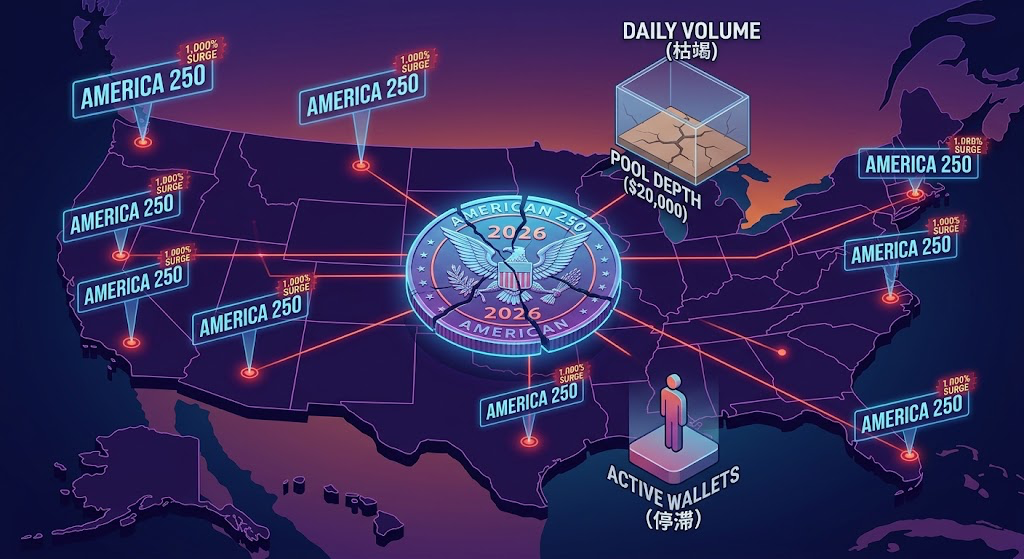
The American 250 pitch was beautifully simple: America's 250th birthday was coming, attention would build, and attention would become buying pressure. No whitepaper required. Flags, patriotism, a countdown — a once-in-a-generation narrative anyone could grasp in five seconds. But that simplicity contained the kill switch. The date was public information. Every buyer knew exactly when the story ended, so every rational speculator planned to sell before the crowd did — and the crowd, knowing this, sold earlier still. That recursive logic is why "buy the rumor, sell the news" compresses event-coin rallies into the weeks before the event, not the event itself.
June 4 wasn't a random top. It was the market's collective answer to the question of when the last buyer arrives. The answer was: before July 4. The lesson generalizes to any token whose thesis is a fixed calendar date — a halving, a launch, an anniversary, an election. The narrative is most valuable when fewer people believe it, and worthless once everyone is already positioned for it.
The Number That Actually Matters: $20,000
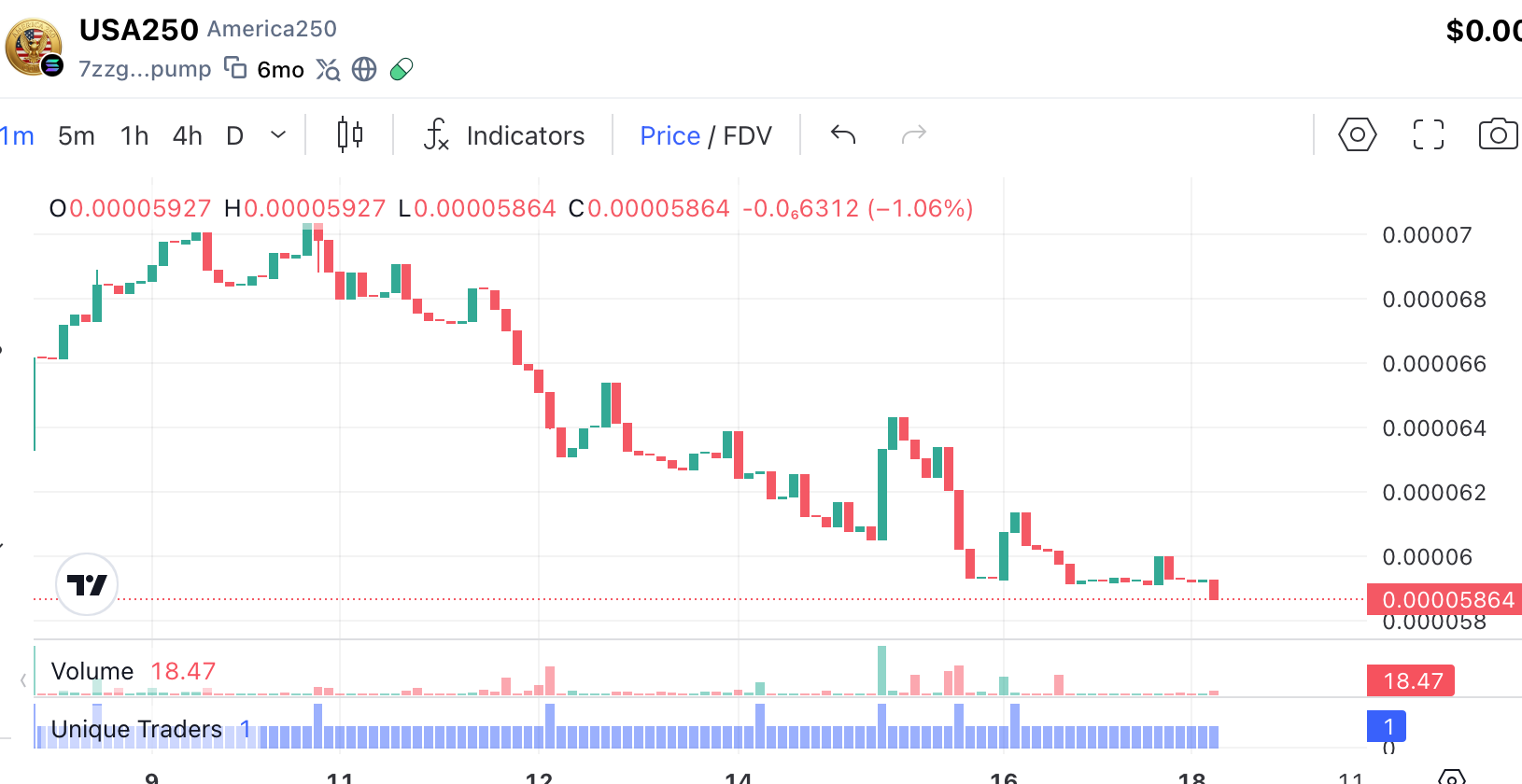
Most post-mortems focus on the 95% price drop. That is the wrong number to watch. The right number is the liquidity pool. With roughly 20,000 of DEX liquidity and daily volume that has at times fallen into the tens of dollars, American 250 no longer has a functioning market — it has a price display. A chart can show 0.000059 all day, but if you hold a $5,000 position, you cannot exit anywhere near that quote. Your sell order is the price move.
This is also why the market cap is misleading, why the holder count is misleading, and why "it's cheap now" is wrong. Market cap is price multiplied by supply; it says nothing about how much real money sits in the pool to absorb sells.
Thousands of holders sounds healthy until you remember that dead wallets, dust balances, and underwater positions that aren't worth the gas to sell all count as holders. And a 95% discount is not a floor — a token at $0.000059 can lose another 90%, because the old all-time high creates zero support. For a token in this state, only three metrics tell the truth: daily volume, pool depth, and growth in active wallets. Everything else is decoration.
The 2027 "Founding Patriots" Plan Is a Retention Tool, Not a Revival
To its credit, the team didn't vanish after July 4. The website reframed the anniversary as a "Genesis Snapshot" and launched a year-long competition: the holder pool narrows through successive snapshots, from the top 2,000 down to 1,500, then 1,000, then 500, until July 4, 2027, when 250 wallets are crowned "Founding Patriots," with 2% of supply reserved for the prize pool. As community design, it is clever. As a market thesis, it has a fatal flaw: snapshots reward people who already hold. They give nobody a reason to start buying.
A second rally requires new money — fresh wallets acquiring tokens from existing holders. The Founding Patriots program does the opposite: it incentivizes the current base to sit still and wait. That can slow the bleed, but it cannot reverse it.
Meanwhile, the program's published details lack the on-chain verifiability serious traders should demand — the snapshot block, eligible addresses, ranking methodology, and distribution records. Absence of proof isn't proof of absence, but when future rewards are part of the pitch, "trust us" is not a data point. Expect the base case: American 250 persists as a small, loyal, illiquid community token. It doesn't need to disappear to stay dead as a trade.
The Copycat Trap
One more hazard, because it is already causing losses: multiple Solana tokens now trade under America250 branding, with different contracts, supplies, and pools.
When you see "America250 surges 1,000%," odds are it is a different contract with a tiny pool — not the token in this article. The rule is non-negotiable. Never identify a meme coin by its ticker. Verify the chain, the contract address, and the actual liquidity pool before touching anything. And note what this token is not: it has no relationship with the official America250 commemoration or the U.S. Mint's 250th-anniversary coins. Patriotic imagery is not a government endorsement.
A Checklist for the Next Event Coin
American 250 won't be the last narrative with an expiration date, so before buying the next one, run through a short discipline. Ask whether the catalyst is a fixed, public date — if yes, assume the rally peaks before it, and plan your exit accordingly. Ask whether the project has a Plan B for after the event, because "we'll think of something" means the chart ends on the date.
Check whether you can actually exit by looking at pool depth rather than market cap; if the pool is $20,000, your position size should be a small fraction of it. Decide whether volume is real and rising or just social noise, since posts are free while on-chain buys cost money — trust the expensive signal. And confirm you are looking at the right contract, because same-name tokens are the oldest trap in the book.
Where American 250 Goes From Here
In the bull case, the team converts the snapshot campaign into genuine social momentum, attracts new wallets, and rebuilds liquidity — meme coins have resurrected on attention alone before. In the base case, it becomes a shrinking but persistent community token.
In the bear case, volume keeps decaying, same-name tokens fragment what narrative remains, and June 4, 2026 stands as the permanent high of a one-time event trade.
None of these scenarios is investable today. The token isn't listed on most major exchanges, and its market is too thin for a meaningful position in either direction — which is itself the answer to the title of this article. What comes next is most likely nothing, and in markets, nothing is also a verdict.
The broader takeaway is worth more than the token: in event-driven memes, the story's expiration date is the trade's expiration date. American 250's first chapter showed how fast a simple story attracts capital. Its second chapter is showing how fast that capital leaves when the calendar runs out.
Users who want to explore digital asset markets can visit the Tapbit homepage. Existing users can access their accounts through the Tapbit login page, while new users can create an account through the Tapbit registration page.
Frequently Asked Questions
What is American 250?
A Solana-based meme coin themed around the United States' 250th anniversary. It is an event- and community-driven token, not an infrastructure project.
Is American 250 an official U.S. government cryptocurrency?
No. It has no connection to the official America250 commemoration or the U.S. Mint's 250th-anniversary physical coin program.
What was American 250's all-time high?
Approximately $0.001213 on June 4, 2026 — roughly one month before the July 4 anniversary.


