

TAO has returned to a key level on the chart.
After trading below $200 earlier in August, it pushed back above and was around $205 at last check. The move is notable, but it doesn't confirm a new uptrend just yet.
The market has already shown that TAO can trade above $200. The question now is whether buyers can defend that level.
A sustained move through $210–$220 would strengthen the near-term structure and could reopen the path to $240. A rejection there, however, would put $200 back under pressure and raise the risk of a deeper pullback.
Beyond price, Bittensor itself is evolving — subnet emission distribution has changed, EVM functionality has expanded, and the network's economic accounting has been tightened. These developments give traders more to watch than just the chart.
TAO Has Already Broken $200 — But the Breakout Is Not Confirmed
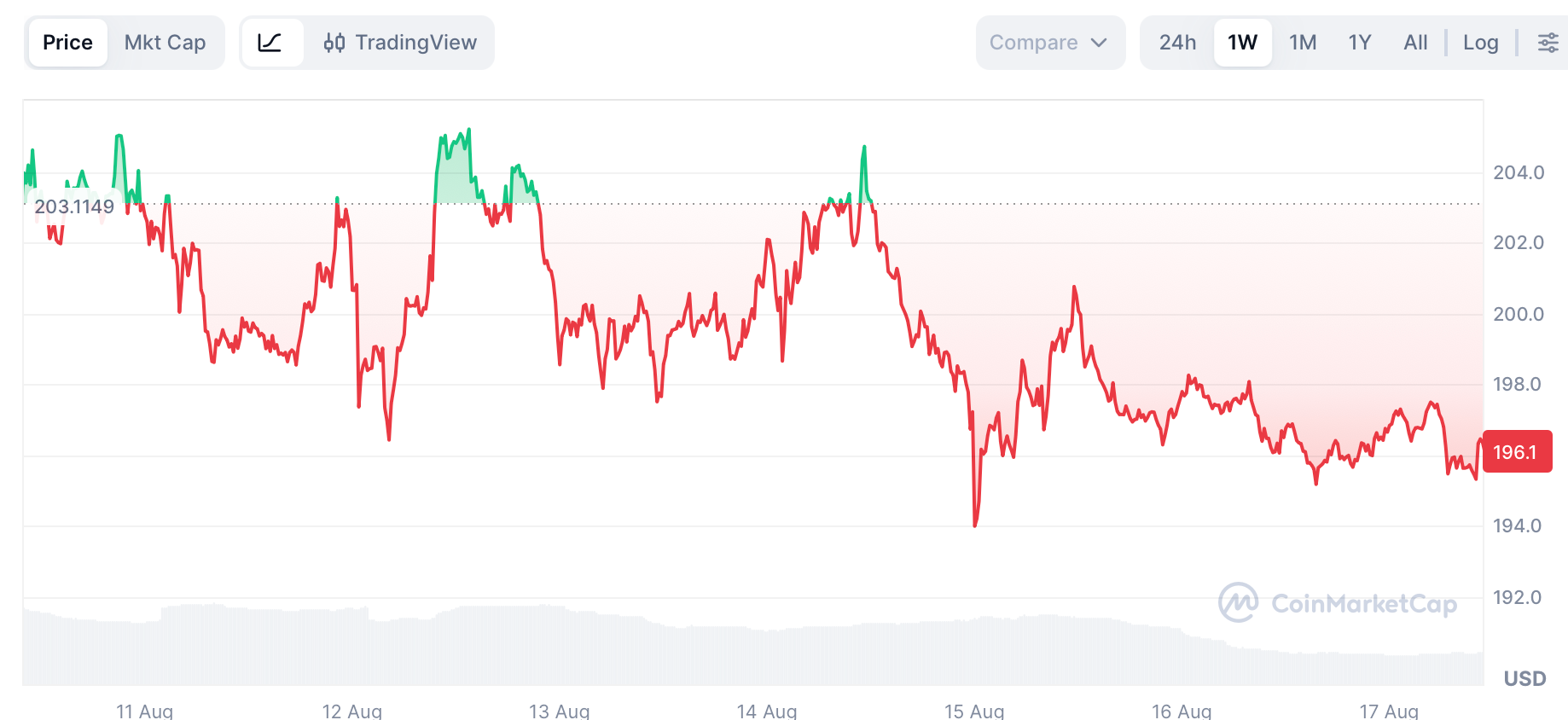
The $200 level dominated TAO trading through the first half of August. TAO moved above it during a rally earlier in the month, reaching roughly $207–$209 before losing momentum. Price later slipped back below $200 and then recovered again.
That sequence changes the interpretation of the chart.
A few weeks ago, $200 was an obvious upside target. Now it is better viewed as a pivot. Buyers want to establish it as support, while sellers are trying to force TAO back into the previous range.
This makes the next few daily closes more important than a brief intraday spike.
If TAO remains above $200 and begins producing higher lows, the market would have a stronger foundation for another attempt at the resistance above. If it repeatedly closes below $200, the recent rebound will look less convincing.
The Next Resistance Sits Around $210–$220
The first area to watch is around $210–$214. TAO has struggled to establish sustained momentum above this region, making it the first short-term test for buyers. A daily close above it, followed by a successful retest, would improve the structure.
The more important resistance sits closer to $220. This is where the market begins to encounter a broader supply zone. A clean break above $220 would be more meaningful than another quick move above $200 because it would show that buyers are absorbing sell orders at progressively higher prices.
If TAO clears $220 with stronger volume, the next major area would likely sit between $230 and $240. Above that, $250 becomes a more realistic target.
Those levels should not be treated as guaranteed destinations. TAO remains volatile, and Bittensor tends to move quickly when liquidity shifts.
For now, the structure is simple: $200 is the pivot, $210–$214 is the first confirmation zone and $220 is the larger breakout level.
Bittensor’s Fundamentals Are Changing
The TAO story right now isn't just about technical resistance. Bittensor has been making structural changes to its network economy — most notably the v440 upgrade, often called the Emission Gate.
The core principle: subnets shouldn't receive meaningful TAO emissions purely by existing.
Under the new model, subnet demand plays a larger role in determining emissions. Networks that don't attract sufficient economic interest can see their rewards reduced significantly.
That addresses a question that's lingered around Bittensor: does adding more subnets automatically add value to the ecosystem?
The answer is increasingly no. A network can have hundreds of subnets, but that number doesn't mean much if most aren't producing useful services, attracting users, or generating demand for their own tokens.
The Emission Gate shifts Bittensor toward a more market-driven model — weaker subnets face greater economic pressure, while stronger ones have a better shot at attracting capital.
For TAO holders, that's more worth watching than the raw subnet count.
Why Subnet Quality Matters More Than Subnet Quantity
Bittensor’s long-term argument is that intelligence can be organized as an open market. Different subnets compete to provide services ranging from machine learning and inference to data, prediction and specialized AI applications. Validators evaluate output, miners compete to provide useful results and economic incentives are distributed through the network.
The system works only if the subnets eventually produce something people actually want.
This is where TAO differs from a simple AI-themed token.
The long-term bull case is not that artificial intelligence is popular and TAO happens to have an AI label. It is that Bittensor may develop into an economic network where useful machine intelligence is produced, evaluated and paid for through decentralized markets.
That is a much harder thesis to prove. It requires real users, useful subnets and economic activity that can survive when speculative interest declines.
Recent Bittensor changes appear designed to push the network further in that direction.
Bittensor Is Also Expanding Its EVM Infrastructure

Another recent upgrade, v445, expanded Bittensor’s EVM functionality. New precompiles allow Solidity-based applications to access more Bittensor-specific functions, including information related to staking, subnet activity, alpha assets, balances and governance.
That may sound like a developer-only change, but it has broader implications.
Making Bittensor easier to access through familiar Ethereum development tools can lower the barrier for developers who already understand Solidity but do not want to build directly around Bittensor’s native infrastructure.
If that results in more applications, tools or financial products interacting with TAO and subnet assets, the network could become easier to use from outside its existing developer community.
The following v446 release focused more heavily on economic accounting and network reliability. It addressed issues involving historical alpha issuance, burn calculations, subnet ownership and parts of the Liquid Alpha system.
These releases do not guarantee higher TAO prices. They do show that Bittensor is actively working on the infrastructure behind its economic model rather than relying only on AI-market enthusiasm.
Grayscale Is Giving Traditional Investors Another Route Into TAO
Grayscale currently operates the Grayscale Bittensor Trust, trading under the ticker GTAO in the US over-the-counter market. The product gives investors a way to gain exposure to TAO through a traditional securities account without directly holding or managing the token.
Grayscale has also filed amended registration documents with the US Securities and Exchange Commission related to a possible transition toward an exchange-listed ETF structure.
The filing does not mean a Bittensor ETF has already received final approval and begun trading on a major exchange.
As of the latest available information, GTAO remains a trust product, while Grayscale is pursuing a structure that could eventually lead to a NYSE Arca listing if the required regulatory process is completed.
That distinction is important because crypto markets often price in headlines before the underlying regulatory event has actually occurred.
Still, Grayscale’s involvement is meaningful. It provides another example of TAO moving beyond crypto-native exchanges and into investment products designed for conventional brokerage accounts.
A Trust Is Not the Same as Holding TAO
Investors should also understand that GTAO and TAO itself are not identical exposures. Trust shares can trade above or below the value of the TAO held by the vehicle. Grayscale itself warns investors that the market price of the trust can deviate significantly from its underlying net asset value.
That means a rising TAO price does not guarantee that GTAO shares will move by exactly the same percentage.
For investors who want direct exposure to the network asset, holding TAO and buying shares in an investment trust are structurally different decisions.
The existence of a traditional investment vehicle may improve access, but it does not remove market risk.
What Matters Most for TAO From Here?
The next price move will attract attention, but the longer-term question is more important. Bittensor needs to demonstrate that its economic system can identify useful AI services and direct capital toward them.
Emission changes are a step toward that goal. EVM improvements make the network easier to integrate. Traditional investment products can expand access.
None of those developments guarantees adoption.
The strongest signal would be growing external demand for services created by Bittensor subnets. That would begin to connect TAO’s economic value with something more durable than speculative trading.
Until then, TAO will continue to trade partly as an AI-sector proxy and partly as a bet on Bittensor’s future execution.
Readers can follow broader cryptocurrency research and market coverage through Tapbit. Existing users can log in here, while new users can create an account.
Frequently Asked Questions
What is Bittensor (TAO)?
Bittensor is a decentralized network designed to create markets for machine intelligence. Participants can contribute models, data, computing resources and other AI-related services through specialized subnets. TAO is the network’s native asset and plays a central role in staking and economic incentives.
Is TAO currently above $200?
TAO was trading around $205 at the time of writing. The price has moved above and below $200 several times recently, so the key question is whether the market can maintain the level as support rather than simply trade through it temporarily.
What is the next resistance level for TAO?
The first short-term resistance is around $210–$214. The more important breakout zone is near $220. A sustained move above $220 could bring the $230–$240 region into focus.


