

ALEPH has lost roughly 99% of its value since its January 2022 peak. For most projects, that kind of decline would signal a fading narrative or an abandoned product.
Aleph Cloud is a bit more complicated.
Its decentralized cloud infrastructure is still active, core development continues, and the project has introduced a new economic model linking node rewards to customer spending. The catch: ALEPH is still trading near record lows, liquidity is limited, and there's little evidence that current cloud revenue can meaningfully support the token.
Aleph v2 aims to address that gap. But its success will depend less on narrative and more on real customers, actual workloads, and revenue that can be tracked and verified.
What Is Aleph Cloud?
Aleph Cloud, previously known as Aleph.im, provides decentralized computing and data services for blockchain applications. Its products include virtual machines, file storage, database services, blockchain indexing, GPU computing and confidential virtual machines.
The project is often compared with decentralized cloud and DePIN platforms because it allows independent operators to contribute computing resources. Developers can use those resources instead of relying entirely on centralized providers such as Amazon Web Services or Google Cloud.
ALEPH supports this network in several ways. It can be used to pay for services, stake with network nodes and reward infrastructure providers. Aleph Cloud also uses the token as part of its governance and network security model.
The technology remains available. The harder question is whether enough customers are paying to use it.
Why Did ALEPH Lose Nearly 99%?
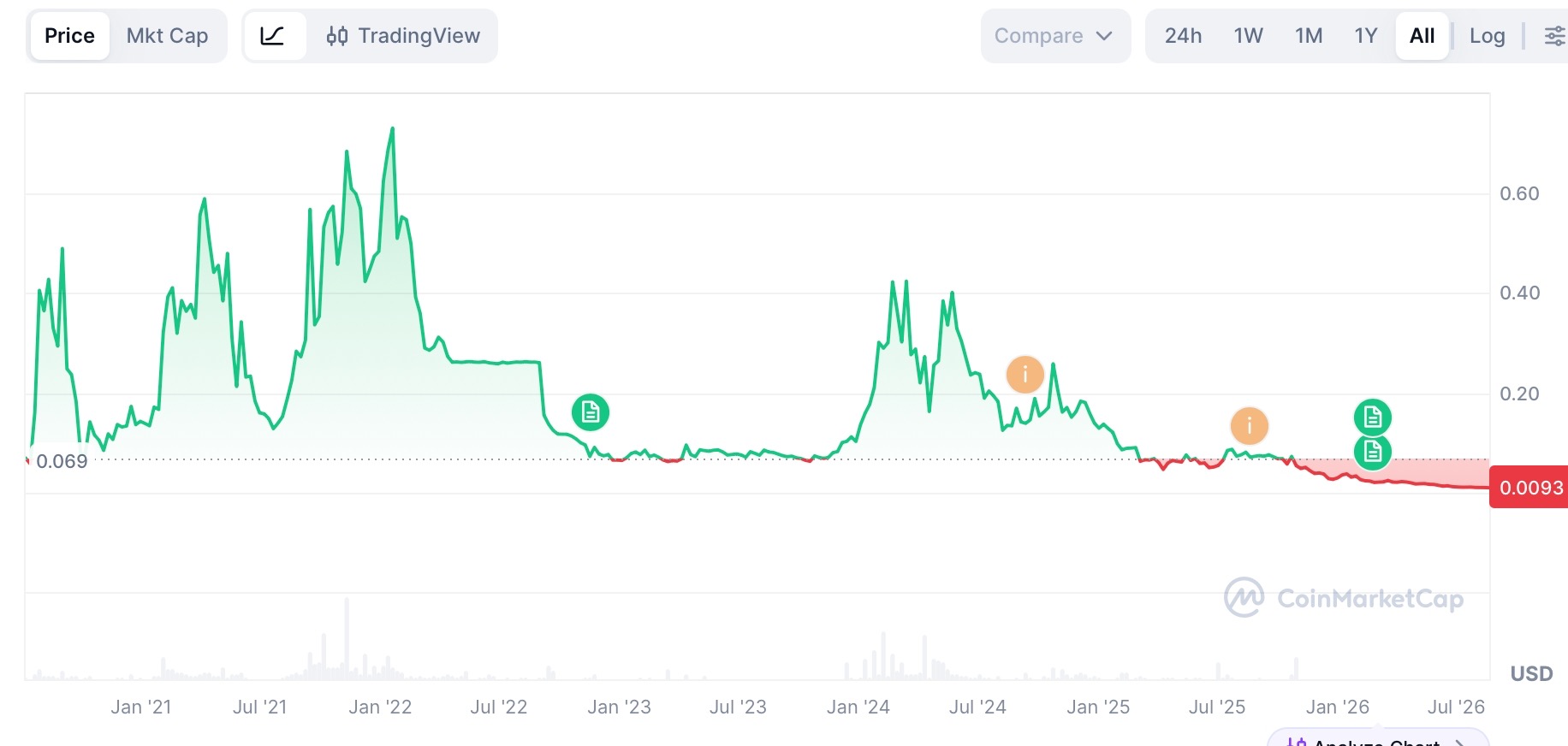
ALEPH reached approximately $0.8758 in January 2022, close to the end of a period when investors placed high valuations on DeFi infrastructure, decentralized storage and Web3 cloud projects.
By August 19, 2026, ALEPH was trading around $0.00938. CoinGecko placed its market capitalization near $1.75 million and reported roughly $136,000 in 24-hour trading volume. The token was approximately 98.9% below its record high.
The decline did not follow one publicly identified project failure. It developed over several years as speculative demand weakened and the market began asking whether decentralized infrastructure networks could support themselves without issuing tokens to subsidize supply.
Aleph Cloud has continued to release software, but product development alone does not create token demand. If customer spending remains small while nodes, stakers and other participants continue receiving ALEPH, selling pressure can exceed organic demand.
Aleph Cloud Is Still Building
ALEPH’s price history can give the impression that the project has been abandoned. Its development activity suggests otherwise.
Aleph Cloud’s public GitHub organization showed updates to several repositories in August 2026. Recent work covered its virtual machine engine, Rust libraries, network testing infrastructure, node services and a dashboard designed to track ALEPH purchases generated by cloud payments.
The project has also added GPU support, confidential virtual machines and a unified credit system. Its network dashboard received updates throughout May, June and July, including better reporting for node earnings, workloads and on-chain revenue processing.
Active development does not guarantee commercial success. It does establish that ALEPH’s decline is not simply the result of an inactive codebase.
Why Aleph Cloud Changed Its Tokenomics
The project’s previous incentive structure shared a common DePIN weakness.
Node operators pay for servers, electricity, bandwidth and hardware in conventional currencies. When most of their compensation comes from a volatile token, a falling token price can make operating the infrastructure unprofitable.
Increasing token rewards can keep nodes online temporarily, but it also introduces more supply. If additional issuance reaches the market without corresponding customer demand, the token can decline further. Lower prices then force the network to issue even more tokens to provide the same dollar value of rewards.
Aleph Cloud acknowledged this problem in its 2026 tokenomics redesign. Aleph v2 is intended to move the network away from rewards funded mainly by incentive pools and toward payments generated by actual cloud use.
How the Aleph v2 Revenue Model Works
The new model combines temporary support for node operators with a longer-term revenue share.
The transitional reward floor starts at 900,000 ALEPH per 30-day period and declines over six months. It is designed to give operators time to adjust while customer-funded revenue becomes a larger part of their income.
Customers purchase credits and spend them on computing and storage. Under the published model, 95% of eligible credit payments flow to operators and stakers, while 5% supports protocol development. Stakers receive 20% of protocol revenue.
Aleph Cloud estimates a baseline staking yield of approximately 4.6% under its model assumptions. That figure is not a guaranteed return. It depends on network utilization, revenue, token prices and the number of participating nodes and stakers.
Workload allocation also includes quality requirements. Compute Resource Nodes must meet a performance score threshold and support public IPv6. Operators providing GPU or confidential computing capacity may qualify for higher rewards because their equipment is more expensive.
The Credit System Could Create ALEPH Demand

The credit system is important because customers do not need to hold ALEPH before using Aleph Cloud.
Users can obtain credits through supported payment assets and spend them as workloads consume computing, memory and storage resources. Stablecoin payments can be processed through a mechanism that purchases ALEPH and distributes it across the network.
This creates a possible source of market demand. A business can pay for cloud services using a predictable asset, while the protocol handles the conversion into ALEPH.
Aleph Cloud has introduced public dashboards showing processed revenue, credit purchases, ALEPH distributed to the network and ALEPH acquired from stablecoin payments. The network changelog shows that these reporting tools entered production during June and July 2026.
The mechanism is more relevant than another partnership announcement because it attempts to connect customer spending directly with the token.
Its scale remains uncertain. The public pages reviewed for this article did not provide enough accessible information to determine whether revenue-generated purchases are large enough to offset emissions, staking rewards and selling by existing holders.
Revenue Must Replace Subsidies
Aleph v2 should not be judged by the size of its temporary reward floor.
The important measure is the share of node income funded by customers. As the six-month subsidy declines, the network will reveal whether demand for virtual machines, storage, GPU capacity and confidential computing is sufficient to keep high-quality operators online.
A healthy transition would show rising credit spending, stable node participation and a growing percentage of rewards funded by real workloads. Weak customer demand could leave operators earning less just as the subsidy disappears.
Aleph Cloud’s model uses assumptions including 350 Compute Resource Nodes operating at 70% utilization. Those figures describe a target scenario rather than verified current demand. Investors should distinguish economic simulations from observed network performance.
Can Aleph v2 Revive ALEPH?
Aleph v2 addresses a genuine problem. Decentralized infrastructure cannot rely indefinitely on issuing tokens to pay providers. Eventually, customer revenue must cover the cost of operating the network.
Aleph Cloud is trying to make that transition visible. Its credit system, revenue-sharing model and public payment dashboard are more meaningful than a simple change in branding or token incentives.
The evidence is not complete. ALEPH still trades close to historical lows, liquidity is thin and publicly accessible revenue data has not yet demonstrated that cloud demand can replace subsidies.
The next important signal will not be a short-lived ALEPH rally. It will be evidence that customers are consistently paying for compute, storage and GPU workloads, and that those payments are becoming a meaningful source of income for operators and stakers.
Readers can follow crypto market research and educational coverage through Tapbit. Existing users can log in, while new users can create an account.
Frequently Asked Questions
What is ALEPH crypto?
ALEPH is the utility token of Aleph Cloud, a decentralized cloud computing and storage network. It is used for service payments, staking, node rewards and participation in the ecosystem.
Is Aleph Cloud still active?
Yes. Aleph Cloud continues to maintain its software and network products. Its public GitHub repositories and network dashboard received updates during August 2026.
Why did ALEPH fall almost 99% from its all-time high?
The decline followed the broader reversal in speculative Web3 valuations after 2021 and 2022. Limited token demand, increasing supply, low liquidity and uncertainty about actual cloud revenue also contributed to the long-term repricing.


