
STONK’s rapid rise has turned StonkFun from a niche Solana launchpad into one of the market’s most watched speculative stories. The token traded near $0.13 in the supplied seven-day chart after spending much of the week around $0.02–$0.03, with several spikes toward $0.18–$0.19. That is enough to justify the “400% rally” label, but it does not by itself make STONK a good investment.
The short answer is that STONK may still have upside if StonkFun converts attention into lasting trading activity and token buybacks. It also carries the classic risks of a young launchpad token: extreme volatility, fragile liquidity, uncertain token economics and a valuation that can outrun actual platform use.
Readers who want to follow the broader crypto market can create a Tapbit account and compare major assets before considering smaller, higher-risk tokens. STONK availability should always be checked directly on the platform; this article does not claim a Tapbit listing.
What Is STONK and StoneFun?
STONK is the native meme utility token associated with StonkFun, a Solana-based launchpad that lets users create and trade tokens paired with on-chain versions of stocks and exchange-traded funds. In practice, the concept combines meme-coin speculation with tokenized-asset liquidity.
The token’s appeal is not based only on branding. StonkFun says trading fees can support token buybacks and burns, creating a link between platform activity and STONK demand. That mechanism is potentially useful, but investors should focus on transparent, repeatable revenue rather than promotional claims. A buyback model only matters when fees are real, sustained and large enough to affect circulating supply.
Why Did STONK Rally More Than 400%?
The move appears to have been driven by several catalysts arriving at once. StonkFun attracted a burst of token creation and trading activity, liquidity flowed through Solana venues including Raydium, Orca and Meteora, and new centralized-exchange listings expanded access. Reports of fee-funded buybacks and token burns added a reflexive narrative: more volume could mean more revenue, more buybacks and stronger demand for STONK.
Momentum then became its own catalyst. CoinGecko data on September 7, 2026 showed a seven-day gain well above 400%, a market value above $100 million and unusually high 24-hour turnover. Those figures can change rapidly, so they should be treated as a timestamp rather than a stable valuation anchor.
STONK Price Snapshot
The supplied chart captures the key tension. STONK climbed almost vertically, but the path included repeated reversals from the $0.15–$0.19 area. That pattern signals strong demand and equally strong profit-taking. A token can remain in an uptrend while still falling 30%–50% during a normal correction.
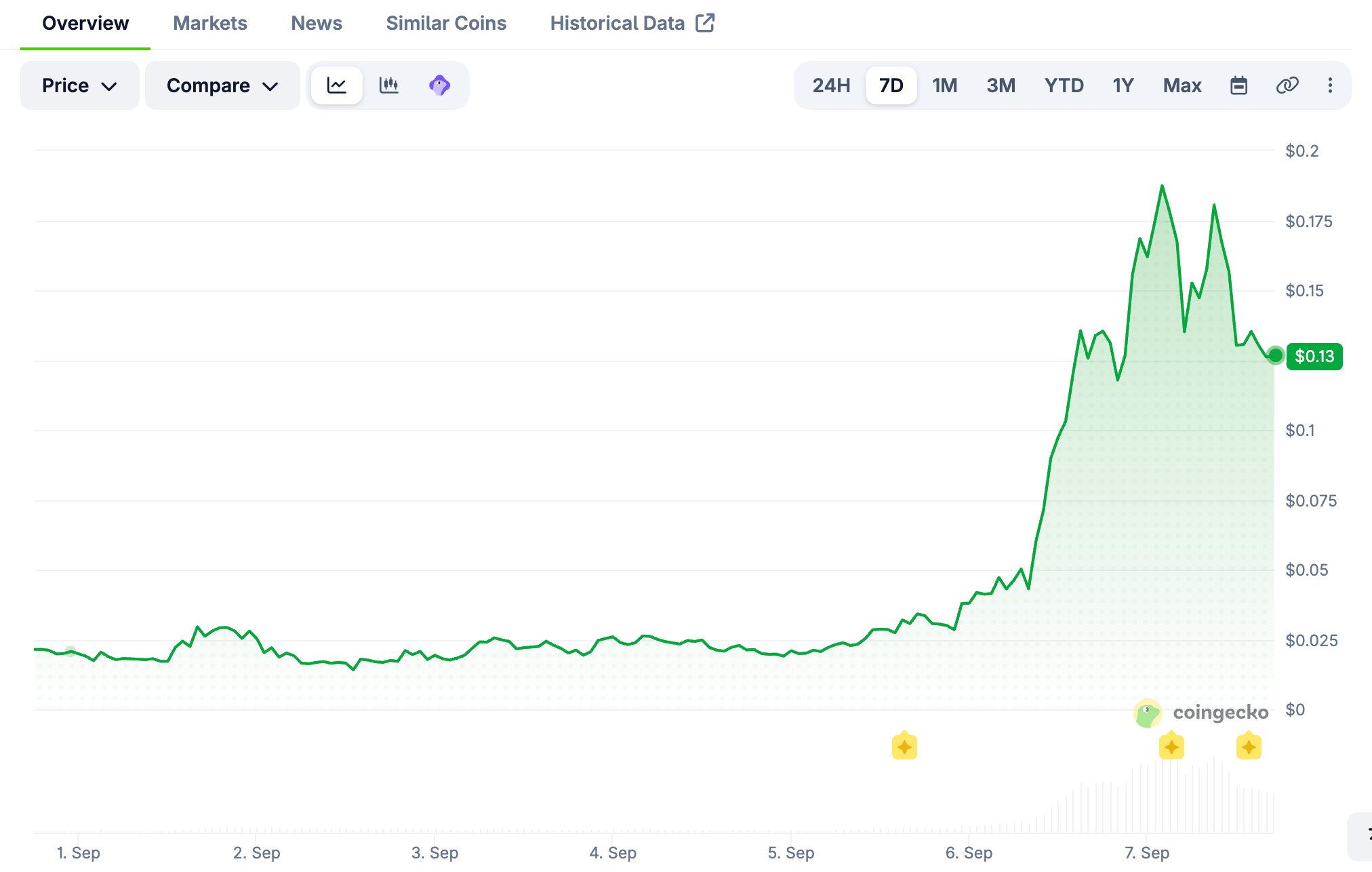
STONK seven-day price chart supplied by the user. Prices are a historical snapshot and may have changed.
The Bull Case for STONK
The strongest argument for STONK is that it sits at the intersection of three active narratives: Solana launchpads, meme-token trading and tokenized stocks. If StonkFun becomes a durable venue rather than a short-lived trend, STONK could benefit from brand recognition, recurring fees and a more credible buyback cycle.
STONK also has better visibility and market access than many newly launched tokens. CoinGecko listed trading across multiple venues and reported roughly 880 million tokens in circulation against a stated maximum supply of 1 billion at the time of review. A relatively high circulating share reduces some future dilution risk, although investors still need to verify treasury holdings, vesting terms and burn records on-chain.
Why the Rally Could Reverse
The same conditions that produced the rally can amplify a decline. When price rises faster than adoption, early holders have a large incentive to realize gains. Thin liquidity outside the leading pools can cause slippage, while liquidity providers may withdraw capital during stress. New exchange listings often create an initial demand shock without guaranteeing sustained buying.
There is also platform risk. StonkFun’s model depends on continued interest in tokens paired with tokenized equities. Regulatory questions around tokenized stocks, third-party asset issuers and access restrictions could affect activity. Smart-contract flaws, oracle problems or a decline in Solana meme-coin demand would weaken the investment case even if the platform continues operating.
What Should Investors Check Before Buying?
| Signal | Why It Matters |
|---|---|
| Verified contract | STONK is a common ticker; confirm the Solana contract from the official project and a trusted explorer. |
| Real fee revenue | Consistent fees are more meaningful than one record day driven by speculative volume. |
| Buyback evidence | Track wallet transactions and burned supply rather than relying on announcements alone. |
| Liquidity depth | Compare executable liquidity and slippage, not just headline 24-hour volume. |
| Holder concentration | Large insider or whale balances can increase sudden sell-pressure risk. |
A cautious buyer may wait for price discovery after the first listing wave, use a small position and avoid leverage. Chasing a vertical chart creates an unfavorable setup: the upside target becomes uncertain while the nearest downside reference can be far below the entry.
Is STONK a Good Investment?
STONK is better described as a high-risk venture-style crypto bet than a conventional long-term investment. It may suit traders who understand Solana DEX execution, can tolerate deep drawdowns and have independently verified the project’s contract and revenue mechanics. It is a poor fit for anyone seeking stable returns, capital preservation or an asset with a long operating history.
The decision should rest on whether StonkFun can retain users after incentives and speculation cool. If weekly volumes, unique traders, fees and buybacks remain strong while price consolidates, the fundamentals would look healthier. If activity fades as soon as the rally pauses, STONK’s valuation could compress quickly.
Conclusion
STONK’s rally is backed by a real burst of platform activity, broader market access and an understandable buyback narrative. Those are meaningful catalysts, but the token has already priced in substantial optimism. The most responsible view is conditional: STONK has potential if StonkFun proves durable, yet buying immediately after a multi-hundred-percent move carries unusually poor timing and liquidity risk.
Before acting, verify the contract, review on-chain holder concentration, measure slippage and compare current market capitalization with sustainable platform revenue. The chart shows opportunity, but it also shows how quickly sentiment can dominate fundamentals.
FAQ
What blockchain is STONK on?
STONK is issued on Solana. Investors should verify the exact contract address through the project’s official channels and Solscan because multiple tokens may share similar names.
What is STONK used for?
STONK is presented as StonkFun’s meme utility token. Its value proposition includes platform branding and a fee-funded buyback-and-burn mechanism, though actual demand depends on continued platform usage.
Why did STONK price increase?
The rally coincided with rapid StonkFun trading growth, launchpad attention, exchange listings and reports of token buybacks and burns. Momentum trading likely magnified the move.
Can STONK keep rising?
It can rise if trading activity, liquidity and fee revenue remain strong, but the recent vertical move makes a sharp correction plausible. No price target is guaranteed.
Where can STONK be traded?
At the time of review, CoinGecko showed activity on Solana venues including Orca, Meteora and Raydium, alongside selected centralized exchanges. Availability, pairs and regional access can change.


