

Palantir Technologies returned to the center of the AI stock trade after reporting second-quarter results that comfortably exceeded Wall Street expectations. PLTR stock closed at $125.65 on August 3, 2026, before rising to $144.45 in after-hours trading, a gain of nearly 15%.
The rally was driven by more than an earnings beat. Palantir reported faster revenue growth, strong demand from both commercial and government customers, and another increase to its full-year outlook. The results strengthened the argument that its Artificial Intelligence Platform, better known as AIP, is translating AI interest into paid deployments.
That does not settle the debate around PLTR stock. Palantir is growing quickly, but its valuation still assumes that unusually strong growth and profitability can continue.
Palantir’s Q2 Earnings Beat Expectations
Palantir generated $1.935 billion in second-quarter revenue, up 93% from the same period a year earlier. Analysts surveyed by LSEG had expected approximately $1.8 billion.
Adjusted earnings reached $0.41 per share, compared with the market expectation of about $0.35. The company’s revenue growth also accelerated from the 85% reported in the first quarter.
According to Palantir’s Q2 2026 results, the quarter was supported by particularly strong performance in the United States:
U.S. commercial revenue reached $764 million, rising 149% year over year and 28% from the previous quarter. U.S. government revenue increased 90% year over year to $809 million.
Together, these two divisions generated $1.573 billion in revenue. This means the United States accounted for more than four-fifths of Palantir’s quarterly sales.
Commercial AI Demand Is Becoming More Important

Palantir built its early reputation by supplying data software to intelligence agencies, defense departments and other government customers. The latest results show that commercial customers are becoming a much larger part of the growth story.
U.S. commercial revenue has been expanding as companies adopt Palantir AIP to connect AI models with internal data, permissions and operational processes. Rather than selling a general-purpose chatbot, Palantir focuses on applying AI to specific decisions and workflows inside an organization.
A manufacturer might use the platform to identify production delays. An insurer could apply it to claims processing and risk analysis. A logistics company could connect demand forecasts with inventory and transportation data.
These deployments matter because enterprises usually require stricter controls over data access, model behavior and security than individual AI users. Palantir describes this demand as “AI sovereignty”: customers want to use advanced models without giving up control of their proprietary information.
The 149% increase in U.S. commercial revenue suggests that this pitch is finding buyers. Still, the percentage should be kept in context. It is partly influenced by Palantir’s smaller commercial revenue base in earlier periods and should not be treated as a sustainable long-term growth rate.
Government Revenue Remains a Major Driver
Palantir’s government business also had a strong quarter. U.S. government revenue grew 90%, supported by demand for data analysis, defense software and AI-enabled decision systems.
The company’s technology is used in areas ranging from intelligence analysis to battlefield coordination. Greater use of AI in defense and public-sector operations has created additional demand for platforms that can combine information from multiple systems while maintaining access controls.
Government work can provide long-term customer relationships, but contract headlines require careful reading. A contract ceiling represents the maximum potential value, not guaranteed revenue. Funding may be released through individual orders, and some contract periods or options can be modified or terminated.
Palantir discusses these uncertainties in its SEC filings. We should distinguish between an announced contract value, the amount actually obligated and the revenue recognized in a particular quarter.
Palantir Raised Its 2026 Outlook
Management raised its full-year revenue forecast to approximately $8.15 billion to $8.16 billion. That would represent growth of about 82% from 2025 and is well above the company’s previous forecast of roughly $7.65 billion to $7.66 billion.
Palantir also expects U.S. commercial revenue to exceed $3.424 billion in 2026, representing growth of at least 134%. Its previous forecast called for more than $3.224 billion.
For the third quarter, management expects revenue between $2.160 billion and $2.164 billion. The company’s willingness to raise both near-term and full-year guidance helped reinforce the positive market reaction.
A single strong quarter can be influenced by contract timing. An upward revision covering the rest of the year indicates that management expects the current momentum to extend beyond the latest reporting period, although it remains a forecast rather than a guaranteed result.
Why Did PLTR Stock React So Strongly?
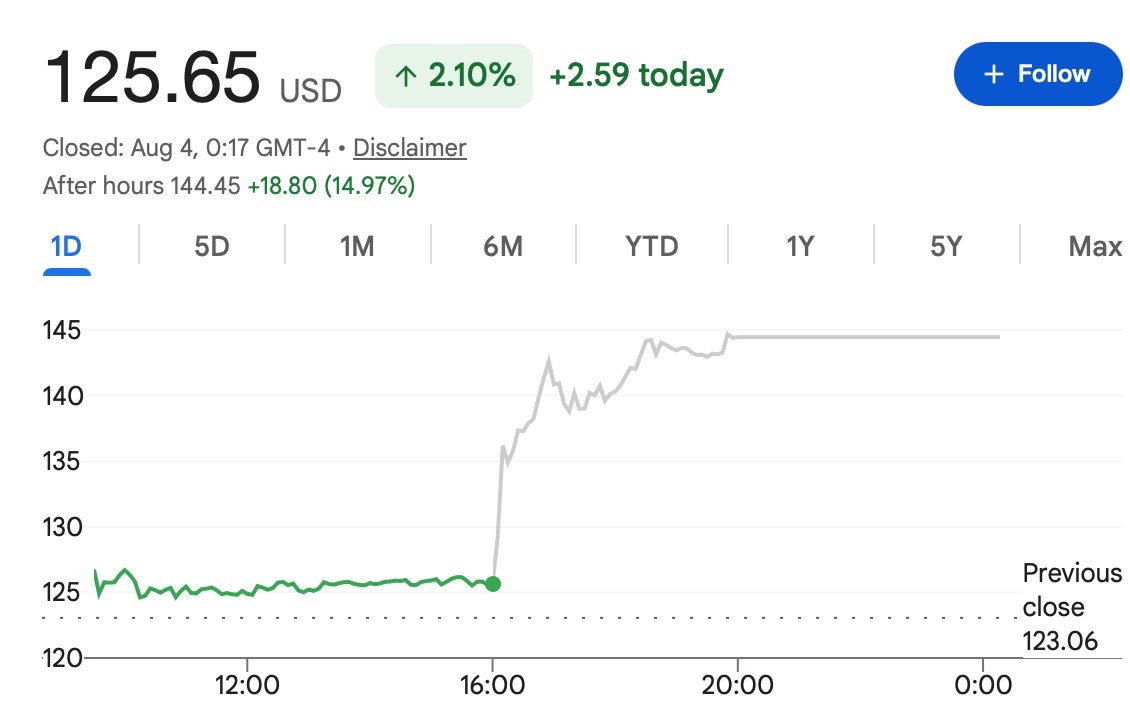
PLTR stock had already gained 2.1% during regular trading on August 3. Following the earnings release, it climbed another 14.97% to $144.45 in after-hours trading.
Several factors contributed to the move. Revenue and adjusted earnings exceeded expectations, commercial growth accelerated, government revenue remained strong, and management raised its annual outlook by a meaningful amount.
The scale of the reaction may also reflect positioning before the report. PLTR had fallen well below its 52-week high of $207.52 as investors questioned whether its premium valuation could survive a broader cooling of enthusiasm around AI stocks. Stronger-than-expected results encouraged some traders to reconsider that view.
After-hours trading is less liquid than the regular session, so the quoted gain should not be treated as a confirmed closing move. The market’s fuller response will become clearer during the August 4 regular trading session.
The Valuation Question Has Not Disappeared
Palantir’s results were strong, but its share price continues to reflect considerable expectations.
Before the after-hours rally, the company had a market value of approximately $301 billion. Its forward price-to-earnings ratio was around 72, based on the estimates displayed by StockAnalysis. The valuation becomes higher if the after-hours price is sustained.
A premium valuation is not automatically unjustified. Palantir is reporting rapid revenue growth, high profitability and strong demand across two major customer groups. The difficulty is that its share price leaves less room for ordinary setbacks.
Future results may still be considered disappointing if revenue merely meets guidance, commercial growth slows or management stops raising its forecast. For PLTR stock, beating expectations can matter almost as much as growing the underlying business.
Other Risks Facing PLTR Stock
Government spending remains one source of uncertainty. Budget negotiations, procurement reviews and policy changes can affect the timing of contracts and revenue recognition.
Commercial execution is another concern. AIP demonstrations and pilot programs must turn into larger, recurring deployments if Palantir is to maintain its current growth rate. Enterprises also have other options, including cloud platforms, specialized AI software and internally developed systems.
Investors should also distinguish between GAAP and adjusted financial results. Palantir uses adjusted measures that exclude items such as stock-based compensation and related payroll taxes. These figures can help show operating trends, but they should be considered alongside GAAP income, cash flow and changes in the share count.
Finally, PLTR remains a volatile stock. Its 52-week trading range stretches from $106.37 to $207.52. Even strong companies can experience sharp corrections when their valuations depend on ambitious future growth assumptions.
Conclusion
PLTR stock is rising because Palantir delivered the combination the market wanted: accelerating revenue, strong commercial AI demand, continued government growth and a substantial increase to its 2026 outlook.
The report gives the bullish case more support. Palantir is showing that its AI products can generate real enterprise revenue rather than relying entirely on an appealing technology narrative.
The risk lies in the price investors are being asked to pay for that growth. With PLTR still trading at a premium valuation, future earnings will need to remain strong enough to justify expectations that have risen along with the stock.
Traders can visit Tapbit to review available markets and current product information. Existing users can log in to Tapbit, while new users can create an account here. Availability, trading conditions and contract specifications should always be confirmed on the relevant product page.
Frequently Asked Questions
Why is PLTR stock rising?
PLTR stock rose after Palantir reported second-quarter revenue and adjusted earnings above Wall Street expectations. Investors also reacted positively to accelerating U.S. commercial growth, strong government demand and an increase to the company’s 2026 revenue guidance.
How much did PLTR stock rise after earnings?
Palantir closed at $125.65 on August 3, 2026, before rising to $144.45 in after-hours trading, an increase of nearly 15%. After-hours prices can change before the next regular trading session opens.
What were Palantir’s Q2 2026 earnings results?
Palantir reported revenue of $1.935 billion, up 93% year over year. Adjusted earnings reached $0.41 per share, compared with the market expectation of approximately $0.35 per share.


