
Leverage is one of the most searched and misunderstood ideas in crypto trading. It can make a small account feel more powerful, but it can also turn a normal price move into a major loss. In simple terms, leverage lets traders open a position larger than the capital they put down as margin.
For users learning how crypto markets work, the Tapbit registration page provides access to market tools, trading features, and a wide range of digital asset markets. Leverage should still be used carefully, because it can increase risk very quickly in volatile conditions.
What Is Leverage in Crypto Trading?
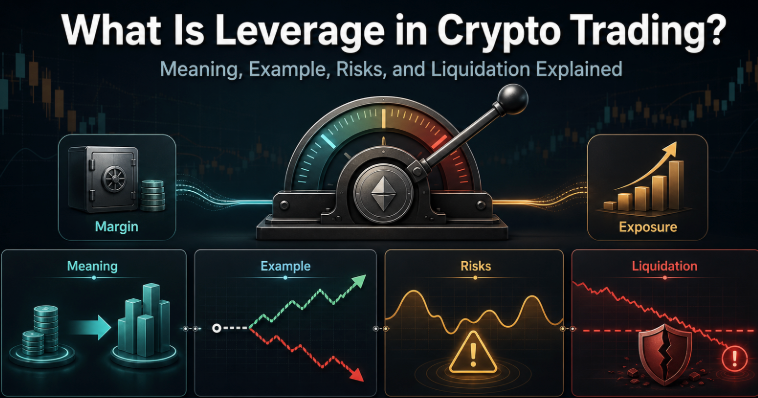
Leverage in crypto trading means borrowing exposure from a trading platform so that your position size is larger than your own margin. If a trader uses $100 with 10x leverage, the position behaves like a $1,000 trade. The trader does not own or deposit the full $1,000; instead, the $100 acts as collateral for the leveraged position.
This is why leverage is attractive to active traders. It can increase capital efficiency and allow users to trade larger market moves without committing the full notional value of the position. But the same mechanism also increases danger. If the market moves against the trader, losses are calculated on the larger position size, not just on the initial margin.
How Does Crypto Leverage Work?
Leverage is usually expressed as a multiple, such as 2x, 5x, 10x, 20x, or higher. The higher the multiple, the less margin is needed to open a position. However, higher leverage also means the position has less room to move before it becomes unsafe.
For example, a trader using 2x leverage has more breathing room than a trader using 20x leverage. With 20x leverage, even a relatively small market move can significantly affect the account’s margin balance. In crypto, where price swings can happen quickly, that difference matters.
| Leverage | Position Size From $100 Margin | Approximate Effect of a 1% Price Move |
|---|---|---|
| 2x | $200 | About 2% on margin |
| 5x | $500 | About 5% on margin |
| 10x | $1,000 | About 10% on margin |
| 20x | $2,000 | About 20% on margin |
Crypto Leverage Trading Example
Suppose a trader deposits $100 of margin and opens a $1,000 Bitcoin position using 10x leverage. If Bitcoin rises by 3%, the position gains about $30 before fees. Because the trader only posted $100 of margin, that $30 gain represents a much larger percentage return on the margin.
But the opposite is also true. If Bitcoin falls by 3%, the position loses about $30 before fees. A move that looks small on the chart can become a large loss relative to the trader’s collateral. This is the central trade-off of leverage: it increases exposure, not certainty.
What Is Margin in Crypto Leverage Trading?
Margin is the collateral used to open and maintain a leveraged position. Initial margin is the amount needed to open the trade. Maintenance margin is the minimum equity required to keep the position open. If account equity falls too close to the maintenance requirement, the platform may liquidate the position to prevent further losses.
Traders often misunderstand margin because they think only in terms of entry price and direction. In leveraged trading, the distance between entry price, liquidation price, and stop-loss level is just as important as the directional view.
What Is Liquidation in Crypto Trading?
Liquidation happens when a leveraged position no longer has enough margin to meet the platform’s risk requirements. When this occurs, the exchange may automatically close the position. The purpose is to limit losses and protect the trading system from negative account balances.
Liquidation is one of the biggest risks of leverage. A trader can be right about the long-term direction of Bitcoin, Ethereum, or another asset, but still lose the position if short-term volatility hits the liquidation level first.
Why Higher Leverage Increases Crypto Risk
Higher leverage reduces the margin buffer. At low leverage, the market can move against the position by a wider percentage before liquidation becomes a concern. At high leverage, the same asset may only need a small move to trigger forced closure.
This is especially important in crypto because price gaps, liquidity sweeps, and rapid wicks are common. A trader using high leverage may be liquidated during a short volatility spike even if the market later returns to the original direction.
| Risk Factor | How It Affects Leveraged Traders |
|---|---|
| Volatility | Fast price swings can hit liquidation or stop-loss levels quickly |
| Funding fees | Holding leveraged positions can create ongoing costs |
| Low liquidity | Thin order books can cause slippage during exits |
| Emotional trading | Bigger position sizes can lead to rushed decisions |
| Overconfidence | Winning trades may encourage traders to increase leverage too quickly |
Leverage vs Spot Trading: What Is the Difference?
Spot trading means buying or selling the asset directly without borrowed exposure. If a trader buys $100 worth of Bitcoin in the spot market, the position is $100. The value may rise or fall, but there is no liquidation price in the same way there is with leveraged futures.
Leverage trading is different because the trader controls a larger position than the margin amount. This can be useful for hedging, short-term strategies, or capital efficiency, but it is not the same as simply holding a coin. It requires more active risk management.
How to Manage Risk When Using Crypto Leverage
Good leverage trading starts with position sizing. Traders should decide how much they are willing to lose before entering the trade. A smaller position with moderate leverage is often easier to manage than a large position with extreme leverage.
Stop-loss orders can help limit downside, although they do not remove all risk. In fast markets, slippage may occur. Traders should also monitor funding rates, avoid adding margin emotionally, and understand that high leverage should not be used simply because it is available.
Is Leverage Good for Beginners?
Leverage is usually not ideal for complete beginners. New traders often underestimate how quickly liquidation can happen and overestimate their ability to react under pressure. Before using leverage, beginners should understand basic order types, chart volatility, risk-reward ratios, margin requirements, and how liquidation price is calculated.
A careful learning path may begin with spot trading, then paper trading or very small leveraged positions. The goal should be to learn market behavior, not to maximize position size too early.
Common Mistakes in Crypto Leverage Trading
One common mistake is using high leverage to chase quick profits after seeing a strong price move. Another is increasing position size after a loss in an attempt to recover quickly. Both behaviors can lead to emotional trading and larger losses.
Traders also make mistakes by ignoring fees and funding costs. A trade can look profitable on price movement alone but become less attractive once costs are included. This matters especially for positions held over multiple funding intervals.
Conclusion
Leverage in crypto trading allows traders to control larger positions with smaller margin, but it also magnifies losses and increases liquidation risk. Used carefully, leverage can be a tool for advanced strategies. Used carelessly, it can quickly erase trading capital.
The safest way to think about leverage is not as free buying power, but as amplified exposure. Traders should understand margin, liquidation, position sizing, stop-loss planning, fees, and volatility before using leverage in crypto markets.
FAQ
What does leverage mean in crypto trading?
Leverage means using margin to control a larger trading position than the capital deposited by the trader.
What does 10x leverage mean?
10x leverage means a trader controls a position ten times larger than the margin used. For example, $100 margin can control a $1,000 position.
Can leverage increase profits?
Yes. Leverage can increase profits if the market moves in the trader’s favor, but it also increases losses if the market moves against the position.
What is liquidation in crypto?
Liquidation is the automatic closing of a leveraged position when the trader’s margin is no longer enough to support the trade.
Is leverage safe for beginners?
Leverage is risky for beginners because crypto markets are volatile and liquidation can happen quickly. Beginners should learn margin and risk management first.


