
What Is Interlink Network and What Is It Used For?
Web3 has a bot problem. Governance votes get skewed by fake wallets, airdrop campaigns are drained by automated scripts, and Sybil attacks — where a single actor controls thousands of synthetic identities — quietly erode the fairness that decentralized systems are supposed to guarantee. Interlink Network was built as a direct structural response to this vulnerability.
Interlink Network is a Layer-1 blockchain that places verified human identity at the center of every network interaction. Through its Proof of Personhood (PoP) mechanism, the protocol ensures that each node corresponds to exactly one real, living person — not a bot, not a smart contract, not a duplicate account.
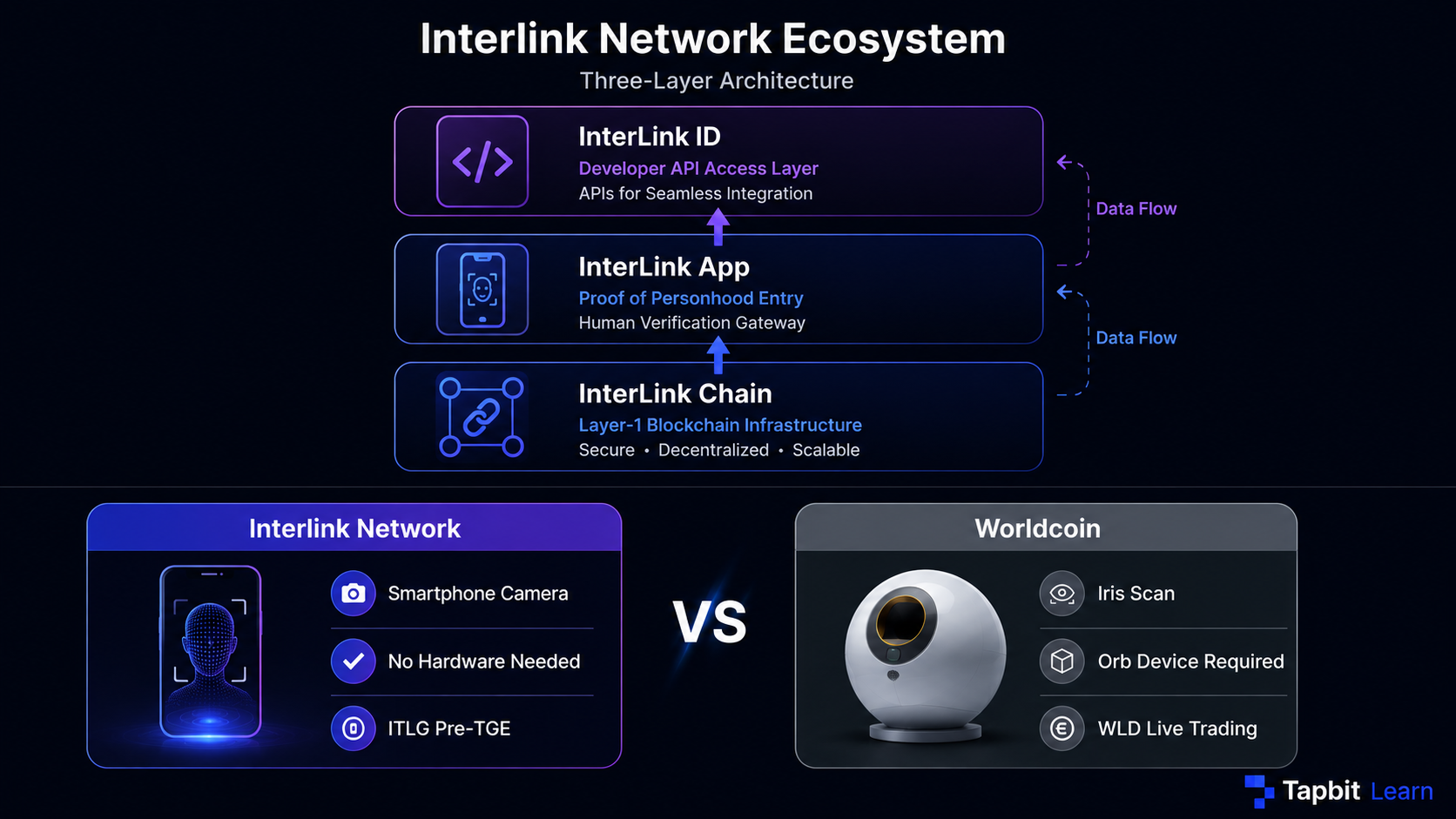
What is the InterLink Network used for in practice? The applications span several distinct layers. Developers can integrate InterLink ID into their dApps to block Sybil attacks at the application level without building identity infrastructure from scratch. Communities benefit from a genuine one-person-one-vote governance model that cannot be overridden by large token holders. End users gain access to an on-chain mini-program ecosystem covering social networking, gaming, AI agents, and decentralized finance — all gated behind verified human participation. At the institutional level, Interlink supports cross-chain settlement through its ITL token, positioning it as shared infrastructure for both consumer and enterprise Web3 use cases.
According to a16z Crypto's official announcement, the firm led a $90M Series B in Q4 2024 and secured a board seat alongside the investment — with Pantera Capital and Google for Startups participating in the same round. Before exploring the mechanics further, you can check crypto prices on Tapbit to see how the broader market is moving.
How Interlink Network Works — Proof of Personhood Step by Step
Most blockchain consensus mechanisms reward resources. Proof of Work (PoW) favors computing power; Proof of Stake (PoS) favors capital. Interlink Network takes a fundamentally different approach: with Proof of Personhood, the only valid credential for joining the network is a verifiable human identity.
Picture a developer in Singapore building a DAO voting tool. Instead of writing custom anti-Sybil logic from scratch, they call the InterLink ID API and the identity problem is handled at the infrastructure level — every voter in their system is already guaranteed to be a unique human. That is the core use case the network is designed to enable. The participation process itself runs in three steps.
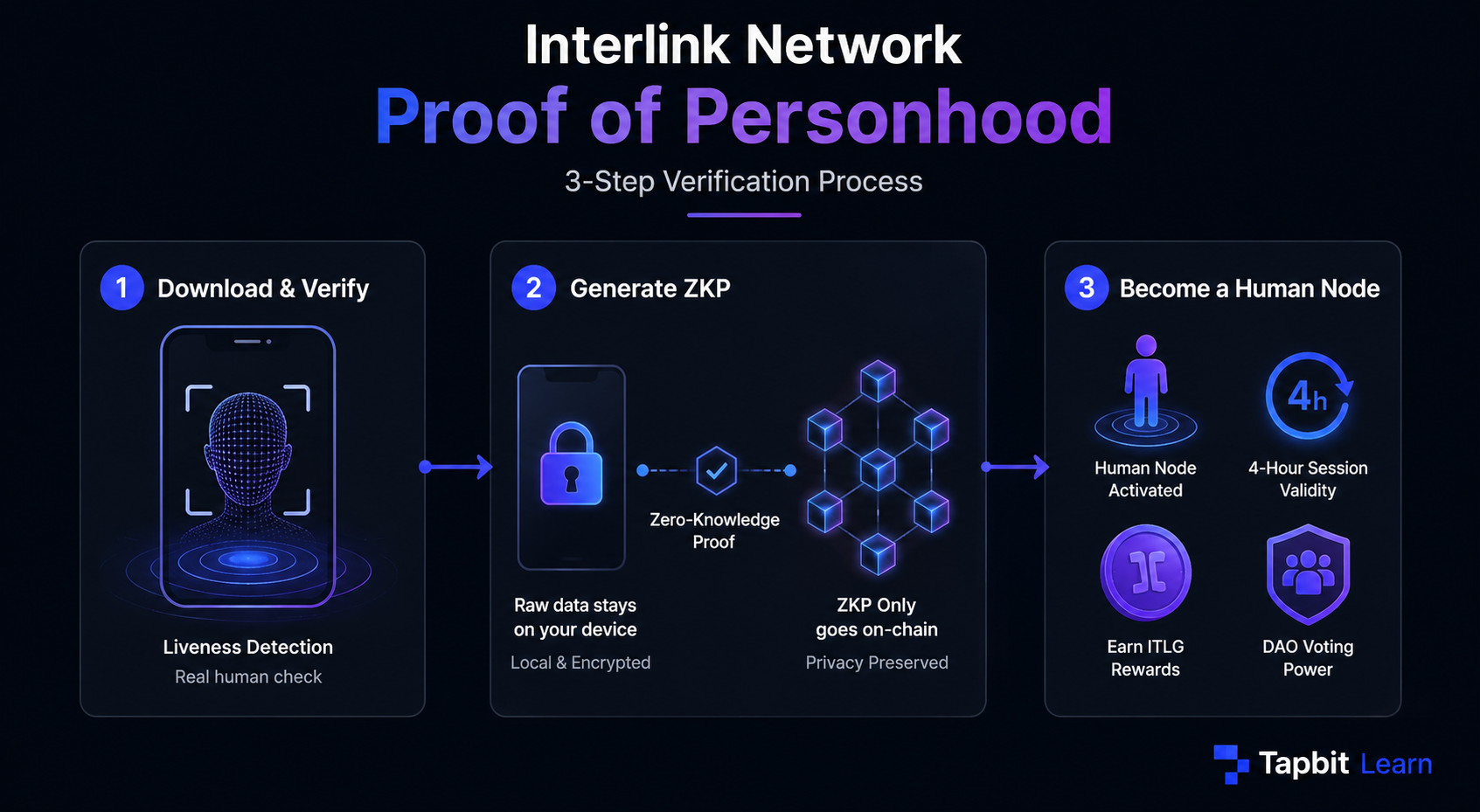
Step 1 — Download and verify. Users install the Interlink app and complete a face scan with liveness detection. The system actively checks for spoofing attempts — static photos, masks, and pre-recorded video are all screened out — to confirm that a real person is present at the time of verification.
Step 2 — Generate a privacy-preserving proof. Rather than transmitting raw biometric data to any external server, the app generates an encrypted identity hash entirely on the user's device. Only a zero-knowledge proof (ZKP) — a cryptographic method that confirms "this is a unique human" without exposing the underlying data — is submitted on-chain. Biometric information never leaves the user's phone.
Step 3 — Become a Human Node and earn ITLG. Once verified, the user is registered as a Human Node. Mining rewards are triggered every 4 hours, distributing ITLG tokens to all active nodes. Human Nodes simultaneously receive DAO governance voting rights, giving them direct input on protocol upgrades and treasury decisions.
The practical outcome is a network where one person equals one node — duplicate accounts and automated bots are excluded by design rather than detected after the fact.
Interlink Network belongs to the same Proof of Personhood category as Worldcoin. The key difference lies in how verification happens: Worldcoin uses iris scanning, which requires a proprietary hardware device called the Orb and limits participation to areas where that hardware is deployed. Interlink uses standard smartphone cameras, making participation possible from anywhere with a compatible device. Both projects state they do not store raw biometric data on external servers, though the scope of published independent security audits differs between the two.
ITLG Token — Uses, Tokenomics, and Can You Sell It?
Interlink Network runs a dual-token structure, with each token serving a distinct function.
|
ITLG (Interlink Genesis Token) |
ITL (Interlink Token) |
|
|
Role |
Governance + mining rewards + ecosystem payments |
Institutional settlement + liquidity provision |
|
Total Supply |
10 billion (fixed) |
Separate issuance |
|
Primary Audience |
Human Node miners (80% allocation) |
Institutions and secondary markets |
|
Exchange Listing |
TGE date set by DAO vote |
Q1 2026 (planned, subject to change) |
Three mechanisms work together to reduce ITLG's circulating supply over time. On-chain activity within the ecosystem triggers token burns. The protocol plans up to 100 halving events that progressively compress new issuance. And ITLG that goes unclaimed by inactive nodes — still within its vesting period — is returned to the main node reward pool, with a portion permanently removed from supply rather than redistributed.
Can we sell InterLink Network coins right now? Not through conventional exchange trading. What users accumulate during the current phase are points, which convert into real ITLG tokens at the Token Generation Event (TGE). The TGE date is subject to DAO community vote and has not been confirmed at the time of writing. After TGE, according to Interlink Network's official documentation, ITLG releases on a linear vesting schedule with the maximum vesting period set at 180 months — a deliberate design choice intended to reduce short-term selling pressure and structurally favor participants with longer time horizons. ITL, the institutional token, is expected to reach major exchange listings earlier, with Q1 2026 cited as the current target, though this timeline may also shift with DAO decisions. For context on how extended vesting timelines can shape a token's long-term price outlook, reviewing comparable token distribution models offers useful reference points.
Who Funds Interlink Network — and Is the Coin Safe?
The funding picture
Interlink Network's $90M Series B represents one of the larger financing rounds in the Proof of Personhood sector. According to a16z Crypto's official announcement, the firm secured a board seat alongside its investment — a distinction that signals active strategic involvement rather than passive capital allocation. Pantera Capital joined as a co-investor, bringing its long-standing crypto market expertise to the cap table. Google for Startups participated through its accelerator program, contributing technical infrastructure support beyond financial backing. Monad is listed as an ecosystem partner.
The company is headquartered in Newport Beach, California, with additional offices in Canada, Singapore, and Vietnam. Interlink has publicly stated its intent to become one of the first crypto-native companies to list on a US stock exchange — a milestone that would represent a significant precedent for the broader industry if executed.
Evaluating the risks
Evaluating any new project benefits from the same verification-first mindset behind Tapbit's proof of reserves standard. For Interlink Network specifically, four risk factors deserve attention.
On biometric privacy: the ZKP design prevents raw data from reaching external servers, but widely published independent third-party security audits are not yet available. Regulatory requirements for biometric data also vary by jurisdiction — GDPR in the EU, BIPA in Illinois, and evolving frameworks across Singapore and Vietnam, where the team maintains offices, each impose distinct obligations that may affect app availability or data handling.
On token liquidity: post-TGE ITLG vesting extends up to 180 months, meaning tokens earned cannot freely circulate in the near term. Pre-TGE balances are points, not tradable assets.
On competition: Worldcoin has a larger existing user base and higher brand recognition in the same PoP market segment. Interlink's lower hardware barrier is a genuine differentiator, but the target user overlap is direct.
On execution: both the US stock listing and the TGE timeline are contingent on DAO community votes, introducing schedule variability that centralized projects do not carry.
Interlink Network has established a credible foundation through top-tier VC backing and a technically grounded approach to Proof of Personhood. Token liquidity constraints and the still-evolving regulatory environment around biometric identity remain the key variables worth monitoring before committing capital.
As the Interlink Network project matures toward its TGE and ITL exchange listings, it stands as one of the more substantiated attempts to solve Web3's identity problem at the infrastructure level. If you are ready to explore opportunities in the broader market while monitoring this project's development, start trading on Tapbit today.
FAQ
Q1: How does Interlink Network compare to Worldcoin?
Both projects use Proof of Personhood to build identity-verified blockchains, but their approaches differ in accessibility and current market status. Worldcoin requires users to visit a physical Orb device for iris scanning, limiting participation to areas with deployed hardware. Interlink uses standard smartphone cameras, removing the geographic barrier. On token availability, Worldcoin's WLD is already tradable on major exchanges; Interlink's ITLG is pre-TGE. Both claim not to store raw biometric data externally, though the extent of published independent auditing differs between the two projects.
Q2: What is a Human Node and what are the benefits of becoming one?
A Human Node is a verified Interlink Network participant who has completed the Proof of Personhood process. Once registered, the node receives ITLG mining rewards every 4 hours and gains DAO governance voting rights. Nodes build an on-chain credit score through consistent activity, which can influence future reward rates. If a node goes inactive, unearned ITLG within the vesting period is returned to the reward pool rather than held in reserve — so sustained participation is structurally incentivized.
Q3: What happens to accumulated ITLG if I stop using the Interlink app?
Interlink Network is designed around active participation. If a node becomes inactive, ITLG that has not yet vested may be redirected back to the main node reward pool, with a portion permanently burned. The app allows re-activation, but the on-chain credit score accumulated through consistent activity may affect the pace at which future rewards accrue. Exact inactivity thresholds and grace periods are defined in Interlink's official documentation, which is worth reviewing before any extended break from the app.
Q4: Does Interlink Network store my biometric data on its servers?
According to the project's design documentation, no raw biometric data is transmitted to or stored on external servers. The Interlink app processes face scan data locally on the device and generates an encrypted identity hash, then submits only a zero-knowledge proof to the blockchain. The network can confirm that a unique human completed verification without retaining a copy of the biometric itself. Users in jurisdictions with specific biometric data legislation — such as Illinois (BIPA) or the EU (GDPR) — should review Interlink's privacy policy for region-specific data handling details.
Q5: What is the ITLG vesting schedule and when can tokens be traded?
Post-TGE, ITLG distributes via a linear vesting schedule with a maximum vesting period of 180 months. Pre-TGE balances are points that convert to ITLG at the generation event and are not transferable in the current phase. The TGE date will be determined by DAO vote. ITL, the institutional-facing token, is expected to reach exchange listings in Q1 2026, providing earlier liquidity than ITLG — though both timelines remain subject to DAO decisions. For active market participants in the meantime, Tapbit's spot trading pairs cover a broad range of established assets.
Q6: Is Interlink Network available to users in the United States?
Interlink Network is headquartered in Newport Beach, California, and the team has publicly stated plans to pursue a listing on a US stock exchange. However, participation eligibility for US-based users depends on ongoing regulatory developments around both biometric data collection and crypto asset distribution. US users should verify current availability directly through official Interlink channels, as the regulatory environment for biometric identity protocols continues to evolve.
Data Sources
-
a16z Crypto — Series B investment announcement: https://a16zcrypto.com
-
Interlink Network official documentation: https://interlinknetwork.com
-
CoinGecko — token and market data reference: https://www.coingecko.com


