

What Is Nasdaq Crypto Index?
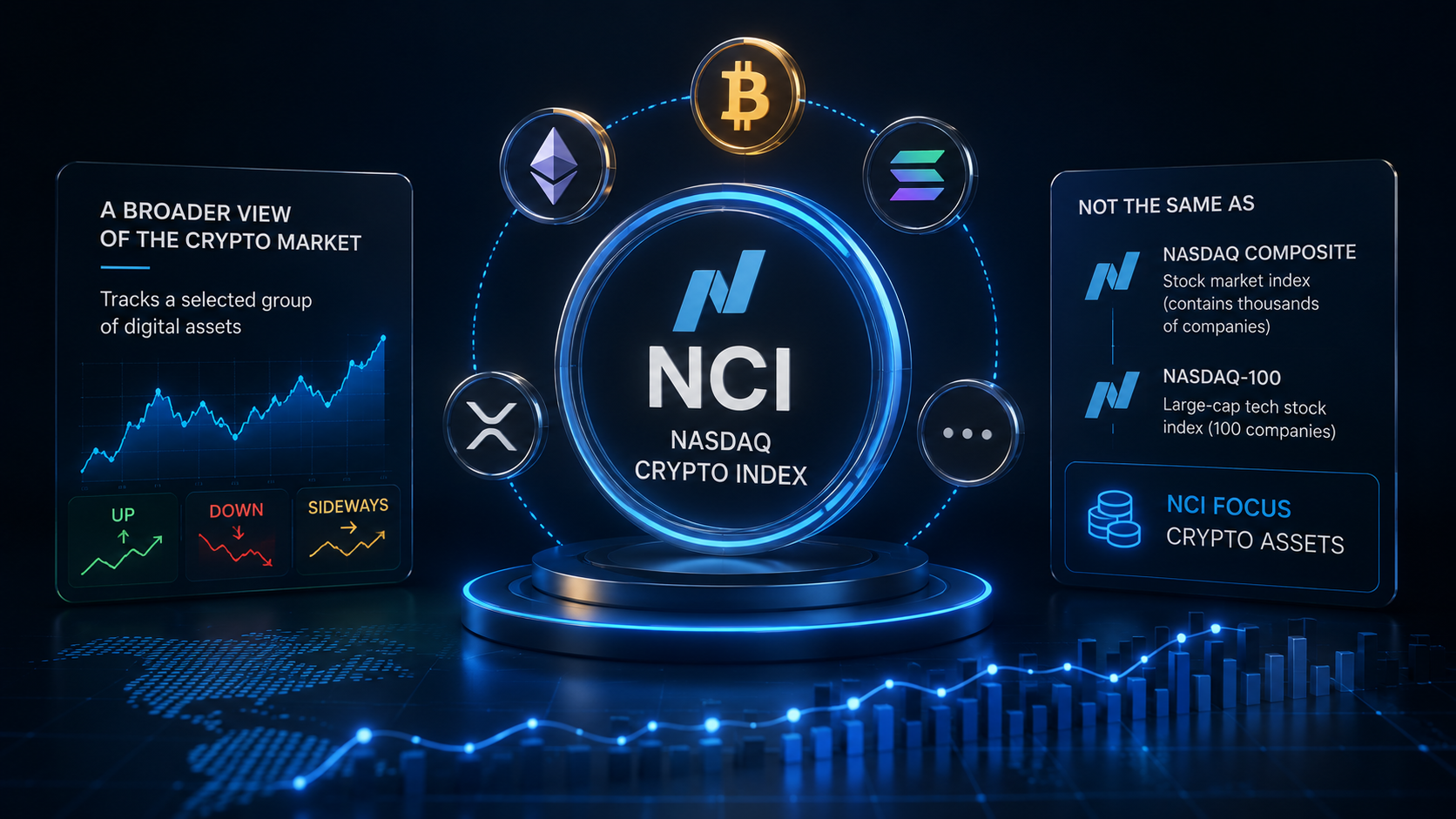
Nasdaq Crypto Index usually refers to the Nasdaq Crypto Index, often shortened as NCI. It is a benchmark that tracks a selected group of digital assets instead of one individual coin.
That makes it easier to answer a simple question: is the broader crypto market moving up, down, or sideways? Instead of checking Bitcoin, Ethereum, Solana, XRP and other assets one by one, investors can look at an index to understand the wider market trend.
The Nasdaq Crypto Index should not be confused with the Nasdaq Composite or Nasdaq-100. Those are stock market indexes. NCI is focused on crypto assets.
How the Nasdaq Crypto Index Works
The index uses a rules-based methodology. In plain English, that means it follows a defined process for choosing and weighting eligible crypto assets.
A crypto index typically considers factors such as liquidity, market size, pricing availability and asset eligibility. The exact methodology matters because it determines which assets get included, how much influence each asset has, and how often the basket is rebalanced.
For users, the key idea is simple: NCI is a market thermometer. It does not predict the future, but it helps show whether large digital assets are moving together or splitting into different trends.
Nasdaq Crypto Index vs Nasdaq Stocks vs Crypto ETFs
| Term | What It Tracks | Main Use |
|---|---|---|
| Nasdaq Crypto Index | A basket of crypto assets | Broad crypto benchmark |
| Nasdaq Composite | Stocks listed on Nasdaq | U.S. equity market gauge |
| Crypto ETF | Exchange-traded fund linked to crypto exposure | Brokerage-market access |
| Single crypto asset | One coin or token | Direct asset-specific exposure |
This distinction is important. If someone asks “is crypto in the Nasdaq,” the answer depends on what they mean. Crypto companies may list shares on Nasdaq, crypto ETFs may trade on exchanges, and the Nasdaq Crypto Index may track digital assets. These are related, but not identical.
Current Market Status of the Nasdaq Crypto Index
The official Nasdaq index page listed the Nasdaq Crypto Index at 3,022.15 as of the last close on July 7, 2026, with 8 constituents. That makes it a compact benchmark rather than a huge list of thousands of tokens.
A smaller basket can be easier to follow, but it may also be more sensitive to the largest assets inside the index. If Bitcoin or Ethereum moves sharply, the benchmark may react even if smaller tokens are quiet.
Users can view market data to compare the index idea with live crypto price action. To explore market tools, users can also create an account and compare major crypto pairs before making any decision.
How Investors Use the Nasdaq Crypto Index
Investors usually use the Nasdaq Crypto Index in four ways:
- to compare crypto performance with stock indexes,
- to track broad digital asset sentiment,
- to evaluate crypto index or ETF products,
- to avoid relying on one token as a market proxy.
For example, if Bitcoin is flat but the index rises, that may suggest strength in other large crypto assets. If Bitcoin rises while the index lags, the market may be more concentrated.
What to Check Before Using Any Crypto Index
Before relying on any crypto index, check the asset list, weighting method, rebalance schedule and pricing sources. A good index should be transparent enough for users to understand what they are actually tracking.
It is also useful to compare index data with platform transparency tools such as proof of reserves, especially when moving from research to actual trading platforms.
FAQ
What is the Nasdaq crypto index?
It is a benchmark that tracks a basket of selected crypto assets to show broad digital asset market performance.
Is the Nasdaq Crypto Index the same as Nasdaq stocks?
No. Nasdaq stock indexes track equities, while the Nasdaq Crypto Index tracks crypto assets.
Is crypto in the Nasdaq?
Crypto-related companies and ETFs may trade on Nasdaq, but the Nasdaq Crypto Index itself is a crypto benchmark.
Is there a crypto index?
Yes. Several crypto indexes exist, including benchmarks designed by major index providers.
Can I trade the Nasdaq Crypto Index directly?
Usually, users access index exposure through products that track an index, not by buying the index itself.


