

The AI trade is no longer only about chips. As artificial intelligence workloads expand, the market has started to focus on a less visible but equally important part of the infrastructure chain: electricity. Data centers need GPUs, servers and memory, but they also need reliable power. That demand has pushed investors toward companies involved in gas turbines, grid equipment, electrification and backup power.
Siemens Energy, traded in Germany under the ticker ENR, has been one of the biggest beneficiaries of this theme.
But the recent move in Siemens Energy share price shows an important lesson for traders: a strong story can still face valuation risk when the market has already priced in too much future growth.
Barclays recently downgraded Siemens Energy from Hold to Sell while still raising its price target from €110 to €130. The downgrade triggered a broad selloff across power-equipment names, with Siemens Energy, GE Vernova, Caterpillar and Cummins all under pressure. The market reaction reflected concern that the AI-driven power equipment trade may have become too crowded.
Why Siemens Energy Became an AI Infrastructure Trade

Siemens Energy is not an AI company in the traditional sense. It does not build GPUs or train large language models.
Its connection to AI comes from power. AI data centers require enormous amounts of electricity. As hyperscalers expand computing capacity, they need more grid connections, backup systems, gas turbines, transformers and power-generation equipment. This has turned companies like Siemens Energy into indirect beneficiaries of the AI infrastructure cycle.
That demand is visible in company results. Siemens Energy reported first-quarter orders of €17.61 billion, up more than 30% year over year, and a record order backlog of €146 billion. Net profit for the quarter nearly tripled to €746 million, while profit before special items rose to €1.16 billion. The company also reaffirmed its fiscal 2026 guidance.
Those are not weak numbers. They explain why the market has been willing to assign Siemens Energy a higher valuation.
Siemens Energy Share Price and the AI Power Demand Story
The demand side of the story remains strong.
According to the Financial Times, U.S. spending on coal and gas plants is projected to reach $50 billion in 2026, surpassing China for the first time in decades. The report linked the increase to data center electricity demand and noted that gas turbine orders reached about 20GW in the first quarter of 2026, while turbine prices have more than tripled because manufacturing capacity is limited.
AI does not only need faster chips. It needs energy systems that can support larger, denser and more power-hungry data centers. In some regions, grid connection delays are pushing hyperscalers to seek alternative power solutions.
The Wall Street Journal reported that some data center operators are turning to off-grid or near-site natural gas engines because grid access can be slow. Small engine makers such as Innio, Rolls-Royce and Caterpillar have benefited as customers look for faster power deployment options.
This broader context supports the long-term AI power infrastructure thesis. However, Siemens Energy share price is now showing that even a strong demand story can become vulnerable when valuation expectations move too far ahead.
Why Siemens Energy Share Price Still Fell
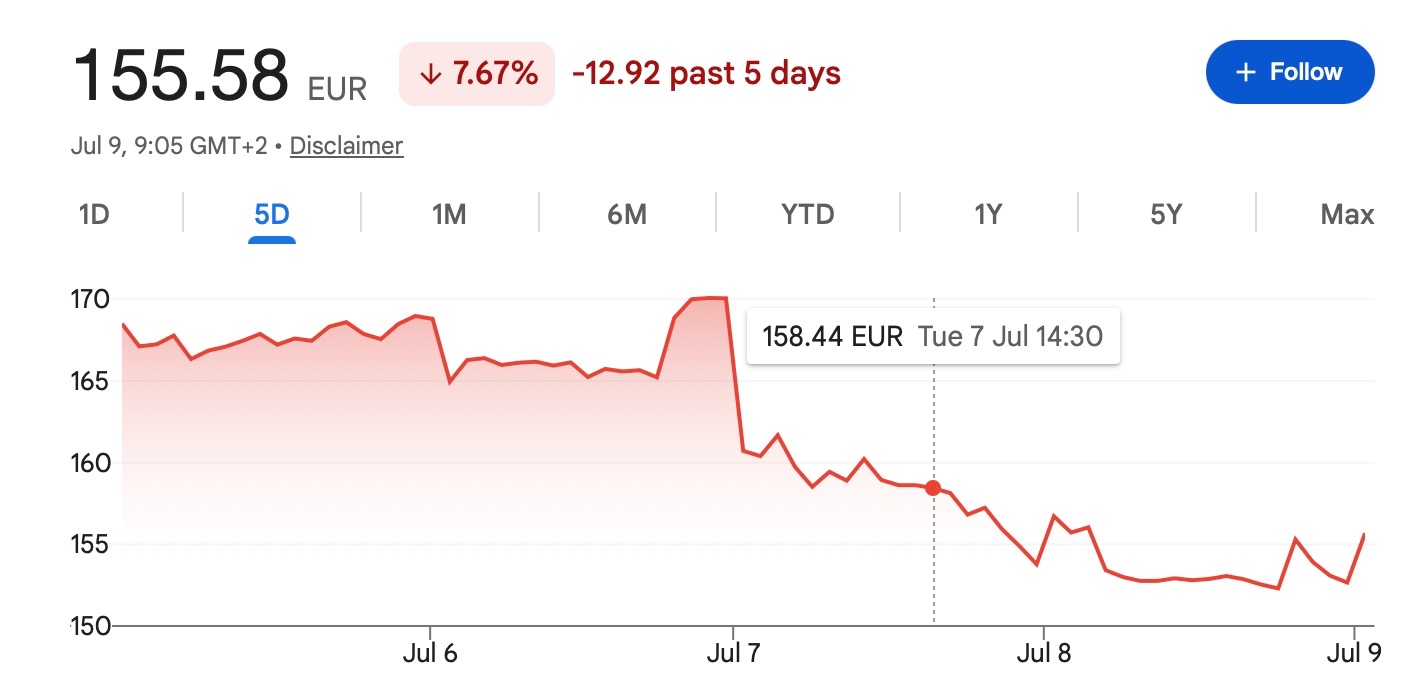
The reason Siemens Energy share price fell was not that AI power demand disappeared.
The concern was valuation. When a stock rises sharply on a powerful theme, investors begin asking whether future growth has already been priced in. Barclays’ downgrade suggested that the market may be treating the current order cycle as a permanent supercycle, even though orders, market share and free cash flow could eventually normalize.
This distinction is important.
A company can continue growing and still see its stock fall if the market expected even more. A sector can have real demand and still correct if investors believe valuations have moved too far ahead of fundamentals.
This is common in high-growth themes. It happened in AI chips, electric vehicles, cloud software and parts of crypto. Now it is appearing in AI power infrastructure.
The Risk of Calling Every Strong Cycle a Supercycle
The word “supercycle” can be dangerous for traders.
It suggests that demand will stay unusually strong for a long time. Sometimes that is true. But when everyone begins using the same word, prices may already reflect the best-case scenario.
In Siemens Energy’s case, the market has been pricing a combination of powerful trends: AI data centers, gas turbine scarcity, grid upgrades, electrification, energy security and power equipment bottlenecks.
Those are real themes. But they do not remove risk.
Orders can slow. Manufacturing capacity can expand. Customers can delay projects. Competitors can gain share. Free cash flow can peak. Margins can normalize. If any of these happen, a stock priced for a perfect cycle may re-rate lower.
That is the core message from the latest move in Siemens Energy share price.
Tapbit View
Siemens Energy share price is not falling because AI power demand has disappeared. It is falling because valuation matters.
AI infrastructure is becoming a much broader investment theme. It now includes chips, memory, data centers, power generation, gas turbines, grid equipment and backup energy systems. That makes the market more complex and creates more opportunities for traders to study cross-sector signals.
But traders should avoid a simple conclusion. Strong demand does not automatically mean a stock can keep rising. A good company can be fully priced. A real trend can become crowded. A supercycle story can turn into a valuation risk if investors stop believing that peak conditions will last.
For Tapbit users, the key lesson is to separate theme strength from price discipline.
The AI power trade may remain important, but the next stage will depend on order growth, margin durability, cash flow and whether data center energy demand continues to surprise the market.
Users can visit Tapbit to explore supported crypto services. Existing users can access their accounts through Tapbit Login, while new users can start through Tapbit Register.
Frequently Asked Questions (FAQ)
Why did Siemens Energy share price fall?
Siemens Energy share price fell after Barclays downgraded the stock from Hold to Sell, even though the bank raised its price target. The downgrade reflected concerns that the market may have already priced in too much of the AI-driven power equipment supercycle.
What is Siemens Energy’s stock ticker?
Siemens Energy trades in Germany under the ticker ENR.
Why is Siemens Energy linked to AI?
Siemens Energy is linked to AI because data centers require large amounts of electricity. AI infrastructure growth has increased demand for power-generation equipment, gas turbines, grid systems and backup energy solutions.


