

What Is the Fidelity Bitcoin ETF and What Is It Called?
Most investors who search "Fidelity Bitcoin ETF" already have a clear goal: they want Bitcoin exposure without dealing with crypto wallets, private keys, or exchange accounts. FBTC exists to serve exactly that need.
Fidelity's Bitcoin ETF is formally named the Fidelity Wise Origin Bitcoin Fund, trading under the ticker symbol FBTC. It launched on January 11, 2024, the same day the US Securities and Exchange Commission approved the first wave of spot Bitcoin ETFs in the United States. FBTC was among the eleven funds approved simultaneously, alongside BlackRock's iShares Bitcoin Trust (IBIT) and several others.
The name "Wise Origin" reflects Fidelity's internal philosophy about Bitcoin's origin as a fixed-supply, mathematically governed asset. The fund is listed on CBOE BZX Exchange and is available through any standard US brokerage account that supports ETF trading — including Fidelity's own platform, Schwab, TD Ameritrade, and most major brokers.
Fidelity is not new to digital assets. The firm has been researching Bitcoin and building blockchain infrastructure since 2014, making it one of the earliest traditional financial institutions to take crypto seriously. FBTC is the product of over a decade of internal development, not a reactive pivot. To track how Bitcoin's price is moving in real time as you evaluate FBTC, you can check bitcoin price data alongside the fund's share price.
As of May 2026, FBTC holds approximately 191,000 BTC with assets under management of roughly $13.5 billion, making it the second-largest spot Bitcoin ETF in the United States after BlackRock's IBIT.
Does FBTC Hold Real Bitcoin — and Is It Actual BTC?
This is the question that generates more confusion than any other about FBTC, and the answer has two parts that are both true simultaneously: yes, the fund holds real Bitcoin — and no, buying FBTC does not mean you own Bitcoin.
The fund holds real BTC. Every share of FBTC is backed by actual Bitcoin held in custody. The fund does not use futures contracts, derivatives, or synthetic instruments to track Bitcoin's price. When you buy FBTC shares, your investment is backed by physical BTC sitting in cold storage. According to Fidelity's official fund documentation, at least 98% of the fund's Bitcoin is held in cold wallets — offline storage that is not connected to the internet and therefore inaccessible to remote attackers.
But FBTC shares are not Bitcoin. What you purchase when you buy FBTC is an equity security — a share in a trust that holds Bitcoin on your behalf. The distinction matters in several practical ways. You cannot withdraw your FBTC investment as Bitcoin and transfer it to a personal wallet. You cannot use FBTC in any blockchain application, DeFi protocol, or on-chain transaction. Your assets are protected under securities law, not crypto law, and are custodied within the traditional financial system rather than on a blockchain.
The mechanism that keeps FBTC's price aligned with Bitcoin's spot price is called the creation and redemption process, managed by authorized participants (APs) — large financial institutions authorized to create or destroy FBTC shares. When FBTC trades above Bitcoin's net asset value, APs purchase Bitcoin and deliver it to Fidelity in exchange for new shares, increasing supply and pushing the price back down. When FBTC trades below NAV, APs buy shares off the market and redeem them for Bitcoin, reducing supply and supporting the price. This arbitrage loop keeps FBTC tracking Bitcoin's spot price with minimal deviation.
Fidelity Bitcoin ETF Fees, Holdings, and the Self-Custody Advantage
Fees
FBTC charges a 0.25% annual expense ratio — meaning for every $10,000 invested, $25 is deducted from fund assets each year. Fidelity does not bill this separately; instead, it reduces the fund's NAV incrementally each trading day. The practical effect is that FBTC's per-share value drifts very slightly below Bitcoin's spot price over time, with the gap widening at a rate of roughly 0.25% per year.
According to ETF Database, FBTC launched with a temporary fee waiver on the first $1 billion in fund assets, which expired in July 2024. Since January 2025, the full 0.25% applies to all assets in the fund.
|
ETF |
Ticker |
Issuer |
Annual Fee |
Custodian |
|
Fidelity Wise Origin Bitcoin Fund |
FBTC |
Fidelity |
0.25% |
Fidelity Digital Assets (self-custody) |
|
iShares Bitcoin Trust |
IBIT |
BlackRock |
0.25% |
Coinbase Custody |
|
ARK 21Shares Bitcoin ETF |
ARKB |
ARK/21Shares |
0.21% |
Coinbase Prime |
|
Bitwise Bitcoin ETF |
BITB |
Bitwise |
0.20% |
Coinbase Prime |
|
Grayscale Bitcoin Trust |
GBTC |
Grayscale |
1.50% |
Coinbase Custody |
The self-custody advantage
The most structurally distinctive feature of FBTC is one that rarely appears in headlines: Fidelity uses its own subsidiary, Fidelity Digital Assets, to hold the fund's Bitcoin rather than outsourcing custody to a third party. Every other major Bitcoin ETF — IBIT, ARKB, BITB, and GBTC — relies on Coinbase Custody or Coinbase Prime to store the underlying BTC.
This matters for a specific reason. When multiple ETFs share the same custodian, any operational disruption, regulatory action, or security incident at that custodian creates concentrated systemic risk across the entire ETF ecosystem simultaneously. FBTC's vertically integrated custody structure means its Bitcoin holdings are operationally independent of Coinbase's infrastructure. Fidelity Digital Assets is a regulated trust company with its own security infrastructure, not a shared service.
This is the same verification-first logic behind platforms that publish transparent proof of reserves — the principle that asset security should be independently verifiable, not assumed.
Is the Fidelity Bitcoin ETF Safe? Returns and Risks
What "safe" means for FBTC
FBTC operates under full SEC regulatory oversight as a registered investment product. Fidelity is one of the world's most established financial institutions, managing over $14 trillion in assets. The fund's Bitcoin holdings are segregated from Fidelity's corporate assets, meaning that if Fidelity faced financial difficulty, FBTC's Bitcoin holdings would be protected as trust assets rather than treated as company property. The self-custody structure through Fidelity Digital Assets, with 98%+ of holdings in cold storage, represents institutional-grade security practice.
Risks that remain regardless of structure
No ETF structure eliminates the underlying asset's risk. Bitcoin has experienced maximum drawdowns of 50–80% during historical bear markets. FBTC tracks Bitcoin's spot price almost exactly, which means those drawdowns translate directly into FBTC share price declines. There is no protective mechanism built into the ETF that cushions Bitcoin's volatility.
FBTC also does not carry FDIC deposit insurance or SIPC investor protection — these frameworks apply to bank deposits and traditional securities, not to funds holding cryptocurrency. Additionally, as a single-asset fund, FBTC offers no diversification; the entire position is Bitcoin, and performance is entirely dependent on Bitcoin's market price.
Performance context
FBTC's return in any given period will be approximately equal to Bitcoin's spot price return minus 0.25% annually. For a fund that can swing 5–10% in a single session, the fee drag is minimal on short time horizons. Over a decade, the compounding effect of the 0.25% annual cost becomes more meaningful — a factor worth modeling before sizing a long-term position. The bitcoin long-term price outlook offers a framework for thinking through how analysts approach extended holding period scenarios for the asset underlying FBTC.
FBTC vs Buying Bitcoin Directly — What Is the Real Difference?
For traditional investors, this comparison resolves most remaining questions about whether FBTC is the right vehicle.
|
FBTC (ETF) |
Bitcoin Directly |
|
|
Ownership |
ETF shares (securities) |
On-chain BTC (private keys) |
|
Custody |
Fidelity Digital Assets |
Self-custody or exchange |
|
Wallet required |
No |
Optional but recommended |
|
Annual cost |
0.25% expense ratio |
Exchange fees only |
|
IRA / retirement accounts |
✅ Yes |
❌ Generally no |
|
On-chain use (DeFi, transfers) |
❌ No |
✅ Yes |
|
Regulatory protection |
SEC-registered security |
Varies by jurisdiction |
|
Risk of losing access |
Very low (institutional custody) |
Private key loss = permanent loss |
The choice between FBTC and direct Bitcoin ownership is not primarily about returns — it is about infrastructure preference and intended use. Investors who operate within traditional financial systems, want to hold Bitcoin inside a Roth IRA or retirement account, or simply do not want to manage wallets and private keys will find FBTC a genuinely practical solution. Investors who want full sovereignty over their Bitcoin — the ability to transfer it, use it on-chain, or hold it outside the traditional financial system — will find ETF shares an unsatisfying substitute regardless of how the underlying is custodied.
For investors who want the direct route, the how to buy bitcoin guide covers the process step by step.
How to Trade Bitcoin on Tapbit
For investors who want to go beyond ETF exposure and engage with Bitcoin directly, Tapbit offers three distinct ways to participate in the market.
Spot trading is the most straightforward entry point. You buy Bitcoin at the current market price and hold it in your account — direct ownership of the asset without the 0.25% annual drag that comes with an ETF wrapper. Tapbit's spot trading market provides real-time order book access with competitive fees, making it suitable for both one-time purchases and active position management.
Futures trading allows experienced traders to speculate on Bitcoin's price direction or hedge an existing position using leverage. Unlike FBTC, which only profits when Bitcoin rises, futures contracts can be structured to benefit from downward price movements as well. Tapbit's BTC futures market supports both long and short positions with transparent fee structures. Futures trading carries significantly higher risk than spot and is not appropriate for all investors.
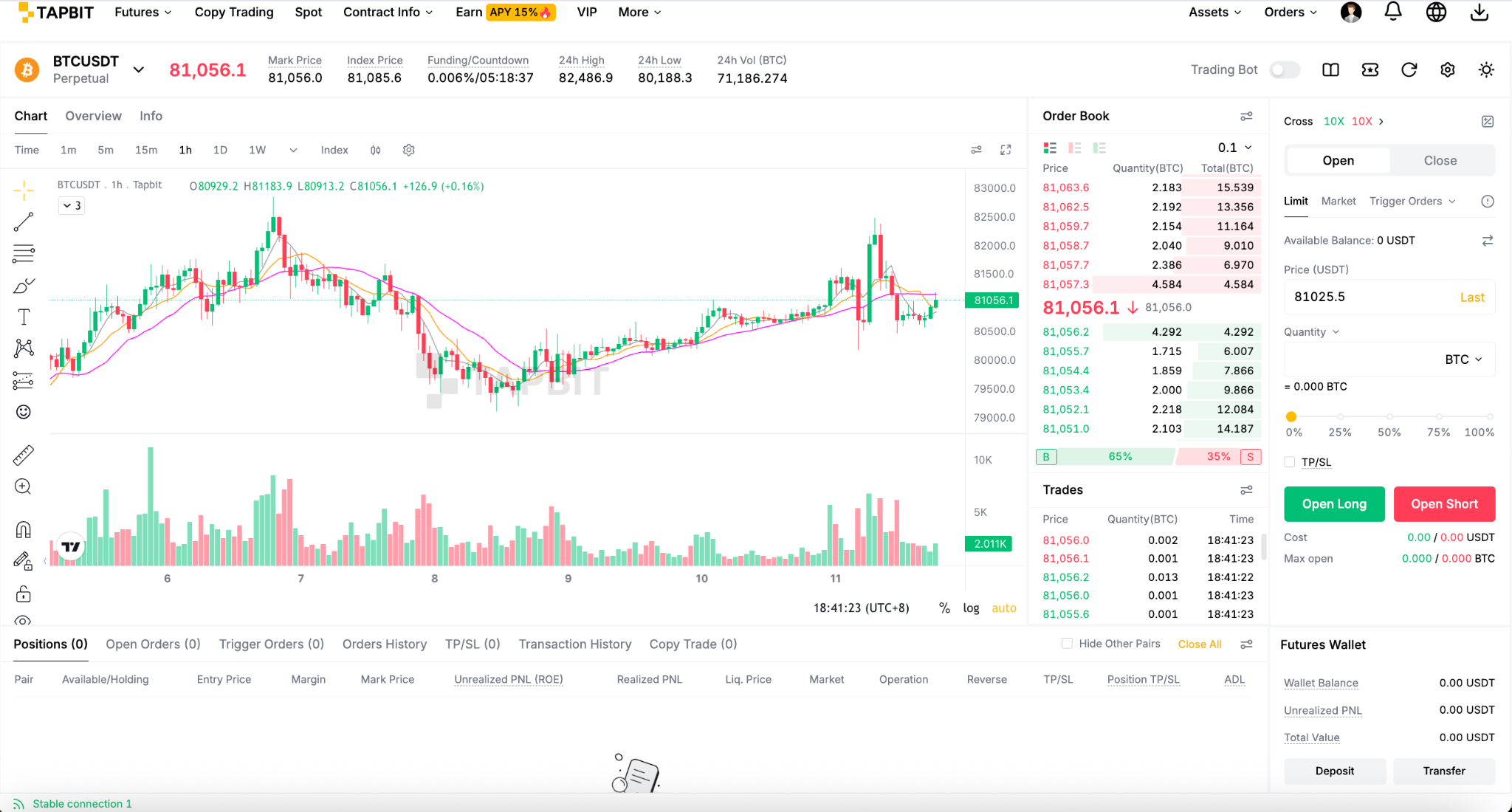
Direct ownership through spot buying gives you the flexibility that no ETF can replicate: the ability to withdraw Bitcoin to a personal wallet, use it on-chain, or transfer it freely across platforms. This is the structural difference that separates holding actual BTC from holding FBTC shares — ownership of the asset itself rather than a security that tracks it.
Whether you are evaluating the Fidelity Bitcoin ETF as a starting point or looking to build a more active Bitcoin position, understanding both paths helps you match your approach to your actual goals. Start trading on Tapbit today to access spot, futures, and direct Bitcoin ownership in one platform.
FAQ
Q1: Can I hold FBTC in an IRA or 401(k) retirement account?
Yes — this is one of FBTC's most significant practical advantages over direct Bitcoin ownership. FBTC is available in standard Fidelity brokerage accounts, traditional IRAs, and Roth IRAs. Some self-directed 401(k) brokerage windows also offer access. Holding FBTC in a Roth IRA means any appreciation in the fund's value grows tax-free, and qualified withdrawals in retirement are not subject to capital gains tax. Direct Bitcoin ownership cannot be placed inside a standard IRA without a specialized self-directed IRA structure, which involves significantly more complexity and cost.
Q2: What is the difference between FBTC and Fidelity Crypto — Fidelity's direct crypto trading service?
These are two separate products serving different investor profiles. FBTC is an ETF that holds Bitcoin on investors' behalf — you own shares, not BTC. Fidelity Crypto is a direct cryptocurrency trading service that allows eligible customers to buy, sell, and hold actual Bitcoin and Ethereum in a crypto account with direct on-chain ownership. Fidelity Crypto charges a spread on each transaction rather than an annual expense ratio. The practical choice depends on your goals: FBTC for tax-advantaged accounts and traditional portfolio integration; Fidelity Crypto if you want actual Bitcoin you can eventually self-custody.
Q3: Does Fidelity have an Ethereum ETF as well?
Yes. Alongside FBTC, Fidelity offers the Fidelity Ethereum Fund (FETH) — a spot Ethereum ETF with the same 0.25% expense ratio and the same in-house custody structure through Fidelity Digital Assets. FETH holds Ethereum directly and does not stake its holdings, per its prospectus. Together, FBTC and FETH cover the two largest crypto assets by market capitalization, giving Fidelity customers a reasonably complete crypto ETF toolkit within a standard brokerage or retirement account.
Q4: How much does FBTC's 0.25% fee actually cost over ten years?
On a static $10,000 investment with no price change, the annual fee compounds to approximately $247 over ten years — slightly less than ten times the annual $25 cost due to the fee being applied to a shrinking base. In practice, Bitcoin's price volatility dominates any return calculation over that period, making the fee drag relatively small in percentage terms compared to the asset's own price swings. The more meaningful impact of the fee is its effect on the BTC-per-share ratio: each FBTC share represents slightly less Bitcoin each year as the fund deducts its expense ratio from holdings, creating a permanent and widening gap between FBTC's BTC backing and Bitcoin's spot price.
Q5: Is FBTC available outside the United States?
The US-listed FBTC (on CBOE BZX) is only accessible to investors with US brokerage accounts. However, Fidelity Canada offers a separate product — the Fidelity Advantage Bitcoin ETF, also trading under the ticker FBTC on the Toronto Stock Exchange. The Canadian product has its own structure, NAV pricing, and management fee (0.32% MER as of late 2025). These are distinct funds that happen to share a ticker symbol across different exchanges and should not be confused. Investors outside North America do not currently have access to a Fidelity-branded Bitcoin ETF product.
Q6: What happens to FBTC's Bitcoin holdings if Fidelity faces financial difficulty?
FBTC's Bitcoin is held in a trust structure that legally separates the fund's assets from Fidelity's corporate balance sheet. This means that if Fidelity Investments faced insolvency or regulatory action, the Bitcoin held by the trust would be protected as investor assets rather than treated as Fidelity's property. The trust structure is a standard feature of ETF design and is specifically engineered to ensure that fund assets cannot be claimed by the issuer's creditors. This protection is separate from and in addition to Fidelity Digital Assets' security practices around cold storage.
Data Sources
-
Fidelity Institutional — Fidelity Wise Origin Bitcoin Fund (FBTC): https://institutional.fidelity.com/advisors/investment-solutions/asset-classes/alternatives/fidelity-wise-origin-bitcoin-fund
-
ETF Database — FBTC fund data and expense ratio: https://etfdb.com/etf/FBTC/
-
CoinGecko — What is FBTC? Complete guide: https://www.coingecko.com/learn/what-is-fbtc-fidelity-bitcoin-etf


