

The phrase “Epstein Bitcoin” has become a search topic as records released in 2026 renewed scrutiny of Jeffrey Epstein's relationships with people, companies and institutions connected to cryptocurrency. In this context, Epstein Bitcoin does not describe a cryptocurrency. It is shorthand for questions about financial exposure, institutional funding and possible influence around the early crypto ecosystem.
Reporting on the released documents describes a $3 million Coinbase investment in 2014, a separate investment connected to Blockstream and Epstein's previously documented financial relationship with the MIT Media Lab. Those facts have encouraged much broader claims online. A careful Epstein Bitcoin fact-check should distinguish what the records demonstrate from what commentators infer.
An investment can establish economic exposure. An email can establish communication. A donation can establish funding. None of those facts, by itself, proves ownership or control of the Bitcoin protocol.
What Does “Epstein Bitcoin” Mean?
The keyword Epstein Bitcoin is best understood as shorthand for a set of separate questions. Did Epstein invest in cryptocurrency companies? Did he have relationships with people involved in crypto? Did his funding reach institutions that supported Bitcoin developers? Did any of those relationships amount to technical control?
Those questions are not equivalent. Bitcoin is open-source software operated through a distributed network, so financial or institutional relationships are not the same as ownership of the network.
What Do the 2026 Records Show About Epstein and Crypto?
Major reporting on the released files says Epstein had financial exposure to the early cryptocurrency industry. The Washington Post reported that Justice Department documents described a $3 million Coinbase investment made through IGO LLC in 2014. The Guardian also reported a separate investment connected to Blockstream and described his ties to MIT's digital-currency efforts.
These relationships should remain precisely described. Coinbase is a cryptocurrency company, while Blockstream builds Bitcoin-related infrastructure; neither is the Bitcoin protocol. A stake in either company is different from ownership of the network.
What Is the Epstein, MIT, and Bitcoin Connection?
MIT enters the story because the MIT Media Lab had documented financial ties to Epstein, while the Digital Currency Initiative became an important institutional home for research and support related to Bitcoin and other digital currencies.
Funding an institution that supports open-source developers can raise legitimate questions about transparency, conflicts of interest and resource allocation. It does not automatically establish control over those developers' code, and it does not establish control over users who decide which Bitcoin software and rules they accept.
Bitcoin's software changes are publicly visible, and adoption depends on a broader ecosystem. That is why the Epstein Bitcoin evidence should be evaluated in layers rather than collapsed into a single claim.

How Should the Evidence Be Evaluated?
| Claim | Evidence Needed | What It Establishes |
|---|---|---|
| Epstein communicated with a crypto figure | Authentic correspondence | A relationship or communication |
| Epstein invested in a crypto company | Financial or investment records | Economic exposure to that company |
| Epstein funded an institution | Donation or accounting records | A financial relationship with the institution |
| Epstein controlled Bitcoin | Technical and governance evidence | Actual ability to determine network or protocol outcomes |
The evidence threshold becomes much higher as the claim becomes stronger. A responsible Epstein Bitcoin analysis should not jump from an investment record to conclusions about Bitcoin's creation, governance or ownership.
Did Epstein Control Bitcoin or Bitcoin Core?
Available evidence of investment and institutional relationships does not, by itself, establish that Epstein controlled Bitcoin. Bitcoin is not a corporation whose network rules can be purchased through equity ownership.
Developers can propose and review code. Node operators decide what software they run. Miners participate in block production. Exchanges and custodians influence market access. Investors can fund companies or research. These roles can create different forms of influence, but none alone is equivalent to unilateral control.
Questions about funding remain relevant. Financial support can affect which projects receive resources or which researchers are hired. The key distinction in the Epstein Bitcoin debate is simple: influence, funding, investment and protocol control are different concepts.
Does the Epstein Bitcoin Story Change Bitcoin's Security?
Reputational information about people who invested in crypto businesses does not automatically change Bitcoin's cryptographic or consensus security. Technical security questions require technical evidence, such as a software vulnerability, a failure in cryptography, dangerous concentration among network participants or a credible attack on consensus.
A historical funding revelation may change perceptions of early industry governance without changing how a valid Bitcoin transaction is verified today. Readers interested in market structure can compare that distinction with Tapbit Learn's Bitcoin price outlook and its guide to Bitcoin dominance.
Why Are Online Claims Broader Than the Records?
The files contain emails, investments and institutional relationships that can be combined into broader online narratives. A useful fact-check asks whether the original record is available, whether it authenticates the claimed relationship and whether the conclusion goes further than the document itself. An investment record can establish financial exposure; it cannot independently establish control of a decentralized protocol.
What Should Bitcoin Investors Take Away?
The useful lesson is neither to ignore uncomfortable financial relationships nor to exaggerate them. Documented investments and funding relationships deserve scrutiny, especially when they involve influential technology institutions. But the strength of the conclusion should match the strength of the evidence.
For Bitcoin investors, historical evidence can change how early industry financing is understood. Changing the assessment of Bitcoin's security or decentralization would require evidence of a relevant technical or governance mechanism.
Trading Bitcoin on Tapbit
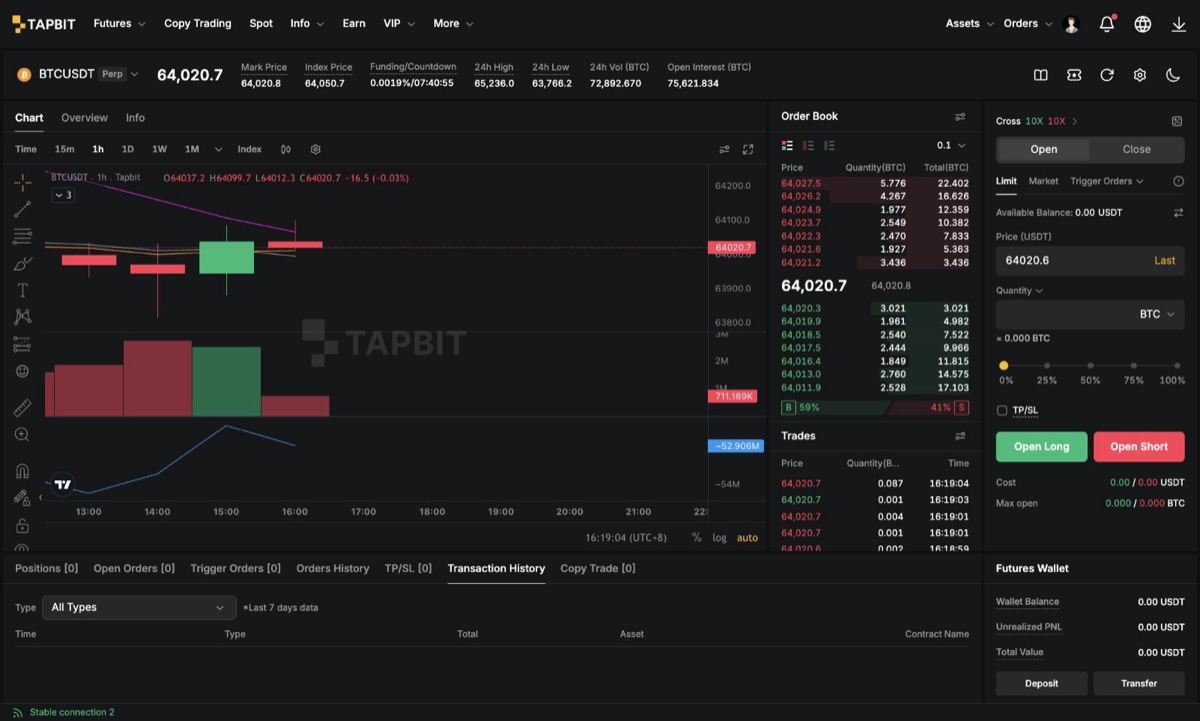
The availability of BTC markets on Tapbit is unrelated to the historical Epstein Bitcoin story. Traders can access BTC-USDT spot or BTC-USDT perpetual futures. Futures are derivatives and can involve leverage, funding costs and liquidation risk.
- Register or log in. Create an account and choose whether you want spot or futures exposure.
- Open the BTC-USDT contract. For futures, review the contract name, mark price, index price, funding rate and funding countdown.
- Choose the order. Select Limit, Market or Trigger Order, set quantity and leverage, then choose Open Long or Open Short.
- Manage risk. Add TP/SL and monitor margin, Positions, Open Orders, Trigger Orders and liquidation risk.
Bottom Line
The Epstein Bitcoin connection refers to documented financial ties between Jeffrey Epstein and parts of the early cryptocurrency ecosystem, together with broader claims built around those ties. Reported Coinbase and Blockstream investments and MIT funding relationships deserve careful examination. They do not, without additional technical evidence, establish that Epstein created, owned or controlled Bitcoin. The most reliable approach is to identify the primary record, state exactly what it demonstrates and stop where the evidence stops.
Epstein Bitcoin FAQ
Did Jeffrey Epstein own Bitcoin?
The records discussed in this article establish reported investments and funding relationships, not proof that Epstein owned or controlled the Bitcoin network. Personal Bitcoin holdings would require separate evidence.
Did Epstein control Bitcoin developers?
Institutional funding can raise questions about influence, but it does not by itself establish that a donor could dictate code changes or force users to accept them.
Does the Epstein Bitcoin story change Bitcoin's decentralization?
Historical funding relationships may matter to governance transparency, but changing the technical assessment of decentralization would require evidence about actual control over software rules, nodes, mining, consensus or other network mechanisms.


