
Etherscan is one of the most important tools in the Ethereum ecosystem. If Ethereum is a public settlement network, Etherscan is the search engine that helps users read what is happening on that network. It lets anyone look up wallet addresses, transaction hashes, token transfers, smart contracts, gas fees, and other public blockchain records.
For beginners, Etherscan can feel technical at first. A transaction page may show hashes, block numbers, confirmations, gas limits, and contract calls. Once you understand the layout, however, it becomes a practical way to verify activity instead of relying only on wallet notifications or screenshots from other users.
For users who are learning how to track digital assets, compare wallet activity, or follow Ethereum-based tokens, pairing public blockchain explorers with a broader market platform can be useful. You can also explore crypto market access on Tapbit when you want an exchange-focused view of prices, trading pairs, and market activity.
What Is Etherscan?
Etherscan is a blockchain explorer for Ethereum. It collects public Ethereum data and organizes it into searchable pages. Users can enter a wallet address, transaction hash, block number, token contract, or ENS name to view related on-chain information.
The key point is that Etherscan is not a wallet and not a bank-like account system. It does not store your private keys, approve transactions for you, or reverse mistakes. It only displays public data that already exists on Ethereum.
| Feature | What It Shows | Why It Matters |
|---|---|---|
| Wallet Address | ETH balance, token balances, transfers, activity | Helps users verify address history |
| Transaction Hash | Status, gas fee, sender, receiver, block | Confirms whether a transfer succeeded |
| Token Contract | Supply, holders, transfers, contract details | Helps users inspect token authenticity |
| Smart Contract | Code, read/write functions, events | Supports deeper protocol research |
| Gas Tracker | Estimated Ethereum network fees | Helps users time transactions more efficiently |
How Does an Ethereum Block Explorer Work?
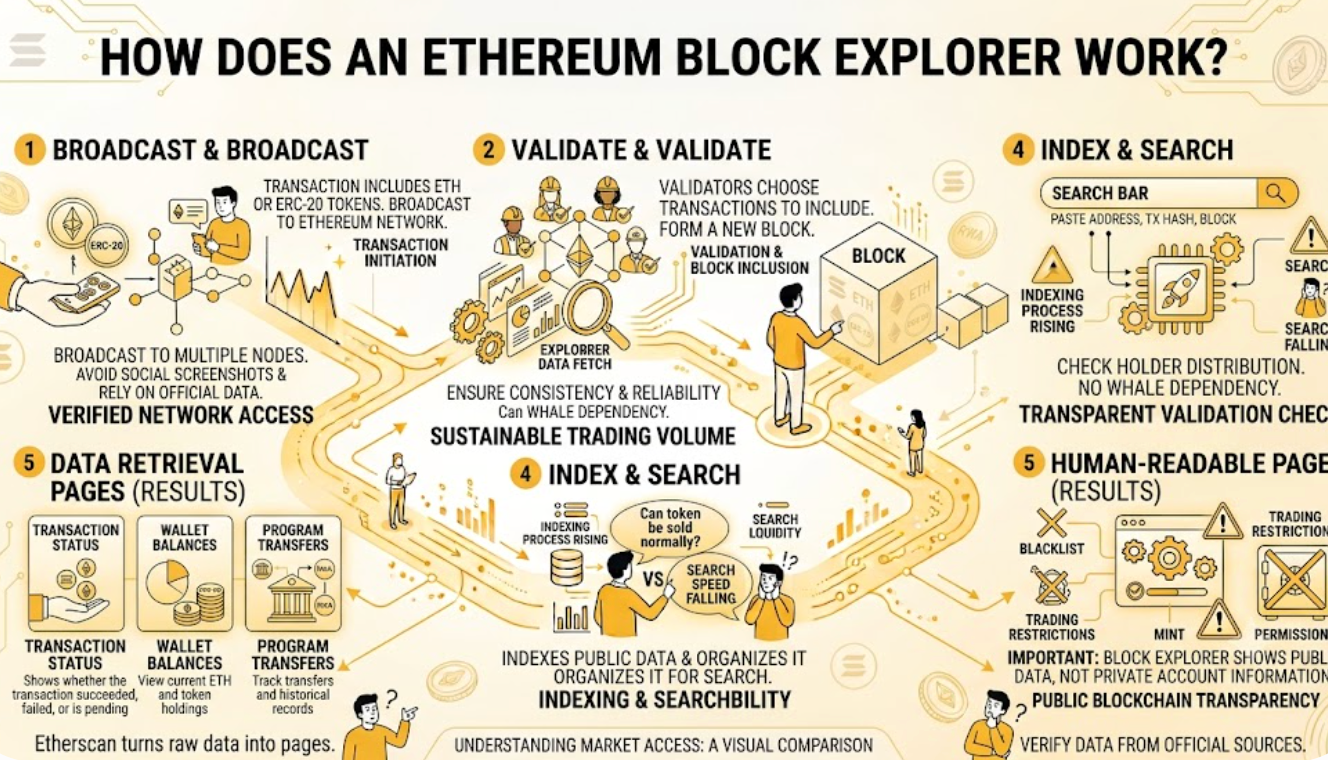
A block explorer reads blockchain data from Ethereum nodes, indexes it, and makes it easier for users to search. Ethereum itself records transactions in blocks. Etherscan turns that raw data into pages that humans can read.
When you send ETH or an ERC-20 token, the transaction is broadcast to the Ethereum network. After validators include it in a block, the transaction becomes visible on Etherscan. The explorer then shows whether the transaction succeeded, failed, or is still pending.
How to Read an Etherscan Transaction Page
The transaction hash, often called a TXID, is the unique identifier for an Ethereum transaction. If someone says they sent funds, the transaction hash is usually the cleanest way to verify the claim.
On a transaction page, the most important fields are status, block confirmation, from address, to address, value, gas fee, and timestamp. A successful status means the transaction was executed on-chain. A failed status means the transaction was submitted but did not complete as intended, often because of contract rules or insufficient gas.
| Field | Meaning |
|---|---|
| Status | Shows whether the transaction succeeded, failed, or remains pending |
| From | The address that initiated the transaction |
| To | The receiving address or smart contract |
| Value | The amount of ETH or token value transferred |
| Gas Fee | The network cost paid to process the transaction |
| Timestamp | When the transaction was confirmed |
Using Etherscan to Check Wallet Addresses
Wallet address pages are useful for reviewing public activity. You can see ETH balance, token transfers, NFT transfers, internal transactions, and contract interactions. This can help users verify whether funds arrived, whether an address is active, or whether a wallet has interacted with suspicious contracts.
That said, address data requires context. A wallet with many token transfers is not automatically safe, and a wallet label does not always prove ownership unless it is verified by a trusted source. Scammers often send fake tokens to visible wallets to create confusion.
Etherscan and Smart Contracts
One of Etherscan's most useful features is smart contract transparency. For many contracts, users can review verified source code, contract creation details, token supply, holder distribution, and public interaction functions.
Verified code does not guarantee that a project is safe, but it gives developers, auditors, and advanced users more information to inspect. Unverified contracts are not automatically scams, but they require more caution because users cannot easily review what the contract is designed to do.
How Etherscan Helps With Token Research
Etherscan can be especially helpful when researching ERC-20 tokens. Instead of relying only on token names or logos, users can compare the contract address with official project channels. This matters because fake tokens often copy the names of popular assets.
Useful checks include holder distribution, recent transfers, contract verification, liquidity-related wallet activity, and whether the token appears to have unusual permissions. For high-risk tokens, these details can reveal warning signs before a user interacts with a contract.
Etherscan vs a Crypto Exchange
Etherscan and a crypto exchange serve different purposes. Etherscan is built for transparency and on-chain verification. An exchange is built for account management, price discovery, order execution, and market access.
| Tool | Main Use | What It Does Not Do |
|---|---|---|
| Etherscan | Read Ethereum blockchain data | It does not execute exchange trades or custody user funds |
| Crypto Exchange | Trade and manage market exposure | It does not replace public on-chain verification |
| Wallet App | Sign transactions and manage addresses | It does not always provide deep transaction analysis |
Common Etherscan Mistakes Beginners Make
A common mistake is assuming that seeing a token on Etherscan means the token is legitimate. Etherscan shows public records; it does not approve every asset. Another mistake is trusting random links that imitate Etherscan pages. Users should type the official domain directly or use trusted bookmarks.
Beginners should also avoid connecting wallets to unknown websites after viewing a contract page. Reading data on Etherscan is generally low risk, but signing transactions from unfamiliar interfaces can expose users to loss.
Is Etherscan Safe to Use?
Etherscan is generally safe as a read-only blockchain explorer when accessed through its official website, Etherscan.io. The main risks usually come from phishing sites, fake ads, malicious token links, and users misunderstanding what on-chain data means.
Users should never enter seed phrases, private keys, or wallet recovery information into any explorer page. A legitimate block explorer does not need that information to display public blockchain data.
Conclusion
Etherscan is a core Ethereum research tool because it makes public blockchain data searchable and readable. It helps users verify transactions, check wallet activity, inspect token contracts, understand gas fees, and research smart contracts.
For crypto beginners, the best way to use Etherscan is practical: check transaction status, verify contract addresses, and learn how Ethereum activity appears on-chain. It is not a guarantee of safety, but it is one of the most useful tools for reducing guesswork in the Ethereum ecosystem.
FAQ
What is Etherscan used for?
Etherscan is used to search and read Ethereum blockchain data, including transactions, wallet addresses, token transfers, gas fees, and smart contracts.
Is Etherscan a wallet?
No. Etherscan is not a wallet. It does not hold funds or private keys. It only displays public Ethereum blockchain information.
Can Etherscan reverse a transaction?
No. Ethereum transactions cannot be reversed by Etherscan. If a transaction is confirmed on-chain, Etherscan can only display the record.
How do I know if a token on Etherscan is real?
Check the contract address against the project's official website or verified social channels. Do not rely only on token names, logos, or search results.
Why does a transaction fail on Etherscan?
A transaction can fail because of insufficient gas, smart contract conditions, slippage settings, or other execution rules. Failed transactions may still consume gas fees.
Is Etherscan free?
Yes. Most Etherscan browsing features are free for users who want to check Ethereum transactions, wallets, tokens, and contracts.


