
What Is Alchemist AI (ALCH) and What Does It Do?
Alchemist AI (ALCH) is a Solana-based no-code development platform launched in November 2024. It allows users to create functional software applications by describing their idea in plain language — no programming experience required. The platform's AI pipeline interprets the input, generates the underlying code, runs tests in a sandboxed environment, and deploys the finished app. A built-in decentralized marketplace lets creators sell or share their builds. The native ALCH token is required to pay for app generation, marketplace transactions, tipping, and premium feature access.
At its core, Alchemist AI addresses a problem that has existed since the early days of software: most people have ideas but lack the technical skills to build them. According to data from Solana Compass, the platform has already processed more than 100,000 application builds — evidence that the product works beyond the whitepaper stage.
The decision to build on Solana was deliberate. Solana's high throughput and extremely low transaction fees make it a practical foundation for a platform where users may interact with the blockchain dozens of times per session.
What can you build with Alchemist AI?
The platform supports a wide range of lightweight application types — from games and productivity tools to experimental Web3 utilities — all created through plain-language prompts in the Sacred Laboratory interface.
Anyone — creators, entrepreneurs, students, small business owners — can build a functional application without writing a single line of code. Developers with a technical background can use Alchemist AI to generate working prototypes in minutes rather than days. Completed applications can then be listed, sold, or transferred through the platform's built-in decentralized marketplace, giving creators a direct monetization path.
How Does Alchemist AI Work?
Alchemist AI does not rely on a single AI model. Instead, it runs a multi-model parallel pipeline where specialized models each handle a distinct part of the application creation process.
Step 1 — Natural Language Processing (NLP): The user enters a description into the Sacred Laboratory interface. The NLP layer parses the input to identify core functionality, interaction logic, and visual style requirements.
Step 2 — LLM-Driven Interpretation: The parsed intent is passed to a large language model. Alchemist AI currently integrates OpenAI GPT-5 (upgraded August 2025) and Grok 4 (added July 2025), giving the platform access to state-of-the-art reasoning capabilities. The LLM maps user intent to an application architecture plan.
Step 3 — Code Generation: A dedicated code generation model translates the LLM's architectural plan into executable code. The platform supports web framework integration and limited operating system API access, ensuring the output is a genuinely functional application rather than a static mockup.
Step 4 — Sandboxed Testing and Deployment: Generated code runs through automated testing inside a secure sandboxed environment. Once validated, the application is deployed. The user clicks the Forge button — the platform handles everything automatically.
Step 5 — Image Generation: A parallel image generation module produces visual assets simultaneously with the code generation process, keeping build times efficient.
User Input (Natural Language Description)
↓
NLP — Intent Parsing
↓
LLM Understanding & Planning
(GPT-5 / Grok 4)
↓
Code Generation ←——→ Image Generation
↓
Sandboxed Testing & Validation
↓
App Deployment + On-Chain Marketplace
The key architectural insight is specialization: each model does only what it does best, and parallel processing ensures both speed and output quality.
ALCH Token Utility and Tokenomics
Token Utility
ALCH is the sole native token of the Alchemist AI ecosystem. Its utility design reflects a direct attempt to build token demand around platform behavior rather than speculation.
Generation Fees are the primary consumption mechanism. Every time a user initiates a build request inside the Sacred Laboratory, a quantity of ALCH is deducted as the service fee. More complex applications require higher fees, directly linking token demand to platform usage volume.
Marketplace Transactions and Tipping: The platform's built-in decentralized marketplace settles entirely in ALCH. When users purchase completed applications or tip high-quality builds, all transactions flow through ALCH — creating persistent circulation demand independent of new user growth.
Premium Feature Access: Holding or spending more ALCH unlocks enhanced platform capabilities, including access to more powerful AI model tiers, priority queue processing, and advanced image generation parameters.
Governance: According to the project roadmap, ALCH holders will eventually participate in on-chain governance votes covering feature prioritization, fee structure adjustments, and ecosystem fund allocations. Governance functionality is targeted for completion before 2027.
Tokenomics
|
Metric |
Value |
|
Maximum Supply |
1,000,000,000 ALCH |
|
Circulating Supply |
~850,000,000 ALCH |
|
Circulation Rate |
85% |
|
Market Capitalization |
~$66M–$83M |
|
Fully Diluted Valuation (FDV) |
~$81M–$83M |
|
All-Time High (ATH) |
~$0.24 (December 2025) |
|
All-Time Low (ATL) |
~$0.00033 (November 2024) |
|
Launch Date |
November 2024 |
Sources: CoinGecko, CoinMarketCap
An 85% circulation rate is relatively high, meaning the remaining ~150 million ALCH still sits in team, treasury, or vesting reserves. Investors should monitor the unlock schedule, as concentrated releases can create short-term selling pressure. It is also worth noting that, based on publicly available community analysis, the project team currently retains minting authority and asset-freezing permissions — a meaningful centralization risk that long-term holders should factor into their assessment.
Compared to uncapped inflationary tokens, ALCH's hard supply ceiling reduces long-term dilution risk. Combined with the platform's ongoing generation fee consumption, the supply-demand structure has more fundamental support than tokens that rely solely on speculative inflows.
How Alchemist AI Compares to Other AI Tokens
This is the question most analysis articles fail to answer properly — and it is the most important one for evaluating ALCH's actual value proposition.
A Real Product, Not Just an AI Label. The 2024–2025 crypto cycle produced hundreds of tokens that added "AI" to their branding without building anything substantive. Alchemist AI is different in a verifiable way: the platform exists and functions. More than 100,000 application builds are on-chain. The Sacred Laboratory interface is publicly accessible. GPT-5 and Grok 4 integrations are documented and operational.
Utility Token, Not Speculative Wrapper. Many AI-themed tokens derive their price entirely from narrative momentum. ALCH has a direct consumption loop: every application generation event burns ALCH, every marketplace transaction requires ALCH, and every premium feature access consumes ALCH. This use-to-consume model ties token demand directly to platform activity, providing a demand floor that pure narrative tokens lack.
The No-Code + Crypto Logic Makes Sense. No-code development is already a proven market in Web2 — platforms like Webflow, Bubble, and Glide have demonstrated a massive addressable audience of non-technical users who want to build software. Alchemist AI imports this model into Web3 with a coherent economic loop: users build apps and consume ALCH; apps list on the marketplace and generate further ALCH transactions; creators receive tips and drive additional demand.
|
Dimension |
Alchemist AI (ALCH) |
Typical AI Meme Coin |
|
Working product exists |
✅ Yes, publicly accessible |
❌ No, or whitepaper only |
|
Token has consumption mechanism |
✅ Generation fees, marketplace |
❌ No real on-chain consumption |
|
Underlying chain advantage |
✅ Solana (fast, low fees) |
Varies |
|
AI integration depth |
✅ Multi-model pipeline |
❌ Concept only |
|
Price driver |
Platform usage + narrative |
Pure narrative |
ALCH Price History and Market Performance
ALCH has followed a trajectory typical of narrative-driven altcoins with a genuine underlying product:
-
Launch (November 2024): Opened around $0.0756, rallied quickly on initial market enthusiasm
-
All-Time Low (February 2025): Dropped to approximately $0.014 before recovering
-
All-Time High (December 2025): Reached approximately $0.24
-
Current Range (May 2026): Trading approximately $0.065–$0.098, down 60–70% from ATH
The AI Narrative Effect: The 2024–2025 AI agent narrative was one of the strongest thematic drivers in crypto. When AI tokens broadly sold off in December 2025, multiple analysts cited ALCH as one of the few with verifiable utility — a distinction that contributed to its relative resilience.
Solana Ecosystem Tailwind: As the Solana ecosystem expanded through 2024–2025, on-chain TVL and user counts rose substantially. ALCH, as a native Solana project, captured organic traffic from this broader growth.
Independent Price Strength: On March 19, 2026, while Bitcoin fell 4.8% and led a broad market selloff, ALCH gained 12.2% — a notable instance of independent price strength that attracted additional trader attention.
Price Outlook (For Reference Only — Not Investment Advice)
Based on aggregated model projections from multiple data platforms:
-
2026: Average estimates cluster around $0.069, projected range $0.045–$0.079
-
2027: If platform adoption grows, some models project a potential move toward $0.50
-
2031: Long-term scenarios range from $0.19 to $0.49 depending on adoption assumptions
⚠️ All price projections are based on historical data models. Crypto markets are highly volatile and actual prices may deviate significantly from any projection. This is not investment advice.
How to Buy ALCH
Purchasing ALCH is straightforward through both centralized and decentralized routes.
Option 1: Centralized Exchange (CEX) — Recommended for Beginners
-
Register and complete KYC on a supported exchange
-
Deposit funds — USDT, USDC, or other major stablecoins
-
Search for ALCH/USDT in the spot market
-
Place your order — market orders execute immediately; limit orders let you set a target price
-
Secure your holdings — consider transferring long-term holdings to a self-custody wallet
Option 2: Decentralized Exchange (DEX)
Since ALCH is a native Solana token, it is also accessible through Solana-ecosystem DEXes such as Raydium. Set up a Solana-compatible wallet (Phantom is widely used), ensure the wallet holds SOL to cover transaction fees, then swap SOL → ALCH directly.
New users are generally advised to start with a centralized exchange — the process is simpler, customer support is available, and security infrastructure is more robust.
Notable AI Sector Tokens on Tapbit
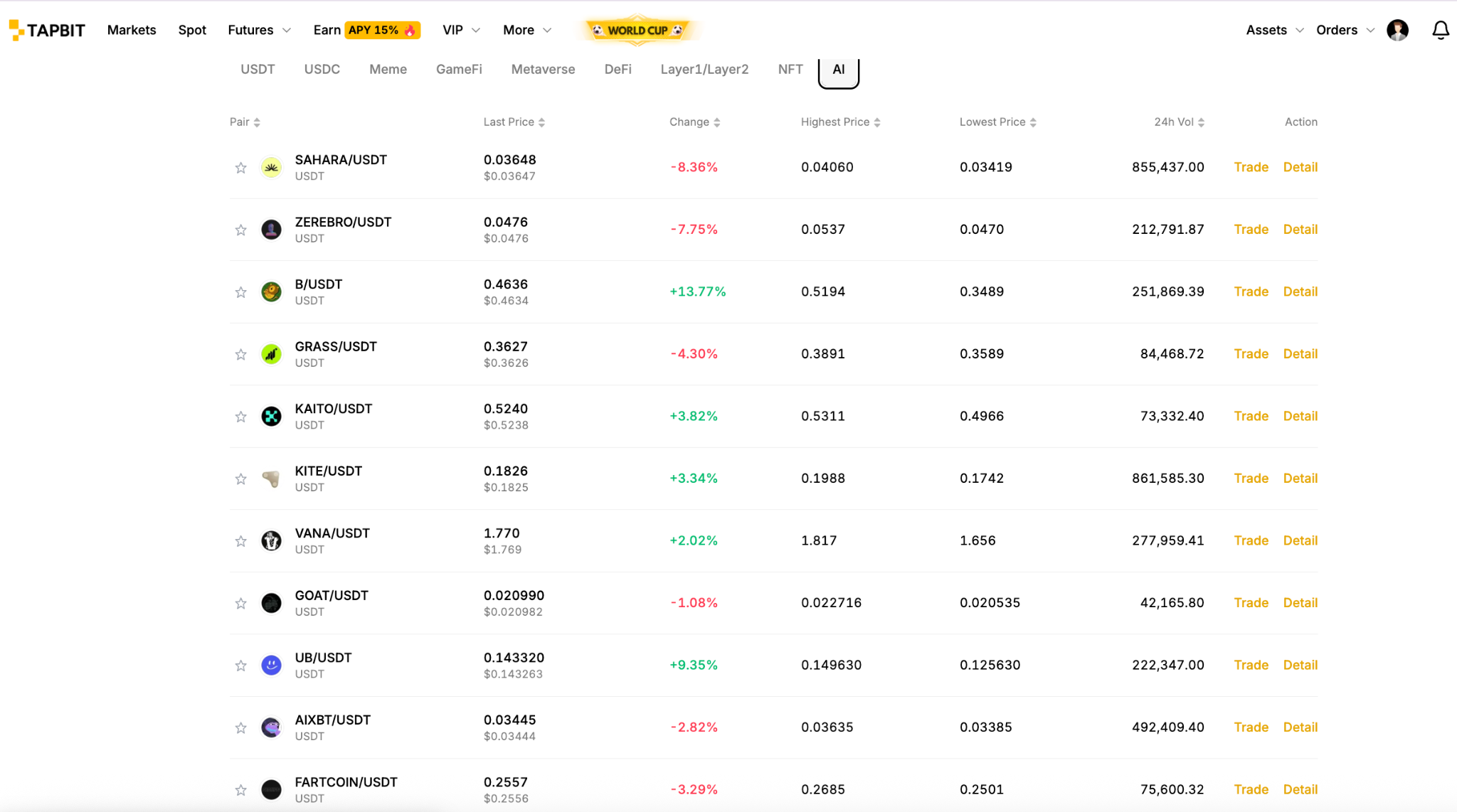
Beyond ALCH, Tapbit supports trading across the broader AI token ecosystem:
-
VANA (Vana) — decentralized data ownership and AI training infrastructure
-
KAITO (Kaito AI) — AI-powered crypto information and research network
-
GRASS (Grass) — decentralized web scraping network for AI data collection
-
KITE (Kite AI) — AI agent ecosystem on-chain
-
GOAT (GOAT Network) — AI agent-driven token and meme ecosystem
For experienced traders, Tapbit also offers AI token futures contracts with long and short options. Risk Warning: Futures trading involves substantial risk and may result in the loss of your entire principal. Trade only what you can afford to lose.
Frequently Asked Questions (FAQ)
What is Alchemist AI used for?
Alchemist AI is a no-code software development platform. Users describe an application idea in plain English, and the platform's AI pipeline automatically generates, tests, and deploys a working application — no programming knowledge required. Completed apps can be listed and sold through the platform's built-in decentralized marketplace.
How does Alchemist AI work?
The platform uses a multi-model AI pipeline. Natural language processing interprets the user's description; a large language model (GPT-5 and Grok 4) plans the application architecture; a dedicated code generation model produces executable code; and an integrated image generation module creates visual assets in parallel. Users trigger the entire process by clicking the "Forge" button — no technical intervention needed.
Is ALCH an AI trading bot?
No. Alchemist AI is an AI-powered application generation platform, not a trading bot. Its artificial intelligence is used to convert natural language descriptions into software applications. It has no market analysis capabilities, no algorithmic trading functions, and no connection to cryptocurrency price prediction or automated trade execution.
What is the ALCH token used for?
ALCH serves four main functions: paying for application generation fees (the primary on-chain consumption event); settling transactions and tipping on the built-in app marketplace; unlocking premium AI capabilities and priority queue access; and participating in future governance votes on platform decisions.
Where can I buy ALCH?
ALCH is available on both centralized exchanges, and on Solana-ecosystem decentralized exchanges such as Raydium (requires a Phantom wallet and SOL for gas fees). New users are generally advised to start with a centralized exchange.


