

Tapbit uses several layers of protection to secure user funds and accounts. According to its official documentation, these include proof of reserves, separation between hot and cold wallets, multisignature controls, SSL encryption, risk monitoring and an insurance fund.
Account security also depends on the user. Features such as Google Authenticator, withdrawal PINs and verification codes are only effective when they are enabled and protected from phishing attempts.
Users who want to access these controls can create a Tapbit account and review the available options in the platform’s Security Center before depositing or trading.
How Does Tapbit Protect User Funds?
A centralized exchange holds assets and processes transactions on behalf of its customers. This makes custody practices, reserve management and withdrawal controls important parts of the security model.
Tapbit states that customer assets are maintained on a 1:1 basis and segregated from company assets. In practical terms, the platform’s claim is that user balances are backed by corresponding assets rather than being used as ordinary operating capital.
These statements should be considered together with proof-of-reserves information, withdrawal performance and the platform’s current terms. No single control is sufficient on its own.
Tapbit Proof of Reserves Explained
Proof of reserves is a verification process intended to show that a centralized exchange controls enough assets to cover customer balances included in the assessment.
Tapbit says it implemented a cryptographic proof-of-reserves process with blockchain security company Hacken and maintains a minimum 1:1 reserve ratio. Its official proof-of-reserves announcement describes the process as a way to verify that assets held on the platform are fully collateralized.
Proof of reserves can improve transparency, but users should understand its limits. A reserve snapshot shows assets controlled at a particular time and within a defined scope. It may not provide a complete view of corporate liabilities, operational obligations or assets outside the assessment.
| Security Question | What Users Should Check |
|---|---|
| Are user balances backed? | Current reserve ratios and covered assets |
| Are liabilities included? | Scope and methodology of the assessment |
| Can users withdraw? | Actual withdrawal availability and processing |
| Is the information current? | Date of the latest reserve update |
| Is verification independent? | Auditor identity and published methodology |
Hot and Cold Wallet Separation
Tapbit states that it separates hot and cold wallets. Hot wallets remain connected to online systems so that exchanges can process routine deposits and withdrawals. Cold wallets store assets in an offline or more isolated environment.
Keeping a significant portion of assets away from internet-facing systems reduces the amount potentially exposed if an online wallet or server is compromised. Hot wallets are still necessary for daily operations, so exchanges must balance security with withdrawal liquidity.
Tapbit also lists multisignature technology among its controls. A multisignature process requires more than one approved key or party to authorize certain transactions, reducing dependence on a single credential.
Encryption, Firewalls and Risk Monitoring
Tapbit’s official platform description lists SSL encryption and a professional firewall architecture among its infrastructure protections. Encryption helps protect data transmitted between users and the platform, while firewalls are designed to filter unauthorized or suspicious network traffic.
The exchange also reports using risk-control systems to monitor deposits, trading activity and withdrawals. Unusual activity may trigger additional verification, delayed processing or account restrictions while a transaction is reviewed.
These controls can prevent some unauthorized withdrawals and financial-crime activity, but legitimate users may still be asked to provide source-of-funds information or complete additional identity checks.
What Is the Tapbit Insurance Fund?
Tapbit states that it maintains an insurance fund exceeding 50 million USDT. Its published materials describe the fund as platform-owned capital intended to respond to qualifying losses caused by platform incidents.
This type of fund is different from government-backed deposit insurance. It should not be interpreted as a guarantee that every loss, token decline, liquidation or account compromise will be reimbursed.
Tapbit also maintains a futures insurance mechanism that helps manage losses when liquidated positions cannot be closed at the bankruptcy price. That mechanism is primarily intended to reduce automatic deleveraging in derivatives markets and is not the same as general compensation for account theft or investment losses.
How Tapbit Protects User Accounts
Platform custody controls cannot stop an attacker who obtains a user’s password and verification codes. Tapbit therefore provides several account-level security features through its Security Center.
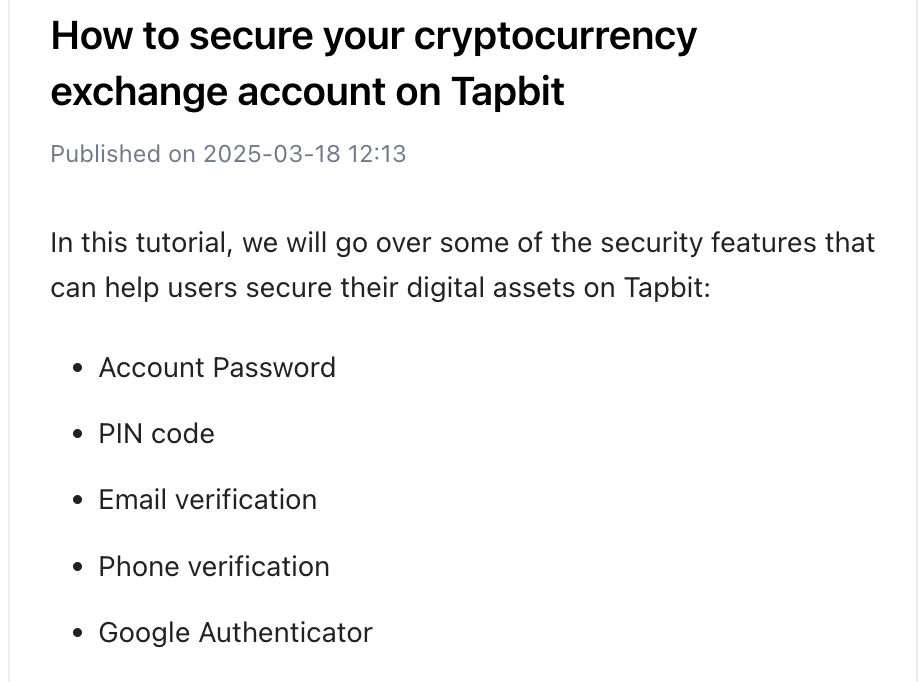
Its account-security guide identifies five main controls: an account password, email verification, a PIN code, phone verification and Google Authenticator.
The withdrawal PIN adds a separate verification step when funds leave the account. Email and phone codes can be required for withdrawals or important changes. Google Authenticator generates time-based one-time passwords on the user’s device.
How Users Can Secure a Tapbit Account
Users should begin with a unique password that is not used for email, social media or another exchange. Google Authenticator should then be enabled through the Security Center, with the setup key stored offline and never shared through chat or a support form.
The email account linked to Tapbit should have its own strong password and two-factor authentication. Users should review withdrawal addresses carefully, make a small test transaction when using a new destination and investigate unexpected login or verification messages immediately.
Tapbit warns that tapbit.com is its official domain. Fake websites and support impersonators may copy the platform’s branding to steal passwords and verification codes. Official support should be reached through verified platform channels rather than unsolicited social-media messages.
What Tapbit Security Cannot Prevent
Security controls reduce risk; they do not remove it. Market losses, leveraged liquidations and incorrect blockchain transfers are not cybersecurity incidents.
Proof of reserves does not protect a user who sends funds to the wrong network or reveals a verification code to an impersonator. Cold storage cannot stop malware from changing a withdrawal address on an infected device. An insurance fund should not be treated as unlimited protection against every loss.
Users should therefore separate platform custody risk, personal account-security risk and trading risk. Each requires different precautions.
Conclusion
Tapbit’s security model combines 1:1 reserve claims, proof-of-reserves reporting, hot and cold wallet separation, multisignature controls, encryption, transaction monitoring and an insurance fund. At the account level, users can enable Google Authenticator, verification codes and a withdrawal PIN.
These measures create several layers of protection, but safe account use still requires user participation. Strong credentials, verified links, secure devices and careful withdrawal checks remain essential even when the platform provides security controls.
Frequently Asked Questions
Does Tapbit publish proof of reserves?
Tapbit states that it publishes proof-of-reserves information and maintains customer assets at a minimum 1:1 ratio.
Does Tapbit use cold wallets?
Tapbit’s official documentation says the exchange separates hot and cold wallets and uses multisignature technology.
Does Tapbit offer two-factor authentication?
Yes. Users can enable Google Authenticator and other verification methods through the Security Center.
Is Tapbit’s insurance fund government-backed?
No. Tapbit describes it as a platform-funded mechanism. It should not be confused with government deposit insurance.
What is the best way to secure a Tapbit account?
Use a unique password, enable Google Authenticator, protect the linked email account, verify the official domain and never share passwords or verification codes.


