

Crypto prop trading is having a moment. Traders love the idea of handling bigger accounts without staking their own cash.
Enter Tradeify Crypto — one of the newer names in the space. They promise funded accounts, 24/7 crypto markets, and real payouts if you hit their targets.
Sounds straightforward, right? But the setup matters more than the pitch.
Here's the catch: Tradeify doesn't hand you a real brokerage account with $50k or $100k in company money. Their own FAQ admits you're trading on sim accounts. Pass their rules, and you qualify for actual payouts. That's a very different animal.
So the real question isn't "is this legit?" It's: do you actually understand what you're paying for, how the drawdowns work, and what it takes to turn those simulated gains into cash you can withdraw?
What Is Tradeify Crypto?
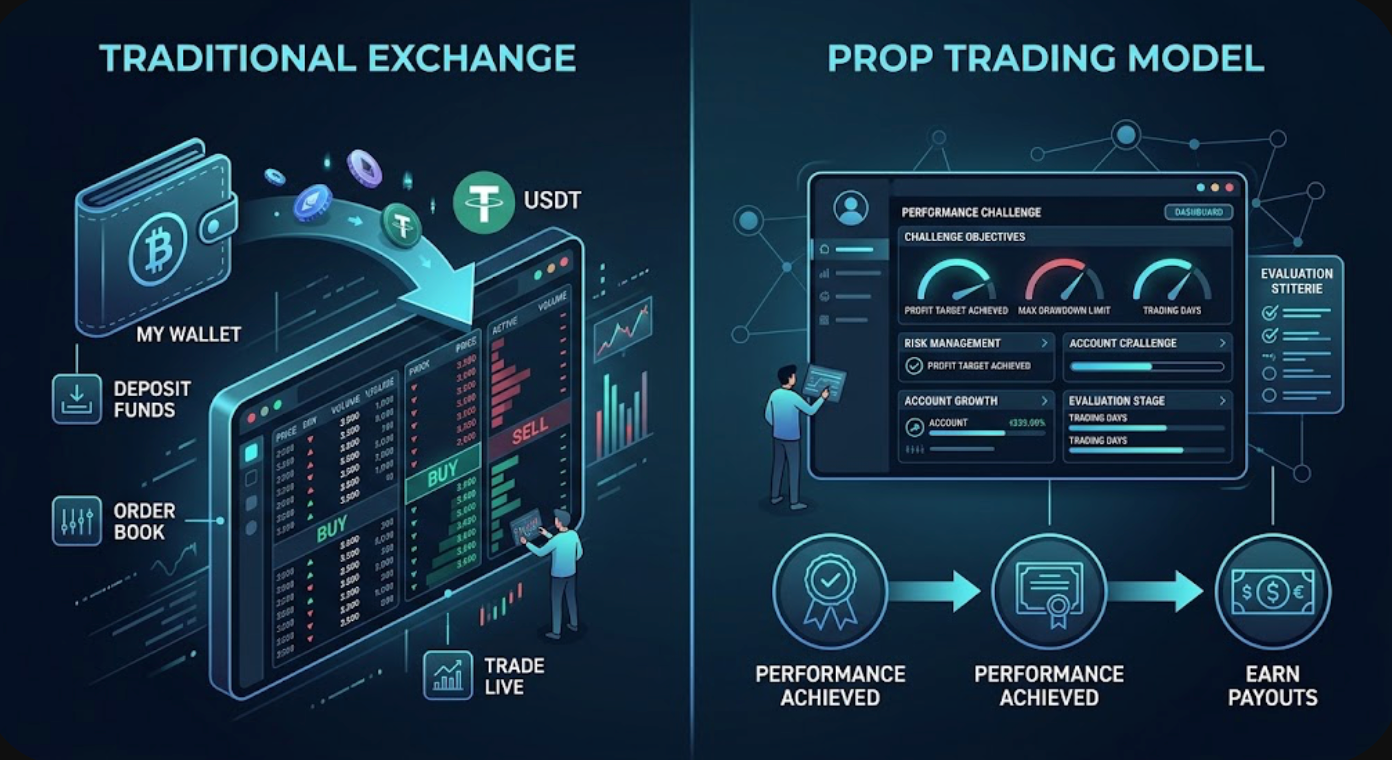
Tradeify Crypto is a proprietary trading program focused on digital assets. Users can either complete an evaluation or purchase an Instant Funding account. Depending on the program, account sizes currently range from $5,000 to $100,000, while the company limits total allocation within each crypto program. Tradeify says more than 100 cryptocurrency pairs are available through DXTrade, including BTC, ETH, SOL, DOGE and XRP.
The platform also offers synthetic instruments linked to stocks such as Nvidia, Apple and Tesla. Tradeify's own documentation makes clear that these are price-tracking instruments rather than actual shares. They do not give the trader dividends or voting rights.
This is not the same model as depositing USDT on a crypto exchange and trading a personal balance.
A trader is paying for access to a rule-based trading program. Performance is measured inside that environment, and payouts depend on staying within the conditions attached to the account.
Are Tradeify Accounts Using Real Money?
Tradeify Crypto says directly that its trading accounts are simulated, while qualifying payouts are real money.
Its Terms of Use reinforce the same point. Tradeify describes its evaluation programs as simulated or hypothetical environments using notional capital and simulated execution. Unless a separate agreement says otherwise, the evaluation does not involve the company placing live trades with real funds on behalf of the user.
So when a trader purchases access to a "$100,000 account," the correct interpretation is not that Tradeify deposits $100,000 into a brokerage account controlled by that trader.
The number represents the notional size of the trading environment and determines limits such as drawdown, position sizing and profit calculations.
If the trader follows the rules and becomes eligible for a payout, Tradeify says that payout is made in real funds through supported payment providers.
That model is common in modern online prop trading, but it is very different from managing a traditional funded brokerage account.
How Do Traders Get Funded?
Tradeify currently offers several routes, including 1-Step, 2-Step and Instant Funding programs. Evaluation accounts require traders to demonstrate profitability while staying inside the relevant risk limits. Instant Funding removes the evaluation stage, but it does not remove account rules.
Tradeify says funded accounts require KYC verification, two-factor authentication and a signed contract before full trading access is enabled.
The important point is that "funded" should not be interpreted as unrestricted capital. The trader is still operating inside a controlled program. Drawdown limits, minimum holding rules, strategy restrictions and payout requirements continue to apply after an evaluation has been passed.
For many traders, passing the challenge may actually be easier than keeping the funded account alive long enough to withdraw meaningful profits.
The Drawdown Rules Matter More Than the Account Size
Large account numbers tend to attract attention, but the drawdown allowance is usually more important.
Tradeify Crypto currently states that its 1-Step, 2-Step and Instant Funding programs use a maximum drawdown of 6% of account size. Most of those programs also apply a 3% daily drawdown limit. The APE-X structure operates differently, with a 4% maximum loss limit and no separate daily drawdown.
This means a "$100,000 account" should not be viewed as giving a trader $100,000 that can be lost.
The real room for error is only a fraction of that amount.
Even more importantly, the platform calculates breaches using live account equity. Unrealized losses can therefore close an account before the trader exits the position.
Imagine that a trader enters a BTC position and expects a temporary pullback before a recovery. If the open loss pushes account equity below the permitted drawdown, the account can breach immediately. It does not matter if Bitcoin rebounds five minutes later.
For crypto traders accustomed to waiting through volatility, this rule deserves close attention.
What Happens When an Account Breaches?
A breach is not simply a warning.
Tradeify says that an account can be closed for exceeding the daily loss limit, breaking the maximum drawdown rule or remaining inactive for 30 consecutive days. Once closed, the account cannot be reopened or reset under the current policy.
The consequence extends beyond losing access to the account.
According to the FAQ, any profit still sitting in a breached account becomes ineligible for payout. Payouts already received are not affected, but unpaid profits remaining when the breach occurs are forfeited.
That creates an important difference between a prop account and a personal trading account.
On a normal exchange, realized profits belong to the trader once they exist in the account, subject to the exchange's normal withdrawal and compliance rules. In a simulated prop program, displayed profit remains subject to the program agreement until a payout is approved and completed.
Traders should therefore think about payout risk as well as trading risk.
How Do Tradeify Crypto Payouts Work?
Tradeify currently advertises an 80/20 profit split, with 80% going to the trader and 20% retained by the company. The standard minimum payout request is $100.
The platform says withdrawals can be processed through Rise or, for certain crypto payouts, Confirmo. Available options include bank transfers and several digital assets, depending on the payment provider.
An 80% profit split sounds attractive, but the percentage should not be analyzed in isolation.
The more useful question is how difficult it is to remain eligible for the payout. A trader who generates $5,000 of simulated profit but breaches the account before requesting an eligible payout may receive less than a trader who makes $1,000 and withdraws according to the rules.
In other words, the headline profit share matters only after the account survives.
Trading Rules Can Change the Strategy
Tradeify Crypto allows several strategies that some prop firms restrict, including holding positions overnight and trading around news events. Crypto markets are available around the clock on the platform.
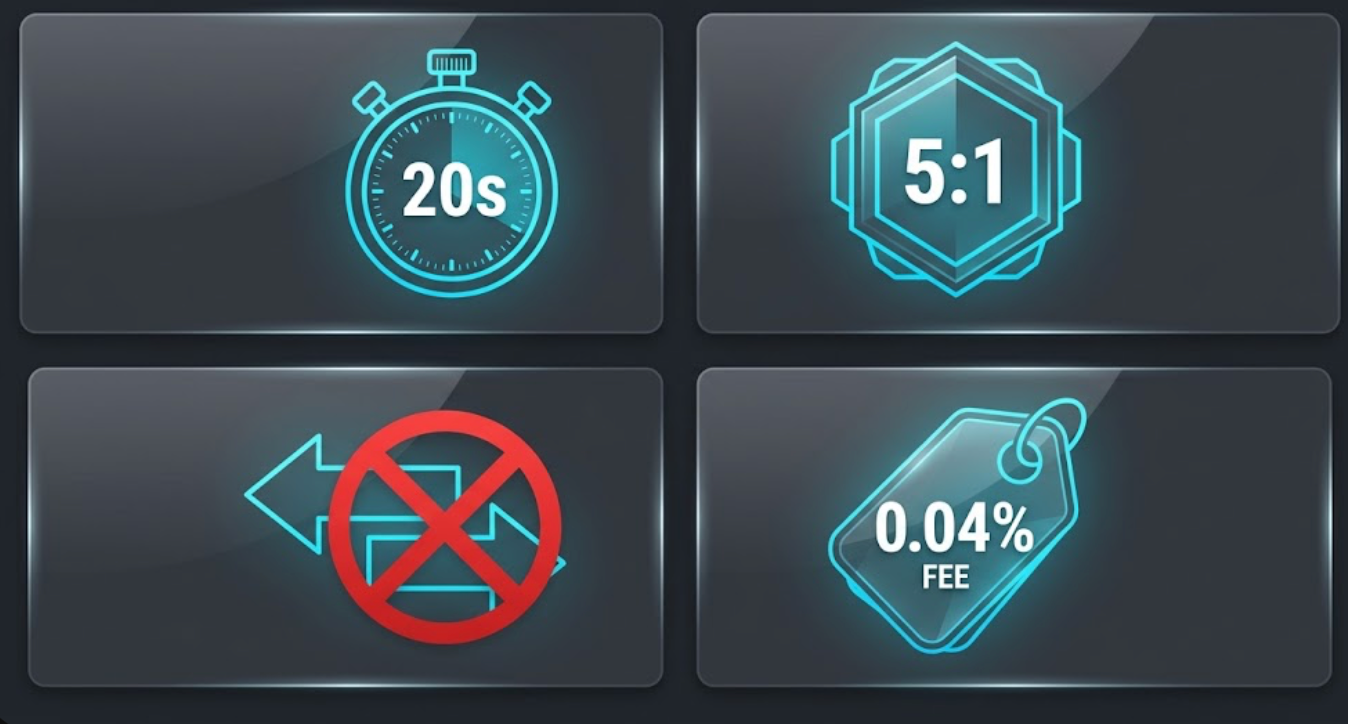
But there are still restrictions. All trades must currently remain open for at least 20 seconds. Tradeify describes this as an anti-microscalping rule. Hedging is prohibited, including opening opposing positions on the same instrument across different Tradeify accounts.
Bots and copy-trading tools can be used under certain conditions, but the trader must own or personally license the software. Shared bots or third-party signal services that automatically execute identical trades for many users are not permitted under the current FAQ.
These details matter because a trading strategy that works elsewhere may not comply with a prop firm's rules. Profitability is only one part of the test. Rule compliance is another.
What Does Trading Cost?
Tradeify says cryptocurrency pairs currently carry a 0.04% commission on the notional value of each transaction. The charge applies when a position is opened and again when it is closed.
According to its FAQ, there are currently no separate overnight fees, swap fees or perpetual-futures-style funding rates. That structure is another reminder that Tradeify Crypto is not simply an ordinary crypto perpetual futures exchange.
Tradeify itself says its crypto product is neither exchange-based trading nor a perpetual futures product. Users trade price movements on DXTrade without owning the underlying cryptocurrency.
For evaluation accounts, the platform currently provides 5:1 leverage on BTC, ETH and PAXG and 2:1 on other crypto pairs. Instant Funding accounts use 2:1 leverage across crypto pairs.
Leverage makes the drawdown limits even more important because relatively small market movements can produce much larger changes in account equity.
Account Fees Are Not Trading Deposits
Another point traders should understand before purchasing an account is what happens to the initial payment.
Tradeify's Terms of Use describe evaluations, activations, upgrades and related purchases as paid services. The terms state that purchases are generally final and non-refundable once access has been provided, unless a separate written agreement says otherwise.
That means the account fee should be treated as a cost of participating in the program, not as cash deposited into a personal trading account.
If a trader fails an evaluation or breaches an account, the fee does not simply return to the user as unused trading capital.
This matters when traders repeatedly purchase challenges.
A relatively inexpensive account can become costly if someone buys a new evaluation each time the previous one fails. The relevant number is therefore not only the price of one challenge, but the total amount spent attempting to reach and maintain payout status.
Is Tradeify Crypto a Regulated Broker?
Tradeify's own terms are clear on this point. The company states that it does not operate as a broker, dealer, futures commission merchant, introducing broker, commodity trading advisor or investment adviser.
This means traders should not describe Tradeify Crypto as a regulated crypto exchange or traditional brokerage simply because it offers a professional trading interface or conducts KYC.
A prop-trading evaluation service is a different type of business.
There is, however, a verifiable corporate entity behind the crypto operation. Florida Division of Corporations records show Tradeify FX LLC as an active Florida limited liability company, filed on November 19, 2025. The public filing lists Brett Simberkoff and Vinan Mistry as managers.
Corporate registration confirms that the legal entity exists. It should not be confused with a financial regulatory license or government endorsement.
Those are separate questions.
Final Thoughts
Tradeify Crypto is easier to understand once you stop equating "funded" with a real brokerage balance.
You're trading in a simulated environment. The account size sets the performance framework — hit the requirements, and you can qualify for real-money payouts.
That model works well for disciplined traders who want to demonstrate their skills without funding the full notional account themselves.
It can also be unforgiving. An open losing trade can breach the drawdown limit. An inactive account can be closed. Profits not yet qualified for payout can be lost if the account fails, and account purchase fees are generally non-refundable.
So the real question isn't whether Tradeify is legitimate. It's whether the rules match how you actually trade.
If you're not sure about that, the account size and advertised profit split shouldn't be your first priority — they should be your last.
Readers can follow broader cryptocurrency research and market coverage through Tapbit. Existing users can log in here, while new users can create an account.
Frequently Asked Questions
What is Tradeify Crypto?
Tradeify Crypto is a proprietary trading program focused on cryptocurrency markets. Traders pay for access to an evaluation or funded account structure, trade under predefined risk rules and may qualify for real-money payouts if they meet the platform's requirements.
Are Tradeify Crypto funded accounts real-money trading accounts?
No. Tradeify Crypto states that its accounts are simulated. The advertised account balance represents notional trading capital rather than cash deposited into a brokerage account controlled by the trader.
Qualifying payouts, however, are paid in real money.
Does a $100,000 Tradeify account mean the trader receives $100,000?
No. A $100,000 account refers to the size of the simulated trading environment. The trader does not receive $100,000 in cash.
The amount of actual risk available to the trader is much smaller because the account is subject to maximum drawdown and, depending on the program, daily loss limits.


