
The SpaceX tokenized stock price can differ sharply across platforms because each product may use a separate contract, liquidity venue, supply figure, or valuation method. A SPACEX quote is therefore not automatically an official SpaceX share price or proof of direct equity ownership.
What Is SpaceX Tokenized Stock and What Does Its Price Represent?
SpaceX is one of the most closely watched private companies in the world, but because it has not conducted a public offering, retail investors cannot simply open a brokerage account and buy shares the way they would with listed equities. Tokenized stock products emerged as one attempt to bridge that gap — and they sit at the intersection of crypto and stocks, combining blockchain settlement with exposure to private-company valuations.
A SpaceX tokenized stock is a digital token whose price is designed to track, or be referenced to, some measure of SpaceX's equity value. Depending on the issuer, the underlying mechanism might be a direct equity claim held in a special-purpose vehicle, a synthetic derivative that references valuation benchmarks, or a contractual entitlement with no direct share backing at all.
What matters most for buyers is what the token does and does not include:
- Most tokenized stock products do not automatically provide voting rights in SpaceX corporate decisions.
- Dividend rights are not automatic — SpaceX currently pays no dividend, and a tokenized product typically does not create a new dividend right even if one were announced.
- The price displayed on any platform represents what participants in that specific market are willing to pay for that specific instrument, which may or may not accurately reflect SpaceX's internal valuation.
The token price is therefore best understood as a market-clearing price for a particular financial product, not a direct window into SpaceX's balance sheet.
Why Does the SPACEX Price Differ Across Platforms?
If you check SPACEX prices across multiple platforms, you will almost certainly see different numbers. This is not a data error — it reflects structural differences between venues.
| Factor | How It Creates Price Divergence |
|---|---|
| Separate order books | Each platform matches buyers and sellers independently; no shared liquidity means prices can move in different directions simultaneously. |
| Different instrument types | One platform may offer a synthetic derivative while another offers an SPV-backed claim; these are economically different products. |
| Contract addresses | On-chain tokens may exist on different blockchains or with different contract addresses, representing distinct issuances. |
| Pricing oracles | Platforms relying on oracles use different data feeds and update frequencies, creating lag-driven divergence. |
| Migration events | Token migrations or reissuances can temporarily fragment liquidity across old and new contract versions. |
| Supply data | Circulating supply figures differ if one platform includes locked or escrowed tokens that another excludes, affecting market-cap calculations. |
The practical implication: a price you see on one aggregator or exchange is the price of that platform's SPACEX instrument in that platform's liquidity environment — nothing more. There is no single authoritative SPACEX spot price the way there is for listed equities with centralized clearing.
Token Price vs Private SpaceX Share Valuation
SpaceX equity trades in private secondary markets among accredited investors at prices that are not publicly disclosed in real time. When a tokenized product claims to track SpaceX's share price, the critical question is: tracked to what, and through what mechanism?
Private company valuations are typically inferred from the last funding round, secondary-market transaction data, or analyst estimates. Comparing a publicly visible token quote to those benchmarks requires knowing:
- The conversion ratio — how many tokens equal one notional SpaceX share under the product's legal documents.
- The legal structure — whether the token represents direct equity, a beneficial interest in an SPV, a synthetic payoff, or something else entirely.
- The valuation source — which funding round or secondary dataset the issuer uses as its reference price.
Without those three pieces of information, a token quote and a private share price are not directly comparable. Investors familiar with how the S&P 500 index works — where constituent weights, rebalancing rules, and calculation methodology are fully disclosed — will appreciate how much structure matters when interpreting any benchmark price.
Can You Buy Real SpaceX Stock Through a Token?
This is one of the most frequently asked questions in the RWA space, and the honest answer is: it depends entirely on the specific product's legal structure, which varies significantly.
| Product Type | What You Actually Hold | SpaceX Share? |
|---|---|---|
| Direct equity token | Token backed by actual SpaceX shares in a custodied SPV | Beneficial interest only; legal title stays with SPV |
| SPV interest | Economic exposure via an off-chain special-purpose vehicle | Indirect; subject to SPV terms and jurisdiction |
| Tokenized claim | Contractual right to cash settlement at a reference price | No shares involved; purely financial |
| Synthetic derivative | On-chain smart contract replicating price exposure | No shares; payoff depends on oracle and counterparty |
None of these structures automatically gives a retail token holder the same rights as a direct SpaceX shareholder. Investors comparing this to more familiar instruments — such as those reviewed in the Palantir stock analysis — should note that even listed-equity analysis depends on clearly defined shareholder rights, disclosure obligations, and regulatory oversight that tokenized private-company products may not replicate.
Always read the issuer's legal documentation before treating a token purchase as equivalent to buying shares.
What Could a Future SpaceX IPO Price Mean for SPACEX Tokens?
As of the date of this article, SpaceX has not filed for a public offering with any securities regulator, and no official IPO date, ticker symbol, offering price, or post-IPO valuation has been announced. Any figure circulating in media or social channels should be treated as speculation.
That said, it is reasonable to consider what a hypothetical IPO might mean for existing SPACEX token holders:
- Repricing: A public offering would establish a market price through a regulated bookbuilding process. Existing tokenized products would need to reconcile their reference prices with the new public market price — a process that depends entirely on issuer terms.
- Settlement questions: Some tokenized structures include clauses that trigger cash settlement or forced conversion at IPO. Others are silent on the topic, creating legal uncertainty.
- Liquidity shift: Public shares would attract institutional and retail flows that currently have no listed venue, potentially making tokenized products less relevant or causing them to trade at discounts.
- Regulatory reclassification: A public company operates under different disclosure rules; regulators in various jurisdictions might reassess how tokenized SpaceX products are classified.
Holders of any SPACEX token should review their product's terms specifically to understand what an IPO scenario would trigger. For context on how AI-driven companies are valued in anticipation of major corporate events, the Nvidia stock outlook discussion offers a useful parallel in thinking about growth-company repricing dynamics.
How to Read SPACEX Price, Volume, Liquidity and Premiums
When reviewing any SPACEX price feed, use this checklist:
Before trusting any quote:
- Confirm the contract address matches the issuer's official documentation.
- Identify the instrument type — synthetic, SPV-backed, or direct claim.
- Note the oracle or data source the platform uses and its update frequency.
- Check the last trade time — thin markets can show stale prices.
Reading premiums and discounts:
A common formula to assess whether a token trades at a premium or discount to the issuer's reference valuation:
Premium / Discount (%) = ((Token Price − Reference Price) ÷ Reference Price) × 100
A positive result means the token trades above the issuer's stated reference. A negative result means it trades below. Large persistent premiums can indicate supply constraints or speculative demand; persistent discounts can signal liquidity or trust concerns.
Volume and liquidity signals:
- Low 24-hour volume relative to market cap suggests the displayed price may not be executable at size.
- Wide bid-ask spreads indicate low liquidity and higher transaction costs.
- Sudden volume spikes without news may reflect oracle updates, token migrations, or thin-book manipulation.
Where Can You Check SpaceX Tokenized Stock Prices?
Price information for SPACEX tokens appears across aggregators, on-chain explorers, and individual platform interfaces. Each source has limitations:
- Aggregators compile prices from multiple venues but may mix data from instruments with different structures, producing a blended figure that does not represent any single tradable product.
- On-chain explorers show actual transaction prices on a given blockchain but require you to verify the correct contract address independently.
- Platform price pages reflect that venue's own order book and should not be assumed to represent the global market.
You can check SPACEX price information on Tapbit's price information page. A price information page confirms that reference data is available; it does not confirm that Tapbit supports SPACEX trading, that the product is available in your jurisdiction, or that any particular legal or economic rights are attached to the instrument.
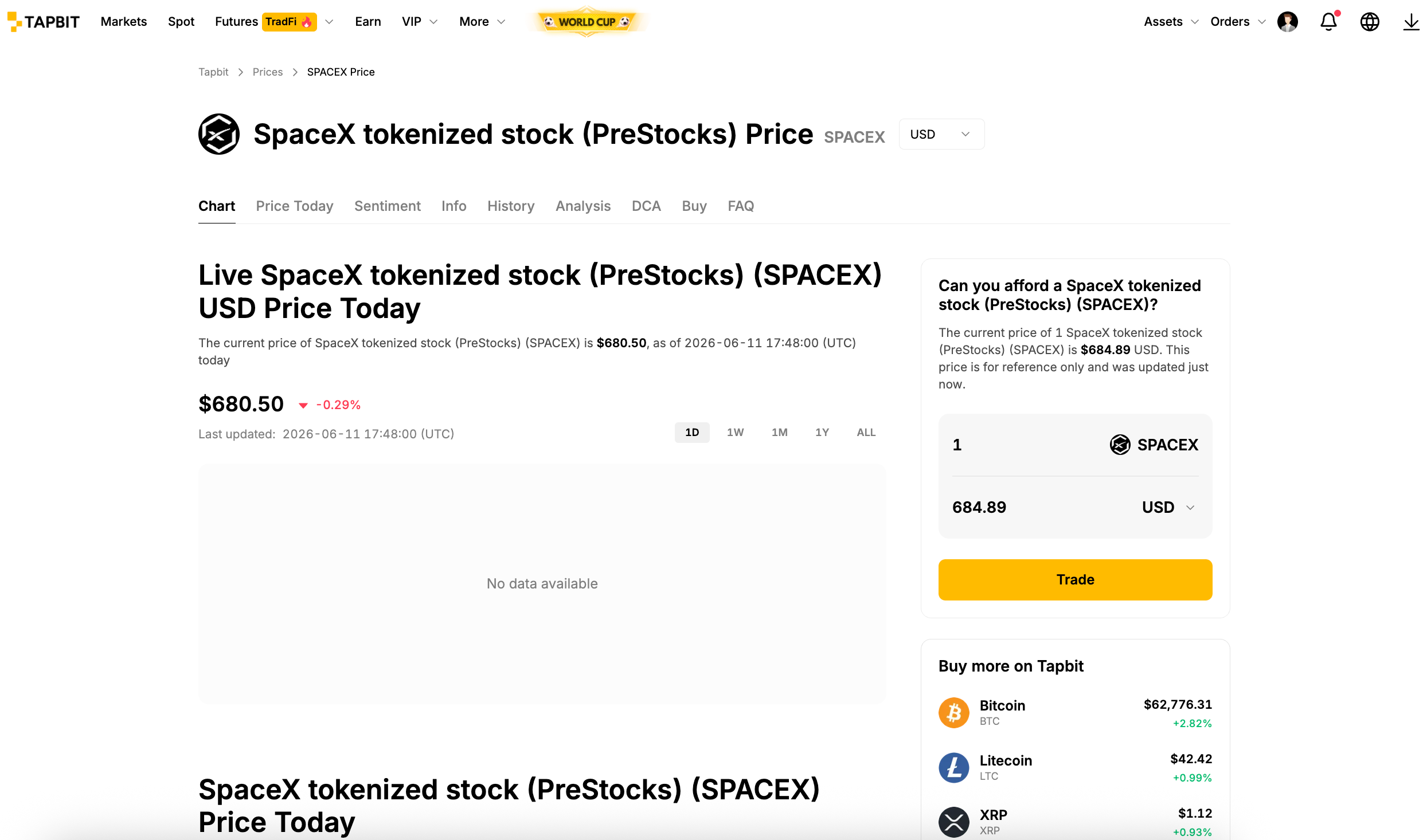
For broader market data across tokenized and crypto assets, you can also view market data to compare price feeds across categories. If you are new to the space and want to explore RWA and tokenized equity products, create an account to access Tapbit's educational resources and price tools.
FAQ
Is SPACEX tokenized stock linked 1:1 to a SpaceX share?
Not necessarily. The ratio depends on the issuer's defined conversion formula. Some products are structured so that one token represents a fraction of a share; others reference share value synthetically without holding any shares. Always check the issuer's product documentation for the exact ratio and legal basis.
Does holding SPACEX tokens provide voting or dividend rights?
In most tokenized structures, the answer is no. Voting rights in SpaceX belong to registered shareholders, not to holders of instruments that reference SpaceX's value. Since SpaceX currently pays no dividend, dividend rights are not relevant today — but even if they were, a tokenized product would not automatically pass them through unless the issuer's legal structure explicitly provides for it.
Why do platforms report different market caps for SPACEX?
Market cap is calculated as price multiplied by circulating supply. Platforms disagree on both inputs: price varies due to separate order books (as explained above), and circulating supply figures differ depending on whether locked, escrowed, or cross-chain tokens are included. Neither figure is standardized across venues.
Where can I buy tokenized SpaceX?
Availability depends on your jurisdiction, the platform's licensing status, and which products are currently offered. Check individual platform disclosures for product availability and regulatory status in your region before proceeding. Tapbit's price information page provides reference data; it does not constitute confirmation of trading availability.


