People searching for SOXL holdings often expect a simple list of semiconductor stocks. That list is useful, but it is only one part of the answer.
SOXL is a daily leveraged exchange-traded fund. Its portfolio is constructed to seek a daily performance target, so the fund can hold financial instruments that look different from the companies represented in its benchmark. Understanding that distinction prevents one of the most common errors in reading an SOXL portfolio.
What Does SOXL Holdings Mean?
The phrase SOXL holdings can refer to two different things:
- the companies included in the semiconductor index or benchmark that SOXL follows; and
- the instruments actually held by the fund to create leveraged daily exposure.
The first category describes the economic theme. It tells investors which part of the semiconductor industry influences the benchmark. The second category describes portfolio implementation. It may include total-return swaps, shares, cash instruments, collateral or other positions used to reach the daily leverage target.
SOXL aims to deliver 300% of its benchmark's daily return before fees and expenses. The word "daily" is essential. It does not mean that a benchmark gaining 10% over a year must produce a 30% SOXL return.
Which Semiconductor Companies Does SOXL Track?
The underlying semiconductor universe can include businesses from several parts of the supply chain:
- chip designers serving AI, computing, mobile and communications markets;
- memory manufacturers;
- analog and mixed-signal semiconductor companies;
- foundry and manufacturing-related businesses;
- semiconductor equipment suppliers; and
- connectivity and infrastructure chip providers.
Well-known semiconductor names may appear in the benchmark, but inclusion and weight are not permanent. Index providers periodically rebalance and reconstitute their indexes. Corporate actions, market capitalization changes and eligibility rules can alter the company mix.
It is therefore better to describe the portfolio by industry role than to present an undated "top ten" as permanent. Readers who need current names should review the latest official index fact sheet and the fund sponsor's dated holdings file.
Why SOXL Holdings Include Swaps and Collateral
A leveraged ETF needs a way to produce more daily market exposure than its net assets alone would normally provide. Total-return swaps are one common tool.
In a swap, the fund and a financial counterparty exchange cash flows based on the performance of a reference asset or index. The arrangement can give the fund additional economic exposure without requiring it to purchase three dollars of physical shares for every dollar of net assets.
Cash, Treasury instruments or money-market holdings may serve as liquidity reserves or collateral connected with those derivative positions. Direct equity holdings may also appear, but a portfolio page dominated by swaps does not mean the semiconductor theme has disappeared. It shows how the daily leverage is being implemented.
This structure introduces considerations beyond the underlying chip companies:
- counterparty exposure to institutions providing swaps;
- financing and transaction costs;
- collateral management;
- tracking differences; and
- the need to rebalance exposure as the fund's value changes.
The fund documents and dated holdings file are the best sources for its current implementation.
How Daily Rebalancing Changes SOXL Exposure
SOXL resets its target exposure each trading day. If the fund gains, the asset base used for the next day's target is larger. If it loses, the base is smaller.
This mechanism creates compounding effects. Consider two simple benchmark paths:
- In a persistent upward trend, gains are repeatedly applied to a growing base, potentially producing more than three times the benchmark's cumulative return.
- In a volatile sideways market, losses and recoveries are applied to different bases, potentially causing SOXL to decline even when the benchmark ends near its starting point.
The effect is called path dependence. It explains why knowing the underlying holdings is necessary but not sufficient. Investors must also understand the daily leverage rule.
Rebalancing can require the fund to increase or reduce derivative exposure near the end of a session. During unusually volatile markets, that activity and the wider demand for leveraged exposure may contribute to tracking differences or trading pressure.
SOXL vs TQQQ: Holdings, Focus and Use Cases
SOXL and TQQQ are often compared because both seek leveraged daily returns, but their economic exposures are different.
| Feature | SOXL | TQQQ |
|---|---|---|
| Main focus | Semiconductor industry | Nasdaq-100 large-cap growth exposure |
| Daily objective | 300% of its benchmark's daily return before fees | 300% of its benchmark's daily return before fees |
| Concentration | One cyclical technology industry | Broader group of non-financial Nasdaq companies |
| Key drivers | Chip cycle, AI infrastructure, memory, foundries and equipment | Mega-cap technology, communications, consumer and growth shares |
| Portfolio tools | May use swaps, securities, cash and collateral | May use swaps, securities, cash and collateral |
| Main analytical question | Is the semiconductor trend broad and durable? | Is large-cap growth leadership durable? |
SOXL can be more directly sensitive to semiconductor inventories, capital expenditure and equipment demand. TQQQ has broader exposure, although a few very large companies can still dominate its behavior.
Neither product should be judged only by its company list. Daily resetting, volatility and derivatives implementation are central to both.
How to Check Current SOXL Holdings and NVDA Weight
The percentage of SOXL associated with NVIDIA or any other company can change. A reliable check should use a consistent date and distinguish benchmark weight from actual portfolio instruments.
Use this process:
- Open the fund sponsor's official holdings page and note the reporting date.
- Review the benchmark or index fact sheet for constituent weights.
- Separate company exposure from swaps, cash and collateral shown in the fund portfolio.
- Check whether a rebalance or reconstitution has occurred since the data date.
- Avoid adding weights from different dates or data providers.
If a swap references the whole benchmark, it may create economic exposure to NVIDIA even when an investor does not see a matching quantity of NVDA shares in the holdings file. That is why the question "What percentage of SOXL is NVDA?" requires both index and implementation context.
How to Trade SOXLUSDT Perpetuals on Tapbit
Tapbit's SOXLUSDT perpetual offers price exposure through a derivative contract. It does not provide ownership of SOXL ETF shares, voting rights, dividends or direct ownership of the fund's semiconductor holdings.
- Create an account or log in, complete the applicable verification steps and fund the derivatives wallet.
- Open trade SOXLUSDT perpetuals and confirm that the selected instrument is the SOXLUSDT perpetual pair.
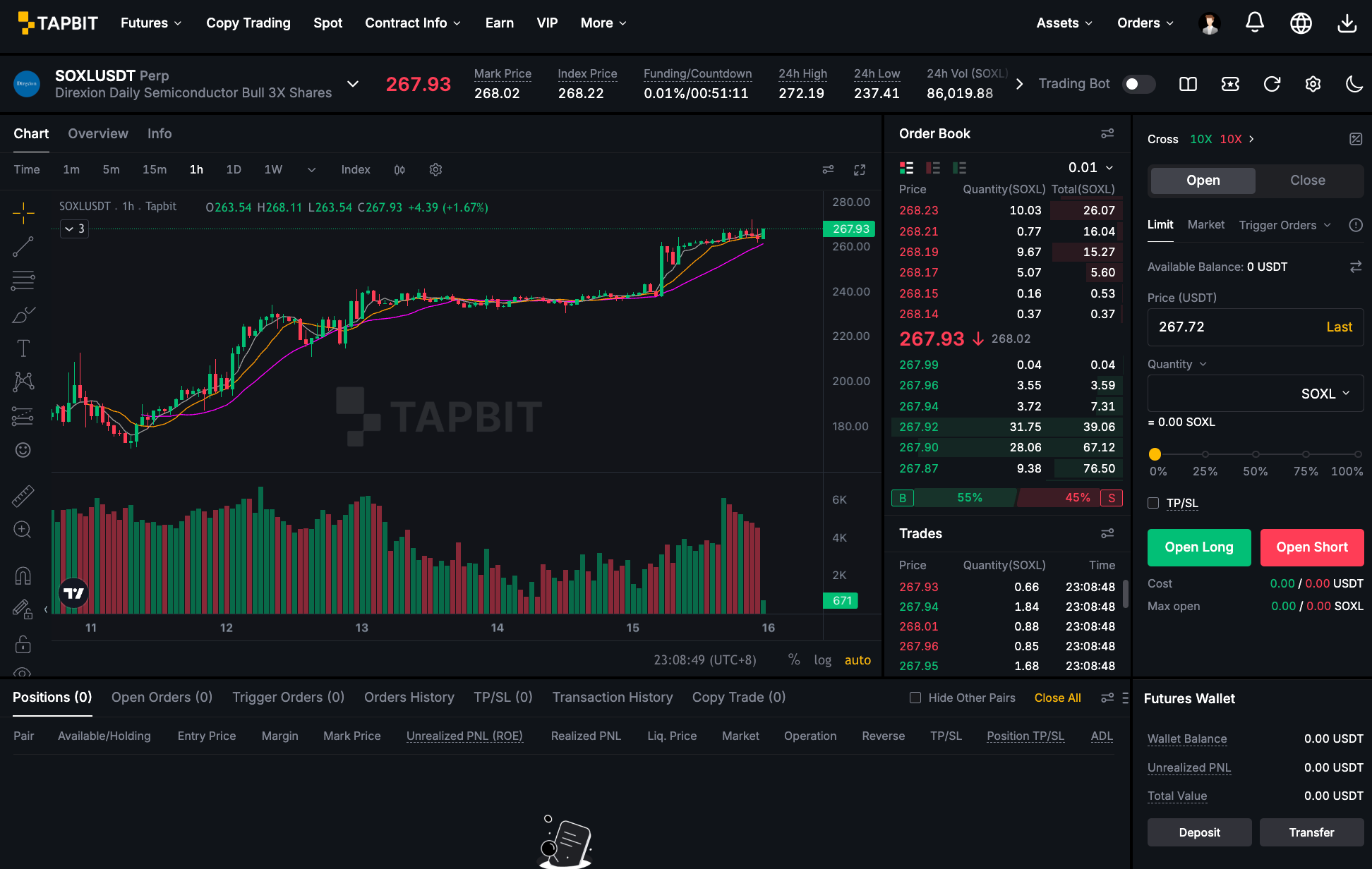
- Review mark and index prices, funding, recent range, volume and order-book depth; then select the margin mode, leverage and order type that match the plan.
- Set position size, take-profit and stop-loss levels before choosing long or short.
Market conditions can change outside the main U.S. equity session. Traders can view market data for wider context and should check the contract's current specifications before placing an order.
Understanding SOXL holdings means looking past a stock list. The benchmark defines the semiconductor exposure, while swaps, securities and collateral help the fund pursue a daily leveraged objective. Daily rebalancing then determines how that exposure compounds over time.
FAQ
Is SOXL a risky stock?
SOXL is an ETF rather than an operating company stock, and it is a high-volatility daily leveraged product. Semiconductor concentration, derivatives, daily resetting and compounding can all produce large gains or losses.
How often do SOXL holdings change?
Portfolio instruments can change frequently as the fund rebalances daily. Benchmark company membership and weights usually change according to the index provider's scheduled or special rebalancing rules.
Does SOXL own every semiconductor stock?
No. Its benchmark follows an eligible set of semiconductor companies, not every company in the global industry. The fund may also use swaps instead of directly holding every benchmark share.
What percentage of SOXL is NVDA?
There is no permanent percentage. Check the latest dated official benchmark weights and fund holdings, and distinguish direct shares from economic exposure delivered through swaps.
What is the difference between SOXL and SOXS?
SOXL seeks 300% of its semiconductor benchmark's daily return, while SOXS seeks an inverse leveraged daily result. Both reset daily and can diverge significantly from simple long-term multiples.


