

Why NVDA Is Still a Core AI Market Asset
NVDA has become one of the clearest symbols of the artificial intelligence investment cycle. Nvidia's GPUs, networking products, AI systems, and software ecosystem remain central to data center expansion, model training, inference workloads, robotics, cloud computing, and enterprise AI deployment.
In 2026, Nvidia continues to sit at the center of the AI infrastructure trade. Demand from cloud providers, AI labs, enterprise customers, and sovereign AI projects has kept investor attention high. The company has also attracted focus after reports of a major bond offering, showing that even the strongest AI companies are raising capital as the sector expands.
For traders, the question is no longer whether Nvidia is important. The real question is whether future growth can still justify a premium valuation.
NVDA Price Prediction: Can It Reach $250?
A $250 target is realistic only under a bullish but not impossible scenario.
NVDA would likely need several factors to align:
| Driver | Why It Matters |
|---|---|
| Strong AI chip demand | Supports revenue growth and pricing power |
| Data center expansion | Keeps order visibility high |
| Margin stability | Helps justify premium valuation |
| Positive analyst revisions | Can attract institutional buying |
| Broader Nasdaq strength | Supports high-growth technology stocks |
| Stable macro conditions | Reduces pressure from rates and risk-off trading |
If Nvidia keeps delivering strong earnings and investors remain confident in AI infrastructure demand, NVDA could attempt a move toward $250. However, if valuation concerns return or AI spending slows, the stock may struggle to sustain that level.
Bullish Scenario for NVDA
The bullish case is built around Nvidia's position as the main infrastructure provider for the AI economy.
In this scenario, hyperscalers continue spending heavily on GPUs, networking, memory-integrated systems, and AI data center capacity. Nvidia successfully passes higher component costs to customers, protects margins, and benefits from new product cycles.
Bullish catalysts may include:
- Strong earnings guidance
- Higher data center revenue
- Continued demand for AI accelerators
- New enterprise AI adoption
- Sovereign AI infrastructure spending
- Stronger semiconductor sector momentum
- Positive analyst target upgrades
Under this scenario, NVDA could test $250 and potentially move higher if market sentiment remains strong.
Neutral Scenario for NVDA
In a neutral scenario, Nvidia remains fundamentally strong but valuation limits upside.
This could happen if earnings continue growing, but investors become less willing to pay higher multiples. The stock may trade sideways as the market waits for new catalysts, such as earnings, product launches, or clearer data center demand.
| Neutral Signal | Possible Meaning |
|---|---|
| Strong revenue but slower growth | Business remains solid, but momentum cools |
| Stable margins | Supports valuation but does not re-rate stock |
| Mixed analyst targets | Market waits for proof |
| Range-bound Nasdaq | Limits breakout potential |
| AI capex debate | Investors question return on spending |
In this case, NVDA may remain volatile between support and resistance levels rather than making a clean move to $250.
Bearish Scenario for NVDA
The bearish case centers on valuation and AI spending risk.
Nvidia is already priced as one of the most important companies in global markets. That means expectations are extremely high. If earnings guidance disappoints, if major customers slow AI spending, or if chip export restrictions intensify, the stock could face pressure.
Key downside risks include:
- AI infrastructure spending fatigue
- China export control restrictions
- Memory and supply chain cost pressure
- Margin compression
- Competition from custom chips
- Broader Nasdaq weakness
- Higher interest rates
- Investor concern over AI valuation bubbles
In this scenario, NVDA could fall well below bullish price targets, even if the company remains a long-term AI leader.
How Nvidia-Linked Futures Fit Into the Market
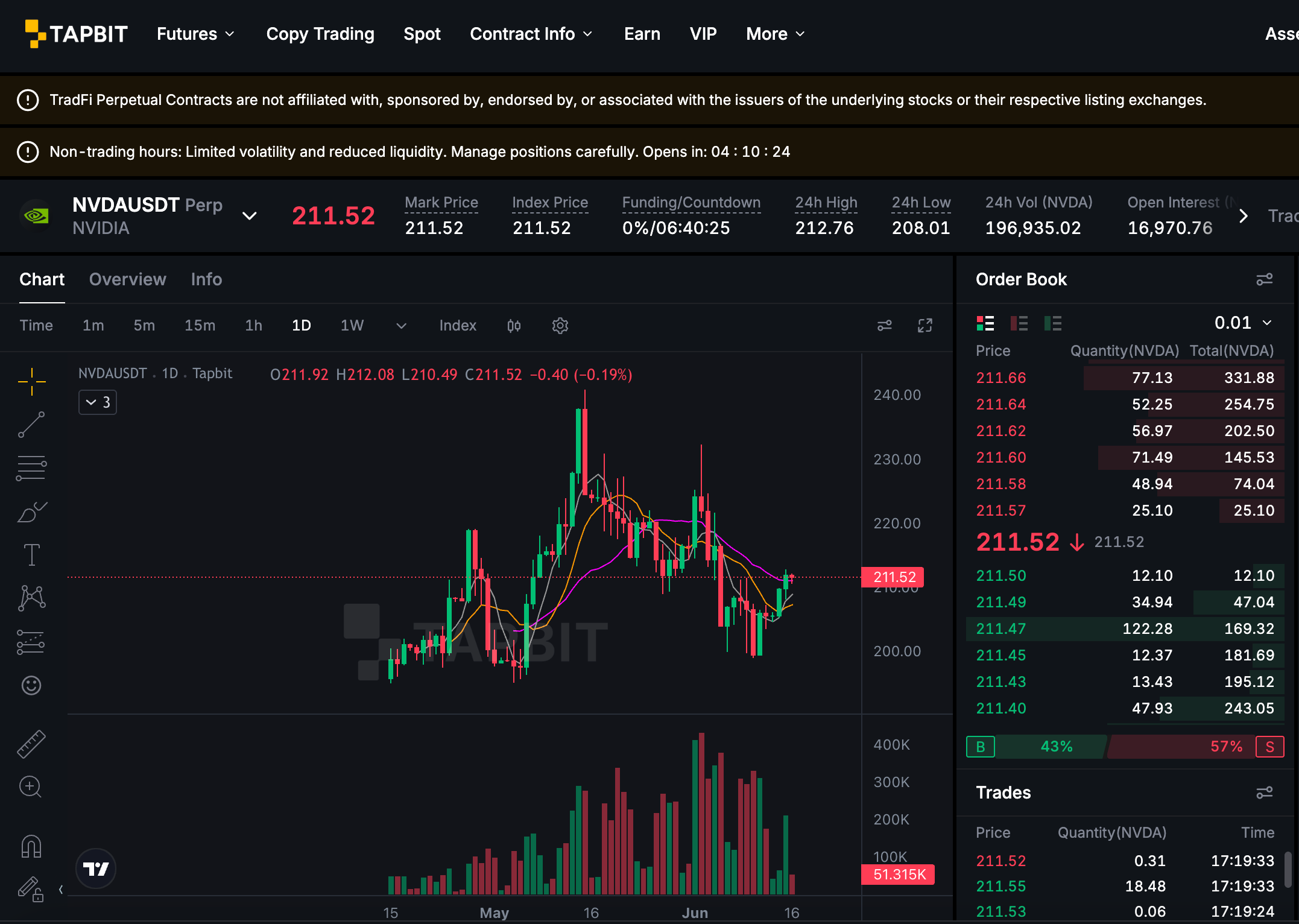
For traders who want to follow NVDA price action through crypto-style derivatives, Nvidia-linked perpetual futures can offer another market structure.
Tapbit provides an NVDA-USDT futures market, allowing users to track Nvidia-linked price exposure through USDT-settled futures.
This type of product may appeal to traders who want:
- Flexible long or short exposure
- Crypto-native account access
- USDT-settled trading
- Faster execution
- The ability to trade market narratives around AI stocks
However, futures trading carries higher risk than spot investing. Leverage can increase profits, but it can also accelerate losses and liquidation risk.
What Could Push NVDA Toward $250?
NVDA could move toward $250 if market confidence improves across several areas.
The strongest catalyst would be another earnings report showing strong data center growth, healthy margins, and robust forward guidance. Investors also want proof that AI spending is not just large, but sustainable.
Other potential catalysts include:
- New AI chip launches
- Strong demand for Rubin or next-generation platforms
- Major cloud customer orders
- Continued semiconductor rally
- Lower interest-rate expectations
- Strong Nasdaq performance
- Positive AI infrastructure announcements
If these factors appear together, the $250 level could become a realistic market target.
What Could Stop NVDA From Reaching $250?
The biggest obstacle is valuation.
Even great companies can underperform if investors believe too much future growth is already priced in. Nvidia's stock can also be affected by news from other semiconductor companies, hyperscaler spending plans, and broader AI sentiment.
A weaker-than-expected outlook from another major chip or cloud company could pressure NVDA, even if Nvidia's own business remains strong.
Investors should also watch debt financing trends across Big Tech. Large AI infrastructure spending requires huge capital, and rising financing costs can make the market more cautious.
Risk Management for NVDA Traders
NVDA-linked products can move quickly, especially around earnings, analyst updates, product events, macro data, and semiconductor news.
A disciplined approach may include:
- Avoiding oversized leveraged positions
- Watching earnings dates and guidance
- Monitoring Nasdaq and semiconductor indexes
- Tracking AI capex commentary from major cloud firms
- Using stop-loss or liquidation-risk controls
- Avoiding emotional entries after large price spikes
For users interested in broader market tools and trading campaigns, the Tapbit rewards page can also be useful to explore platform opportunities.
Conclusion
NVDA remains one of the strongest AI-linked market assets in 2026. Nvidia's role in GPUs, data centers, networking, and AI infrastructure continues to support a powerful long-term narrative.
Can NVDA reach $250? Yes, under a bullish scenario where AI demand remains strong, earnings guidance improves, margins stay resilient, and broader tech sentiment supports growth stocks. But the path is not guaranteed.
The main risks are valuation, export controls, supply chain pressure, hyperscaler capex fatigue, and broader market volatility. Traders using NVDA-linked futures should be especially careful with leverage and treat price targets as scenarios rather than promises.
FAQ
What is the NVDA price prediction for 2026?
NVDA could move higher if AI chip demand, earnings growth, and Nasdaq sentiment remain strong. A $250 target is possible in a bullish scenario, but not guaranteed.
Can NVDA reach $250?
Yes, NVDA could reach $250 if Nvidia delivers strong earnings, maintains margins, and investors stay bullish on AI infrastructure demand.
What could stop NVDA from reaching $250?
High valuation, AI spending concerns, export controls, weaker guidance, margin pressure, and broader market weakness could limit upside.
Where can traders follow NVDA-linked futures?
Traders can view the NVDA-USDT futures market on Tapbit.
Are NVDA futures risky?
Yes. Futures can involve leverage, liquidation risk, fast price swings, and higher volatility than spot investing.
Is NVDA still an AI leader?
Nvidia remains one of the most important AI infrastructure companies, but investors should still evaluate valuation, competition, and macro risk.


