

Solana came closer to a serious network problem on August 12 than many realized at the time.
A routing failure at infrastructure provider TeraSwitch temporarily disconnected about 90 validators — representing roughly 28.8% of staked SOL. The disruption lasted around half an hour and brought the network within about 4.5 percentage points of losing the ability to finalize transactions.
But Solana didn't halt. Blocks continued to be produced, transactions settled, and the chain maintained finality throughout. Solana's official status page still shows 100% Mainnet Beta uptime for the period and lists no network-wide incident for August.
That distinction matters. The event wasn't another full Solana outage — it was a validator infrastructure failure that highlighted how much staked SOL still depends on shared hosting and third-party providers.
For traders, the episode creates an unusual setup. SOL remains near the upper end of its range, but the network just underwent a real-world stress test — one that showed improved resilience on one hand, and a lingering vulnerability on the other. The market hasn't fully priced that tension yet.
What Actually Happened to Solana?
The problem began with a routing failure at TeraSwitch, an infrastructure provider used by a significant number of Solana validators.
Around 90 validators lost connectivity at roughly the same time. Together, they represented approximately 28.83% of the SOL actively securing the network. The affected stake remained offline for about 33 minutes before connectivity was restored.
The incident was therefore different from the software failures associated with some of Solana’s earlier outages.
There was no consensus bug that required validators to coordinate a restart. The blockchain did not stop producing blocks. Instead, a large group of otherwise independent validators became unreachable because they depended on overlapping network infrastructure.
That makes the event less dramatic than a complete chain halt, but arguably more useful as a warning.
Solana survived the failure exactly because enough stake remained online. Had several more large validators disappeared at the same time, the outcome could have been very different.
Why the 33.34% Threshold Matters
Solana’s current Tower BFT consensus system depends on more than two-thirds of staked SOL participating in voting to maintain finality.
If more than roughly one-third of stake becomes unavailable, the network can lose the ability to finalize transactions even if some blocks continue to be produced. During the TeraSwitch incident, offline stake peaked at approximately 28.83%, leaving only a narrow margin before that threshold.
In practical terms, the network came much closer to a finality problem than a casual look at the status page would suggest.
Nothing stopped, so Solana correctly retained its uptime record. But uptime alone does not capture how close a blockchain may come to losing an important safety property.
That is why the incident deserves attention even though users were not left waiting for a chain restart.
The Bigger Issue Is Infrastructure Concentration
Solana has hundreds of voting validators, but validator count alone does not tell the full decentralization story. Validators still need physical servers, data centers, internet connections and routing providers. If apparently independent validators rely on the same underlying infrastructure, they can fail together.
The August 12 event made that risk visible.
Analysis following the incident found that the autonomous system associated with the main failure carried more than a quarter of total staked SOL. When routing failed, much of that stake disappeared from consensus almost simultaneously.
This is known as correlated infrastructure risk. A blockchain can appear decentralized at the validator-operator level while remaining concentrated at the hosting or networking level. If 50 validators are controlled by 50 different operators but all use the same provider, one external failure can still affect all 50.
The lesson from August is therefore not simply that Solana needs more validators. It needs validators spread more effectively across hosting providers, autonomous systems, data centers and geographic regions.
Solana Has Been Trying to Reduce Concentration
This problem is not new to the Solana Foundation. Its delegation program has increasingly focused on building an economically independent validator set rather than simply maximizing validator numbers. Foundation data published in January showed that its own share of delegated stake had declined substantially over time, while the number of validators holding at least 50,000 SOL from sources outside the Foundation’s program had increased by 121% since the revised strategy began in 2024.
That is positive for operator independence.
The TeraSwitch incident shows that the next step is infrastructure independence.
Validator operators can be economically unrelated and still share the same physical or networking dependency. Future decentralization metrics will therefore need to look beyond stake distribution by validator and pay closer attention to where those validators actually run.
Why the Incident Was Also a Positive Stress Test
Almost 29% of staked SOL temporarily disappeared, and the network continued operating. That is not something Solana could take for granted given its history of network disruptions.
The August event showed that the current network can absorb a large infrastructure failure without requiring a coordinated restart. Blocks continued, users kept transacting and consensus remained above the required threshold.
The network was close to the edge, but it stayed on the correct side of it. That makes the incident both a warning and evidence of improved resilience.
It would be a mistake to describe it as proof that Solana’s reliability problems have been solved. It would be equally misleading to describe it as another complete Solana outage.
Both interpretations miss what actually happened.
SOL Is Trading Near Another Important Test
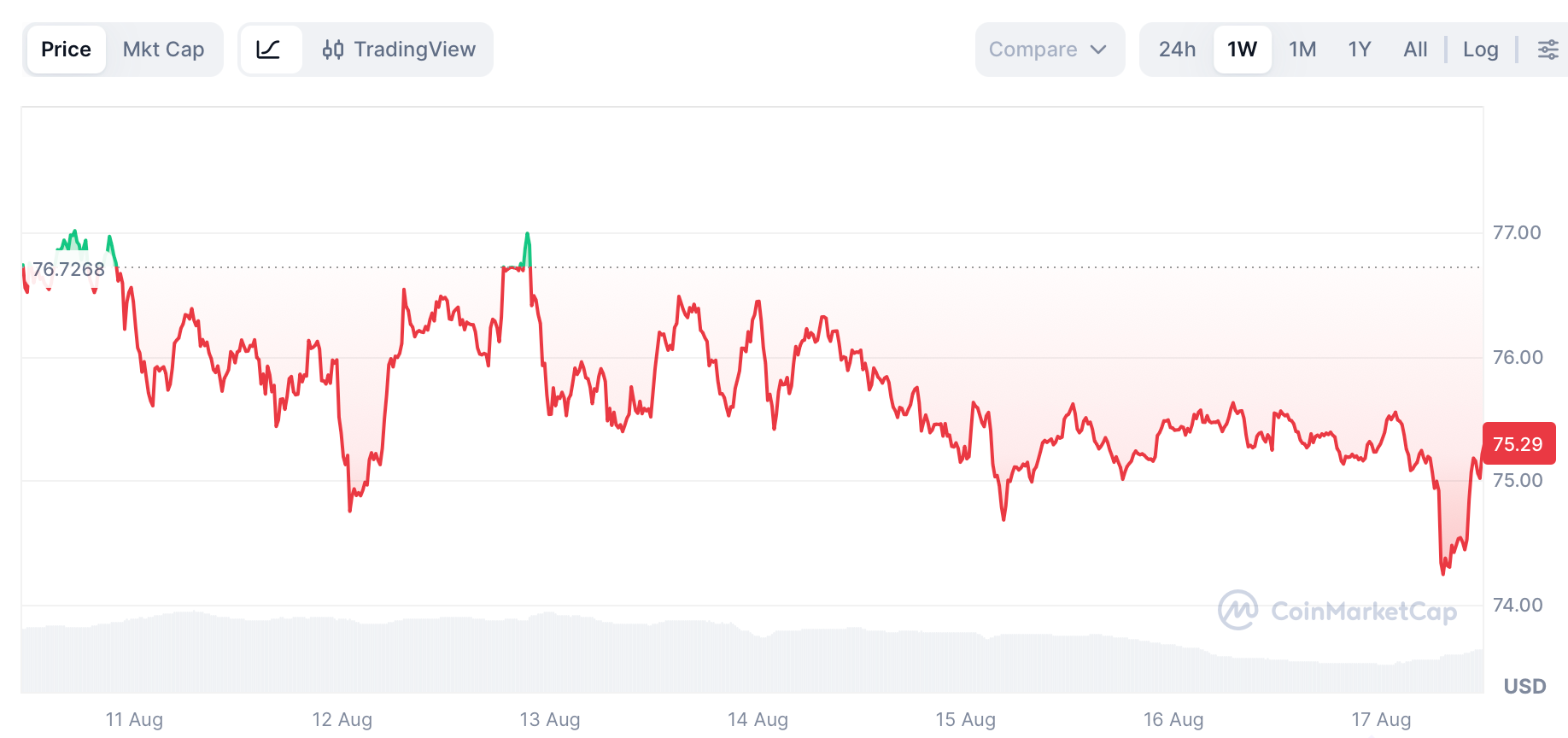
SOL was trading around $75.29 at the time of writing.
That places the token just below a resistance area that has repeatedly mattered around $80.
Recent technical reference levels place initial resistance near $80, followed by another zone around $82–$85. Support sits closer to the low-$70s, with a deeper support area around the low-$60s.
This makes the current setup relatively clear. The validator incident did not trigger a major collapse in SOL. But price has also not yet produced the kind of breakout that would confirm a stronger rally.
For bulls, the next task is to reclaim $80 and then prove that demand can hold through the $82–$85 area.
Alpenglow Could Change Solana’s Consensus Model
The timing of the validator incident is especially interesting because Solana is preparing its largest consensus change in years.
Alpenglow is intended to replace Tower BFT, beginning with a new voting system known as Votor. Solana says the upgrade targets roughly 150-millisecond finality compared with approximately 12.8 seconds for Tower BFT finality today. Phase 1 is targeted for mainnet activation in Q3 2026.
The new design also changes the network’s tolerance model. Solana describes Alpenglow as capable of handling a combination of 20% adversarial stake and 20% offline stake while still reaching consensus under its designed assumptions.
Anza, one of the core engineering teams working on Solana, has also identified Alpenglow as a major 2026 priority alongside efforts to increase bandwidth, lower latency and improve liveness.
That could materially improve the protocol layer. It will not, however, eliminate the infrastructure problem exposed by TeraSwitch.
A more advanced consensus algorithm cannot stop multiple validators from losing connectivity when they share the same external provider.
Institutional Access to SOL Has Expanded
SOL also trades in a very different investment environment from the one that existed during Solana’s earlier outages.
Traditional investors now have access to exchange-traded SOL products. Grayscale’s Solana Staking ETF, GSOL, has traded on NYSE Arca since October 2025 and provides securities-market exposure to SOL and potential staking rewards. Grayscale reported that the product had 100% of its SOL staked as of August 7, 2026.
Franklin Templeton also operates a Solana ETF listed on NYSE Arca under the ticker SOEZ.
These products do not guarantee institutional buying or higher SOL prices. They do mean that network reliability now matters to a broader group of market participants. A serious finality failure would no longer affect only crypto-native traders and validators; it could also influence investment products traded through conventional brokerage accounts.
That raises the economic cost of infrastructure failures as Solana becomes more integrated with traditional markets.
How Traders Can Follow SOL on Tapbit
Traders looking to follow SOL directly can access the SOL/USDT spot market on Tapbit. Tapbit’s own Solana guide confirms that SOL/USDT is available through its spot market.
Those who prefer derivatives can trade SOL through Tapbit’s USDT perpetual market. Tapbit documentation lists SOL/USDT among its supported perpetual contracts and explains that USDT perpetuals support both long and short positions.
Futures traders should remember that leverage adds another layer of risk. A network headline can move SOL rapidly, and leveraged positions can be liquidated long before a longer-term thesis plays out. Tapbit itself classifies futures trading as high risk.
What Traders Should Watch Next
The next phase is less about whether Solana technically recorded an outage and more about what happens after the near-miss.
Validator operators will face pressure to diversify hosting arrangements and improve failover systems. Stake providers may also reconsider how much SOL they delegate to validators that share the same infrastructure dependencies.
At the protocol level, Alpenglow remains one of the most important upcoming upgrades. At the market level, SOL still has to prove it can clear the $80–$85 resistance area.
Those two stories are now connected.
A strong technical breakout accompanied by continued network stability would reinforce the view that Solana has moved beyond many of the reliability issues that defined its earlier years.
Another major infrastructure failure would do the opposite.
Readers can follow broader cryptocurrency research and market coverage through Tapbit. Existing users can log in here, while new users can create an account.
Frequently Asked Questions
Did Solana go offline in August 2026?
No. On August 12, a routing failure temporarily disconnected validators representing about 28.8% of staked SOL, but Solana continued producing blocks and finalizing transactions. Its official status page does not record a network-wide outage for August.
What caused the Solana validator problem?
The incident was linked to a routing failure at infrastructure provider TeraSwitch rather than a failure of Solana’s consensus software. Around 90 validators were affected for approximately 33 minutes.
How close was Solana to losing finality?
Offline stake reached approximately 28.83%. Solana’s current consensus requires more than two-thirds of stake to participate for finality, meaning the network was roughly 4.5 percentage points away from the one-third offline threshold.


