

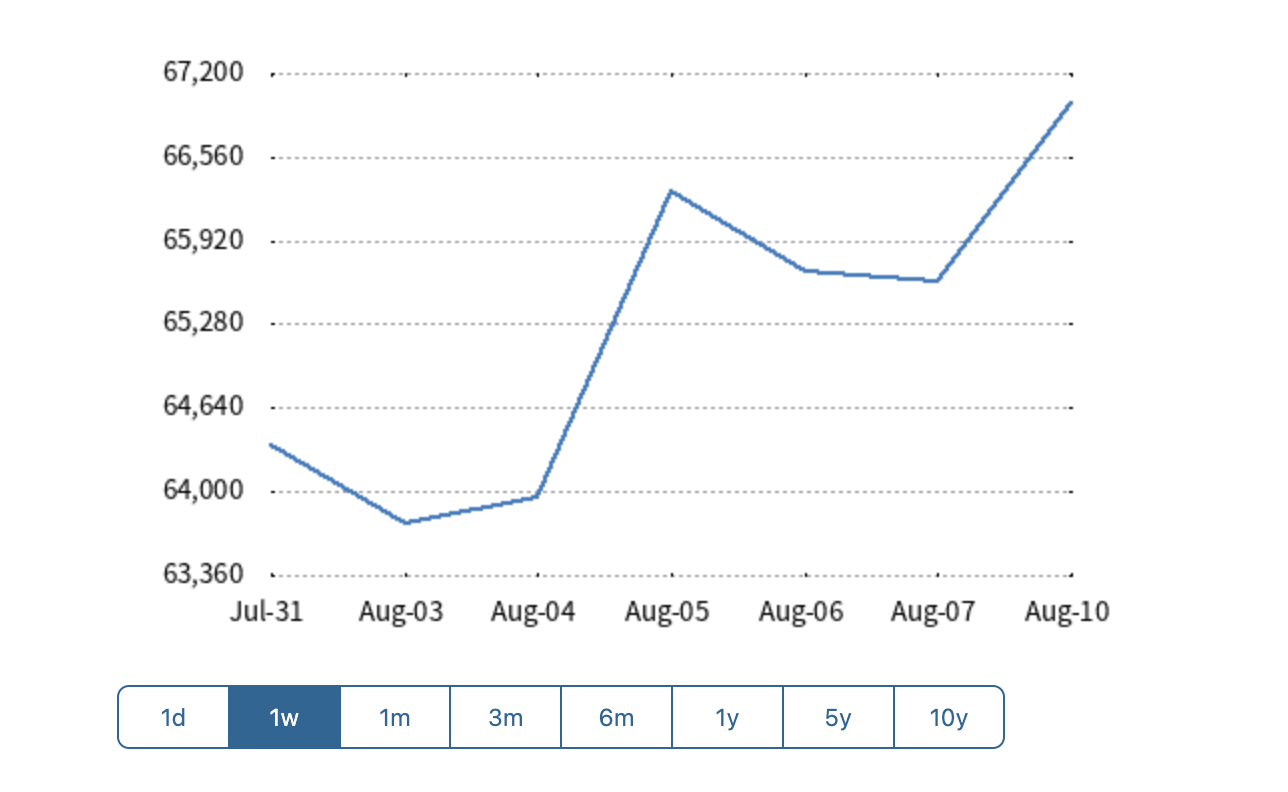
The Nikkei 225 is no longer trying to recover from a weak cycle. After closing at a record 66,329.50 on May 29, 2026, Japan’s benchmark entered a more demanding phase: proving that earnings, capital returns and technology investment can support valuations near historic highs. Around August 10, the index remained close to 66,376, keeping the 66,000–70,000 zone at the center of the Nikkei 225 price prediction debate.
Investors who want to follow global equity and crypto-linked market opportunities can create a Tapbit account and explore the platform’s available markets. Availability varies by product and region, so traders should check the live market page before taking a position.
Nikkei 225 Price Today and Recent Record High
The Nikkei’s May 29 close above 66,000 was its first ever, according to Nippon.com and Jiji Press. The index then stayed near that record area into August. This resilience matters because markets often retreat sharply after a landmark breakout. Instead, Japanese equities have continued to attract buyers even as investors debate interest rates, the yen and stretched AI-related valuations.
That does not mean the index is moving in a straight line. At this level, a change of only a few percentage points can produce large headline swings. Traders should distinguish between a normal consolidation above 62,800 and a more serious trend reversal below that area.
Why Japan’s Stock Market Has Been Rallying
Several forces have supported the Japan stock market prediction. First, listed companies have improved profitability and increased share buybacks. Corporate-governance reforms have encouraged management teams to focus more closely on return on equity, balance-sheet efficiency and shareholder value.
Second, a relatively weak yen can lift the translated overseas earnings of exporters. Automakers, machinery companies and electronics groups may report stronger yen-denominated results when foreign revenue is converted back into Japan’s currency. Third, enthusiasm for artificial intelligence has brought capital into semiconductor equipment, data-center infrastructure and automation names.
These drivers reinforce one another, but they are not permanent. A rapid yen rebound could reduce exporter earnings expectations, while a global AI correction could pressure the most expensive technology shares.
Can the Nikkei 225 Retest Its All-Time High?
Yes. With the index already trading near its record, a retest requires only stable earnings and continued demand. The more difficult question is whether it can hold above the previous peak and advance toward 69,000 or 70,000.
A sustainable breakout would ideally include broad participation beyond a small group of heavyweight technology stocks. Banks, industrials, consumer companies and exporters would need to contribute. Rising prices accompanied by improving earnings forecasts and healthy market breadth would be more convincing than a narrow rally driven by a few AI names.
Nikkei 225 Price Prediction 2026–2027
A May Reuters poll, reported by Investing.com, placed the median analyst forecast near 62,800 for the end of 2026 and 69,000 for the end of 2027. The lower 2026 estimate does not necessarily signal a bear market. It suggests analysts expect some cooling or consolidation after the unusually strong advance.
| Scenario | Potential range | Main conditions |
|---|---|---|
| Bull case | 69,000–70,000+ | Strong earnings, buybacks, weak yen and sustained AI demand |
| Base case | 62,800–69,000 | Moderate growth, gradual BOJ normalization and stable global markets |
| Bear case | Below 62,800 | Sharper BOJ tightening, yen rebound, oil shock or technology sell-off |
Forecasts are scenarios, not guarantees. Index composition, currency moves and global risk appetite can make the Nikkei diverge quickly from consensus targets.
Bull Case: Earnings, Buybacks, Weak Yen, and AI Demand
The bullish case starts with Japanese companies continuing to raise profits and return excess cash to shareholders. More buybacks can reduce share supply and support earnings per share. A controlled, gradual normalization by the Bank of Japan could also be absorbed if domestic growth remains healthy.
AI investment is another possible catalyst. Japan has globally important suppliers in semiconductor manufacturing equipment, materials, robotics and precision components. If data-center spending continues, these companies may benefit even when the end demand originates outside Japan. Under this scenario, 69,000 becomes realistic, and a move through 70,000 could follow if foreign inflows accelerate.
Bear Case: BOJ Tightening, Yen Rebound, and Valuation Risk
The principal risk is that supportive conditions reverse together. The Bank of Japan’s 2026 outlook expects moderate economic growth but highlights uncertainty around inflation, oil prices, geopolitical conditions and policy normalization. The BOJ has also indicated that it will adjust monetary accommodation in response to economic, price and financial conditions.
Higher rates can raise discount rates and challenge richly valued growth stocks. A stronger yen may reduce exporters’ translated profits. Higher oil prices would increase costs for an economy that imports substantial energy. Finally, if global investors reduce exposure to AI shares, the Nikkei’s high-weight technology constituents could amplify the decline.
Key Levels to Watch: 62,800, 66,000, 69,000, and 70,000
- 62,800: The Reuters poll’s median end-2026 forecast and a useful base-case reference.
- 66,000: The record-closing breakout zone. Holding it would support the bullish structure.
- 69,000: The median end-2027 forecast and a plausible upside target.
- 70,000: A major psychological threshold likely to attract profit-taking and momentum interest.
These levels should be treated as decision zones rather than exact turning points. Traders should also watch earnings revisions, USD/JPY, BOJ communication, crude-oil prices and the performance of global semiconductor stocks.
Final Thoughts
The Nikkei 225 can retest or exceed its all-time high if Japanese earnings, buybacks, AI demand, and yen weakness remain supportive, but BOJ tightening and a stronger yen could turn the 66,000–70,000 zone into a difficult resistance area. The most balanced 2026–2027 outlook is therefore constructive but selective: the long-term reform story remains intact, while the starting valuation leaves less room for disappointment.
Frequently Asked Questions
What is the Nikkei 225 all-time high?
The index closed at a record 66,329.50 on May 29, 2026, and remained near that historic region in August.
Can the Nikkei reach 70,000?
It can, especially if earnings, buybacks, AI investment and a weak yen remain supportive. However, 70,000 is likely to be a difficult psychological resistance area.
What is the Nikkei 225 forecast for 2026?
A May Reuters poll showed a median analyst forecast of about 62,800 for the end of 2026, implying possible consolidation after the record rally.
What is the Nikkei 225 forecast for 2027?
The same poll placed the median end-2027 forecast near 69,000, although actual results will depend on earnings, currency moves and BOJ policy.
How does BOJ policy affect Japanese stocks?
Higher rates can increase financing and valuation pressure, while a stronger yen may reduce translated exporter earnings. Gradual tightening alongside stronger growth can be less disruptive.


