

"Moonshot crypto" is back in circulation as traders return to smaller, faster-moving tokens. The idea is simple enough — find an early asset, buy before attention arrives, and capture an outsized move.
In practice, though, it describes a type of speculation, not a reliable category of quality. That distinction matters.
The recent rally in small memecoins has shown how quickly capital can move down the risk curve when sentiment improves. But the same conditions that produce sharp gains can also create thin liquidity, crowded exits, and large losses for late buyers.
There's also a naming issue. "Moonshot" may refer to high-risk tokens broadly, the Moonshot trading application, or recent pre-IPO perpetual products tied to Moonshot AI. They are not the same thing — and confusing them is the first mistake.
Moonshot Crypto Usually Means a High-Risk Trade
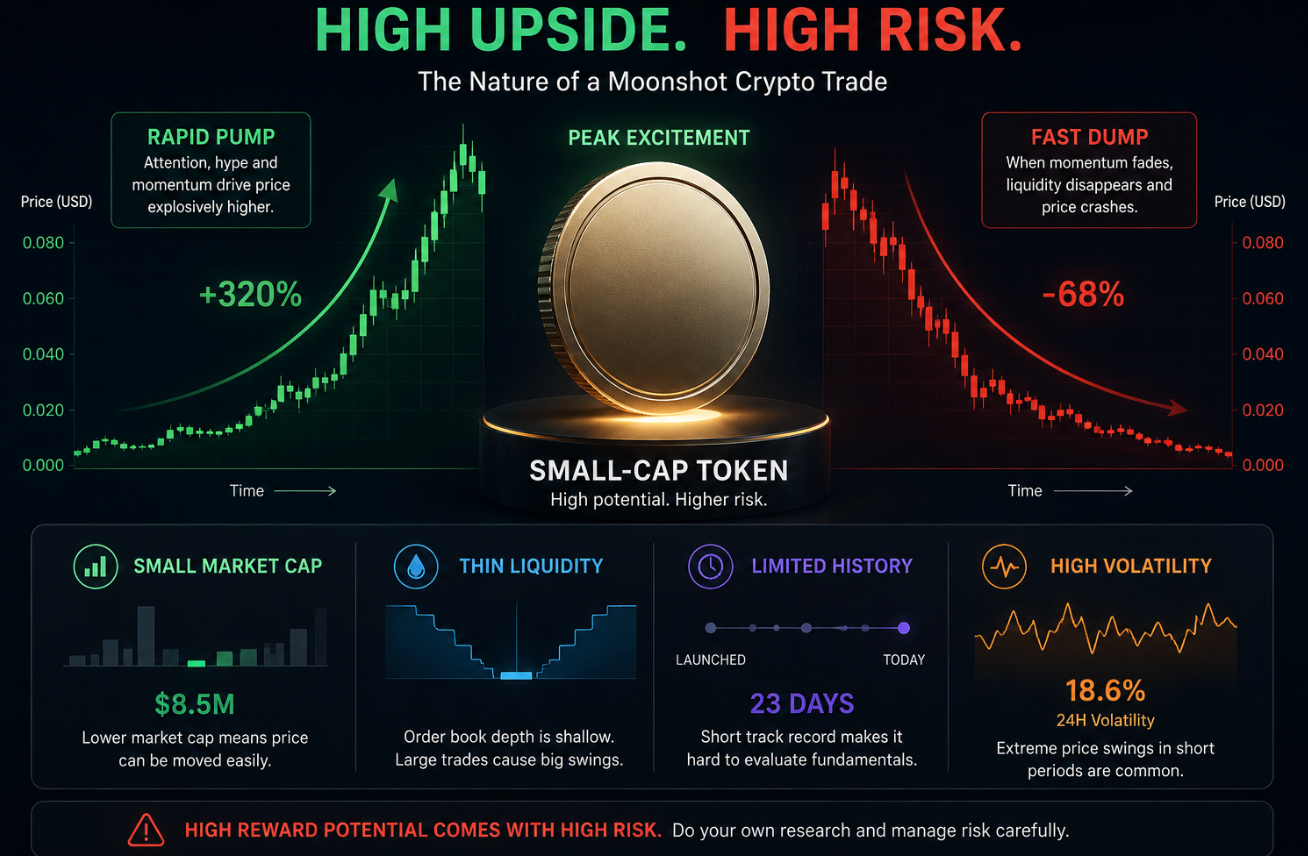
In crypto markets, a moonshot is generally an asset with a small market capitalization, limited trading history and an ambitious upside narrative. It may be a memecoin, a token connected to a new blockchain ecosystem, an early-stage DeFi project, or a presale.
The attraction is obvious. Small assets can move much faster than Bitcoin or Ethereum when attention, liquidity and social momentum arrive at once.
The problem is equally obvious: a large percentage gain does not automatically reflect a working product, lasting demand or a sustainable market.
A token can rise because a few wallets bought aggressively, a popular account posted about it, or traders fear missing the next move. Those factors can be enough to move a small market. They are not, by themselves, an investment case.
Why the Theme Has Returned
The recent rotation into smaller memecoins is part of a broader return of speculative appetite. In late August, CoinDesk reported strong weekly gains across dog- and cat-themed tokens, including Cash Cat, Thinking Cat, Purr, Dog, WIF and Bonk. The moves coincided with a sharp improvement in crypto sentiment, showing how quickly funds can move from major assets into more speculative corners of the market.
That does not mean every newly launched token is becoming valuable. It means traders are again willing to take more risk.
This phase of the cycle usually has a familiar pattern. Liquidity reaches larger assets first. Once prices stabilize or rally, attention shifts toward tokens with smaller floats, louder narratives and lower entry prices. A handful may sustain interest. Most struggle when the initial buying pressure fades.
The label “moonshot” often appears at exactly this point, when possibility is easier to sell than proof.
The Moonshot Name Can Mean Different Things
Moonshot is also the name of a crypto application that allows users to discover and interact with third-party blockchain assets. Its terms state that it is not a broker, custodian or investment adviser, and that it does not directly create, develop or endorse cryptocurrencies. That is important context: use of the application should not be treated as confirmation that a token is official or approved.
Separately, some exchanges have introduced MOONSHOT/USDT pre-IPO perpetual products tied to Moonshot AI, the company behind Kimi. These are valuation-based derivatives, not shares and not a crypto token issued by Moonshot AI. Traders do not gain equity ownership through the contract, and its price can differ substantially from a future IPO price.
Before trading anything carrying the Moonshot name, check the exact ticker, chain, contract type and underlying asset. Similar names are not evidence of a relationship.
What Separates a Tradeable Idea From a Fragile Token
The most useful question is not “Can this token go up?” Nearly any small token can move sharply under the right conditions. However, A better question is: “What would still matter after the first wave of attention disappears?”
Start with liquidity. A token may show a rising price while having very little usable depth. When the order book or liquidity pool is shallow, a relatively small buy can create a large candle. The same is true in reverse when holders decide to sell.
Then look at ownership. If a small number of wallets control a large share of supply, the market may be exposed to sudden selling pressure. A high headline market capitalization does not protect traders from this risk.
The project’s claims also deserve a basic reality check. Is there a product that can be used? Is there a public team, a clear token role, and evidence of users or partners? Or is the entire narrative built around a meme, a chart and a social-media campaign?
None of these checks can remove risk. They can, however, help distinguish a transparent speculative trade from a token that leaves buyers with no reliable information at all.
Fast Gains Can Hide a Difficult Exit
A rally can look convincing on a chart and still be hard to trade in reality.
One warning sign is unusually high volume relative to the token’s size. It may indicate genuine market interest, but it can also reflect short-term churn. When the same traders are repeatedly entering and exiting a thin market, price can move far beyond what the available liquidity would support during a broad sell-off.
Recent token stories offer a reminder. CoinDesk reported that a GTA 6-themed memecoin rose rapidly after leaked content drew attention, while the creator later sold holdings before an official game update. The episode was not proof that every viral token is manipulated. It did show why a popular theme, a viral post and a rising chart should never replace token-level due diligence.
The late buyer in a moonshot trade is often not buying an early idea. They may be buying the exit liquidity for people who arrived first.
A Practical Way to Handle Moonshot Risk
Moonshot tokens belong in the highest-risk part of a portfolio, if they belong anywhere at all. Treating them like Bitcoin, Ethereum or a liquid large-cap asset is a category error.
Traders who choose to participate should decide in advance how much they are willing to lose, avoid using leverage on an asset with limited liquidity, and know what would invalidate the trade. A social-media trend is not an exit plan.
It also helps to separate a token’s narrative from the mechanics of trading it. A good meme may attract attention. A real product may attract users. Neither guarantees that the token has adequate liquidity, fair distribution or a price that can hold once momentum turns.
The Point Is Not to Avoid Every Moonshot
There is nothing unusual about speculation in crypto. New ideas, new communities and new markets can begin at the edges before becoming widely understood.
But the word “moonshot” should describe the level of risk, not the strength of the opportunity.
The market is currently rewarding speed, narrative and attention in parts of the low-cap token universe. That can produce remarkable returns for a small number of early participants. It can also produce losses just as quickly for traders who confuse visibility with value.
For broader market research and tools for following crypto markets, visit Tapbit. Users can log in or create an account.
Frequently Asked Questions
Is Moonshot crypto an official cryptocurrency?
Not necessarily. “Moonshot crypto” is commonly used as a general label for high-risk, high-upside token speculation. It can also refer to the Moonshot app or to Moonshot AI-related pre-IPO perpetual contracts. Always verify the exact asset before trading.
Does Moonshot have an official token?
Current official Moonshot materials describe the service as an application for interacting with third-party blockchain assets. They do not establish a broadly verified official Moonshot cryptocurrency. A token using the name should not be assumed to be official without direct confirmation from the relevant project.
Is MOONSHOT/USDT the same as Moonshot AI stock?
No. A pre-IPO MOONSHOT/USDT perpetual contract is a derivative that tracks an estimated valuation or price index. It does not give the trader ownership of Moonshot AI shares.


