
What Is AVOF Coin?
American Virtual Oil Fund, usually shortened to AVOF Coin, is a crypto token built around an oil and fund-style narrative. The name is doing a lot of work: it hints at energy, commodities, U.S.-linked branding, and something that sounds more structured than a typical meme coin.
That is exactly why investors need to slow down. In crypto, a professional-sounding name does not automatically mean there is a professional financial structure behind it. AVOF may use oil-related language, but that does not prove ownership of crude oil, energy assets, storage facilities, futures contracts, or revenue from the oil industry.
 For now, AVOF is best approached as a speculative digital asset unless the project can show clear evidence of real backing, audited reserves, and legally defined token-holder rights.
Why AVOF Is Getting Attention
Oil is a powerful market theme. It touches inflation, transportation, geopolitics, energy security, and global growth. When oil prices become volatile, traders often look for assets that can capture the story.
Crypto markets also like simple narratives. A token connected to oil, reserves, or real-world assets is easy to understand, even if the actual project details are still thin. That can create short bursts of attention, especially when broader markets are already focused on commodities or inflation.
| Narrative | Why Traders Notice It |
|---|---|
| Oil branding | Links the token to a major global commodity |
| Fund-style name | Creates a more institutional impression |
| RWA trend | Connects the project to real-world asset tokenization |
| Inflation theme | Commodities often regain attention when prices rise |
| Speculative demand | Small tokens can move quickly when the story spreads |
The important point is that a narrative can move a token without proving long-term value.
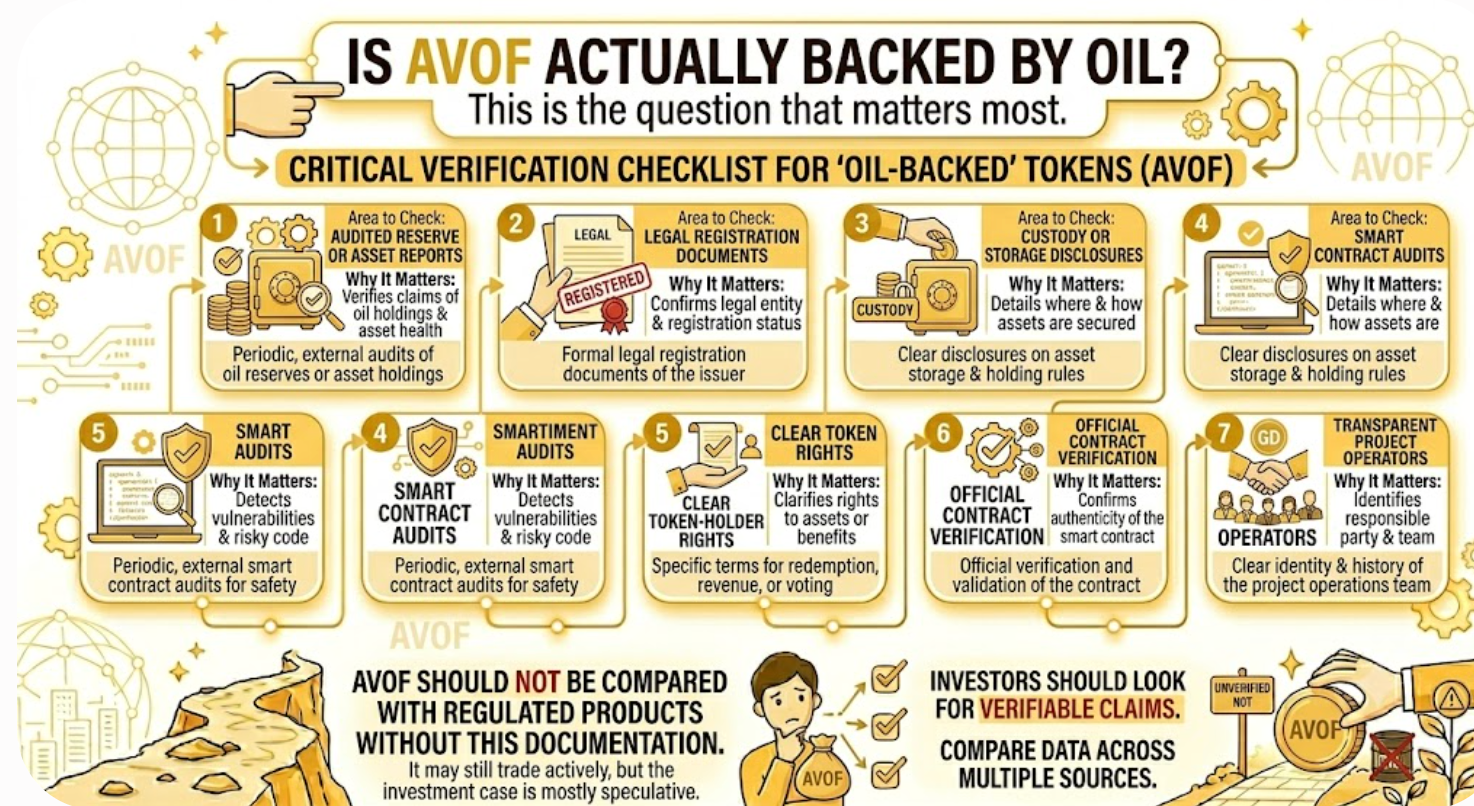
Is AVOF Actually Backed by Oil?
This is the question that matters most.
If AVOF claims to be oil-backed, investors should expect real documentation. That means audited reserve reports, custody or storage details, legal registration records, redemption rules, and clear explanations of what token holders actually own.
Without those materials, AVOF should not be compared with an oil ETF, a commodity fund, or a regulated investment product. It may still trade actively, but the investment case becomes mostly speculative.
Before taking any claim seriously, investors should look for:
- Audited reserve or asset reports
- Legal registration documents
- Custody or storage disclosures
- Smart contract audits
- Clear token-holder rights
- Official contract verification
- Transparent project operators
If those details are missing, the safer assumption is that AVOF is an oil-themed token rather than a proven oil-backed asset.
The Bullish Case for AVOF in 2026
There is still a possible bullish case. AVOF could benefit if energy markets stay in the headlines and traders keep looking for commodity-linked crypto ideas.
The token could also gain traction if the project becomes easier to verify. Better liquidity, clearer tokenomics, a stronger community, and more consistent updates would help investors take the project more seriously.
Potential positive signals include:
- A verified official contract address
- Deeper liquidity pools
- More reliable market data
- Transparent token supply information
- Evidence supporting any oil-related claims
- Consistent project communication
- Broader interest in RWA tokens
If several of these signals improve at the same time, AVOF could attract more speculative demand. Still, that would be a trading thesis, not proof that the project is fundamentally strong.
The Bearish Case for AVOF
The bearish case is straightforward: the name may be stronger than the evidence.
If AVOF cannot prove asset backing or real utility, the token may struggle once the initial oil narrative cools. Thin liquidity can also make price moves look more dramatic than they really are. A small amount of buying can push the price up, but a small amount of selling can do the same in reverse.
| Risk | Why It Matters |
|---|---|
| Unclear oil backing | Investors may overestimate the token's value |
| Low liquidity | Exiting a position may be difficult |
| Holder concentration | Large wallets can move the market |
| Copycat tokens | Users may buy the wrong contract |
| Limited transparency | Hard to judge whether the project is serious |
| Short-lived hype | Demand can fade when the story moves on |
These risks do not automatically make AVOF a scam, but they do mean investors should demand evidence before treating it as an investment.
Is AVOF Coin a Good Investment in 2026?
AVOF may be interesting for traders who understand high-risk, narrative-driven tokens. The oil angle is easy to grasp, and the RWA theme remains active across crypto.
But for long-term investors, the bar is higher. AVOF needs more than a good name. It needs verifiable information, sufficient liquidity, clear tokenomics, and credible documentation around any oil or fund-related claims.
If those pieces are not available, AVOF should be treated as a speculative trade rather than a serious long-term holding.
Users who want to follow broader crypto market trends can explore tools through the official Tapbit platform.
What to Check Before Buying AVOF
Before buying AVOF, investors should run through a basic checklist. This is especially important for smaller tokens where fake contracts and unreliable price data are common.
- Verify the official contract address
- Confirm the correct blockchain network
- Check liquidity depth
- Review top holder concentration
- Look for smart contract audits
- Check whether liquidity is locked
- Read project updates carefully
- Search for reserve or legal documents
- Avoid links from random social media accounts
- Start with a small test transaction if trading
Users interested in broader crypto opportunities and platform campaigns can also visit the Tapbit rewards page.
Conclusion
AVOF Coin has a marketable story. Oil, reserves, and real-world assets are all themes that can catch trader attention in 2026. But a marketable story is not the same as a verified investment case.
Until American Virtual Oil Fund provides stronger proof of asset backing, transparent tokenomics, and reliable liquidity, investors should approach AVOF carefully. It may offer speculative upside if the oil narrative catches fire, but the downside risk is just as real.
The practical takeaway is simple: do not invest based on the name alone. Check the contract, liquidity, holders, documentation, and whether the project can prove what it claims.
FAQ
What is AVOF Coin?
AVOF Coin refers to American Virtual Oil Fund, a crypto token using oil, fund, and real-world asset-style branding.
Is AVOF Coin a good investment in 2026?
AVOF may appeal to speculative traders, but it remains high risk unless the project provides stronger transparency, liquidity, and verified backing.
Is AVOF backed by real oil?
Investors should not assume AVOF is backed by oil reserves, futures, or energy assets unless audited documentation confirms it.
What are the main risks of AVOF?
Main risks include unclear backing, low liquidity, copycat contracts, holder concentration, speculative volatility, and misleading fund-style branding.
What should investors check before buying AVOF?
Investors should verify the contract address, liquidity, holder distribution, audits, official channels, and any reserve or legal documentation.


