

For years, GRVT existed as a future token — points were accumulated, airdrop allocations were debated, and launch dates shifted while the exchange built its derivatives platform.
That phase ended on July 30, 2026.
The token generation event gave GRVT a market price for the first time. It also changed the central question around the project. Traders are no longer waiting for the token to arrive. They now have to assess whether its utility can generate demand as the one-billion supply gradually becomes available.
That's a tougher challenge than the launch itself.
GRVT Price After the TGE
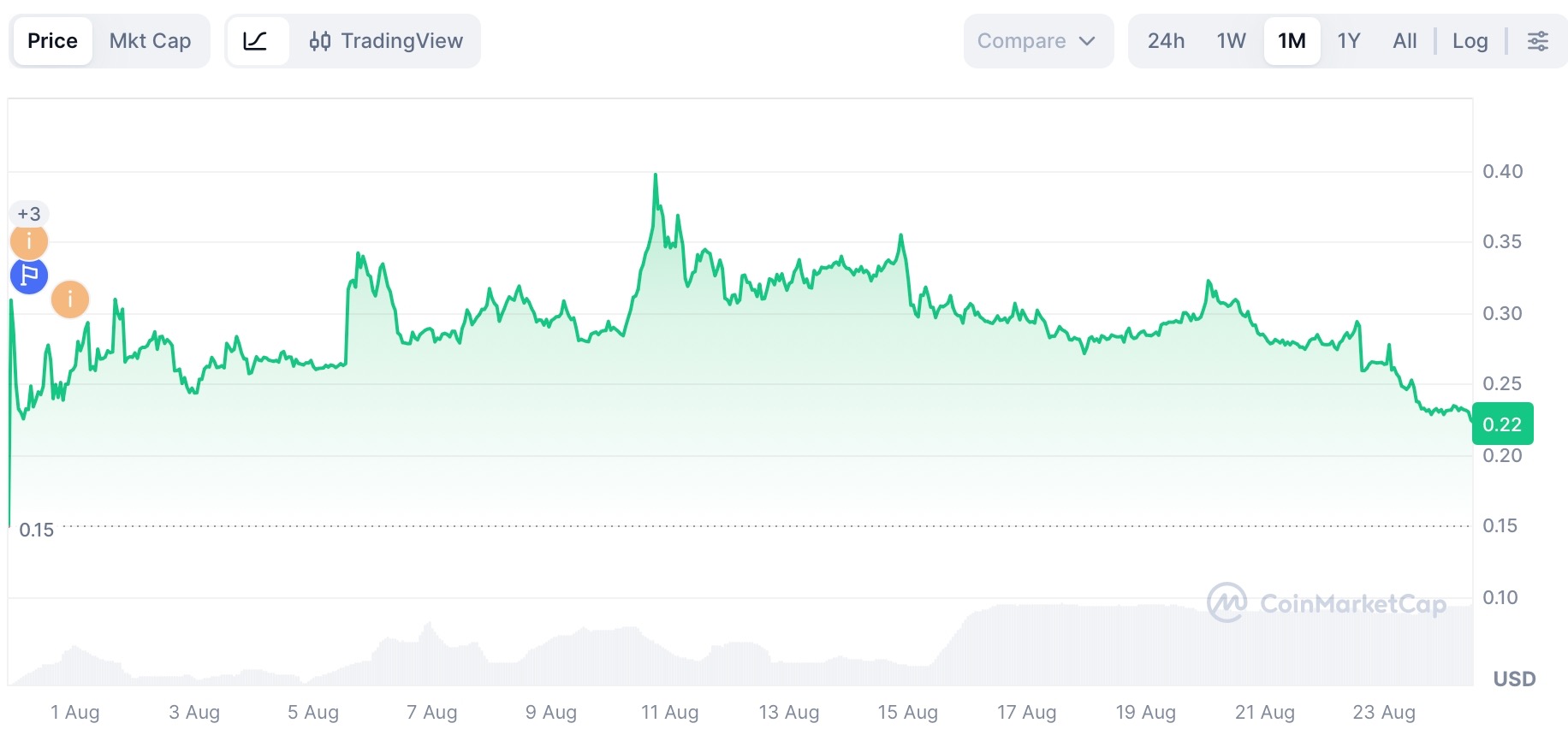
At the time of writing on August 24, CoinMarketCap priced GRVT near $0.224. The token had fallen approximately 10.8% over the previous 24 hours.
GRVT reached an intraday high of $0.4615 on July 30. Its current price is roughly 51% below that level. The wide range on launch day, from a reported low of $0.15 to the $0.4615 high, shows how aggressively the market searched for a valuation when trading opened.
The current numbers remain difficult to interpret without context. CoinMarketCap reported a circulating market capitalization of approximately $25.6 million and a fully diluted valuation of about $224 million. Only 114.3 million GRVT, or 11.43% of the maximum supply, was counted as circulating.
This is not simply a small-cap token with a low valuation. It is a low-float token whose future valuation will depend heavily on how the remaining supply enters the market.
The Launch Brought Access, but Not a Settled Valuation
GRVT debuted through several channels. Binance Alpha opened trading and distributed tokens to eligible users through an Alpha Points campaign. KuCoin and Bitget also introduced spot markets, while Binance later launched a GRVTUSDT perpetual contract with leverage of up to 10x. GRVT itself also added a GRVTUSDT perpetual market on July 31.
These listings gave the token immediate visibility, but they also created a market shaped by airdrop recipients, short-term traders and leveraged positions. Those groups do not necessarily value GRVT in the same way.
An airdrop recipient may be deciding when to sell. A futures trader may be trading volatility rather than the project. A platform user may hold GRVT for lower fees or access to products. Early price action reflects all three.
It is therefore too early to treat either the launch-day high or the current market price as a stable verdict on the platform.
GRVT Is Trying to Become a Membership Token
The clearest case for holding GRVT comes from the exchange’s membership program. Users can lock GRVT to qualify for Basic, Silver, Gold or Platinum membership. The minimum requirements range from one GRVT locked for one week to 50,000 GRVT locked for six months. Higher tiers can provide different fee levels and broader access to the platform’s GLP product.
This gives the token a more concrete role than a points-based airdrop asset. Someone who regularly trades or uses GRVT’s investment products may be able to place an economic value on the membership benefits.
A membership model creates lasting demand only when the underlying service is useful enough to justify locking capital. Fee benefits matter when trading volume is genuine. Product access matters when users want those products. A lock requirement by itself does not create economic value.
GRVT also states that membership benefits may be changed. Traders should evaluate the current program rather than assuming today’s benefits will remain unchanged indefinitely.
The Exchange Is Moving Beyond Perpetual Futures
GRVT began as a hybrid derivatives venue, combining off-chain order matching with on-chain settlement. Its current ambition is broader: one account balance that can earn yield, support trading positions and provide access to investment products.
Recent updates show that this expansion is more than a presentation slide.
The platform introduced spot trading around the TGE, added new markets during August and updated its Earn on Equity program. From August 11, eligible USDT and USDC balances could earn up to 3.5% APY while remaining in a funding or trading account. GRVT also added card-based deposits through Privy.
This product direction gives the token a plausible route to utility. If users keep more capital on the platform and use several services from the same balance, membership benefits could become more valuable.
Yet the relationship between product growth and token demand has not been proven. GRVT has been publicly traded for less than a month. There is not enough history to determine how many buyers are acquiring it for membership, how much supply is being locked, or whether those locks meaningfully reduce liquid supply.
Those figures will matter more than another list of product announcements.
A Billion Dollars of Volume Does Not Tell the Whole Story
CoinMarketCap displayed approximately $1.09 billion in 24-hour GRVT volume at the time of writing. That was more than 42 times the token’s reported circulating market capitalization.
Such a number naturally attracts attention, but it deserves scrutiny. CoinGecko had reported much lower daily volume only days earlier. The gap may reflect timing, market coverage, derivatives activity or differences in how exchanges are aggregated. It could also indicate a short burst of unusually heavy turnover.
Reported volume is not the same as usable liquidity.
A trader still needs to examine order-book depth, spreads, slippage and the share of trading concentrated on individual venues. A market can print a large headline volume while remaining vulnerable to sharp price moves if real liquidity near the current price is limited.
For GRVT, the quality and distribution of liquidity are especially important because the token has a low circulating supply and active perpetual markets. Liquidations or a sudden wave of unlocked tokens could move the market more quickly than the headline volume suggests.
What the Bermuda Licence Actually Covers
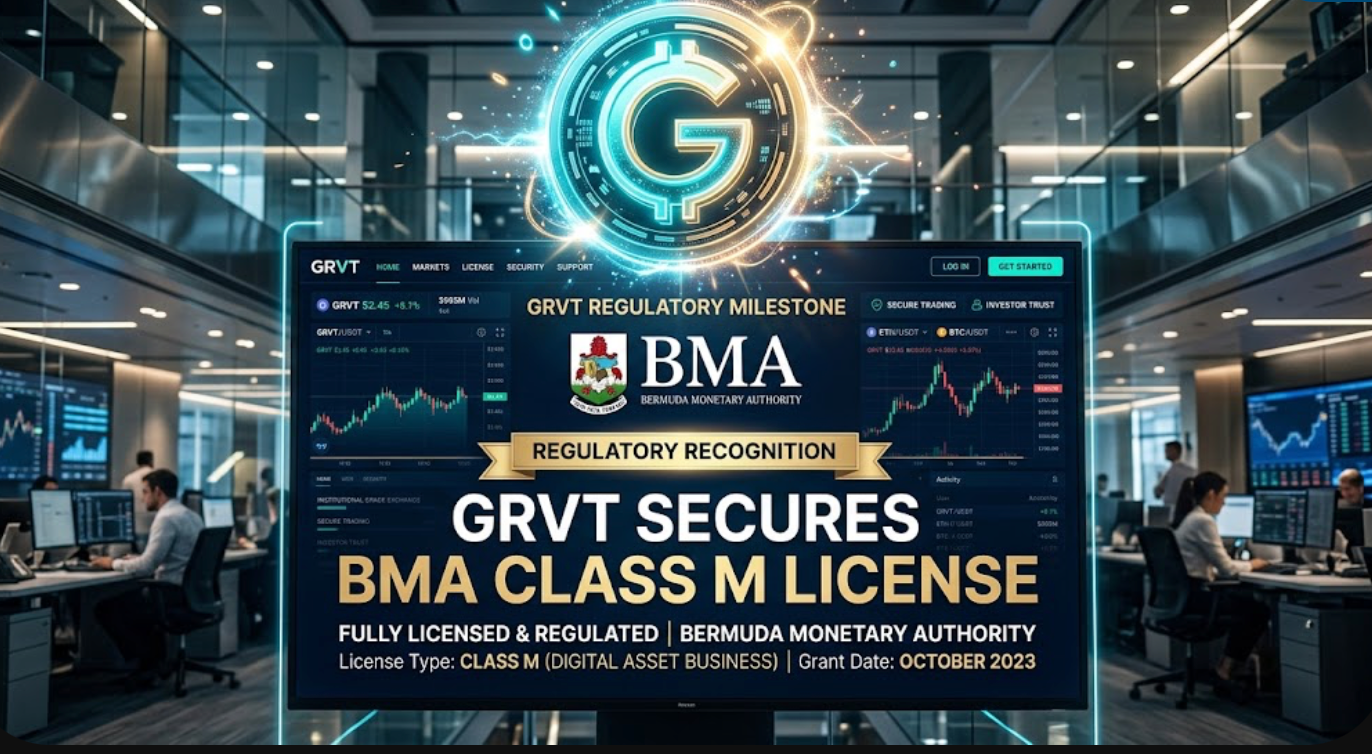
Regulation is central to GRVT’s identity. GRVT International Limited obtained a Class M Digital Asset Business licence from the Bermuda Monetary Authority in 2024. Bermuda’s government subsequently included GRVT in its annual fintech report as a DABA-licensed decentralized exchange.
That is a meaningful distinction in a sector where many derivatives platforms operate without a clearly identified licensing framework.
Class M is a modified licence associated with an early or supervised stage of operation. It is not the same as Bermuda’s full Class F licence, and it does not make GRVT regulated in every jurisdiction. Nor does it remove token-price, smart-contract, counterparty or liquidity risk.
The regulatory angle may help GRVT approach institutions and users who prefer identity checks and a defined legal entity. At the same time, its compliance requirements make it different from permissionless perpetual DEXs. Whether that difference becomes a competitive advantage depends on the customers the platform can attract.
GRVT Now Has to Earn Its Market
GRVT is no longer an expected airdrop attached to a developing exchange. It is a tradable token with a market price, a membership function and a large amount of future supply. Its exchange has also grown beyond crypto perpetuals into spot markets, yield-bearing balances and real-world-asset products.
However, none of that guarantees that the token will hold its value.
The case for GRVT will become stronger if platform activity creates reasons to lock the token, liquidity remains durable after launch incentives fade and future unlocks are absorbed without destabilizing the market. If usage and token demand fail to connect, the difference between its circulating market cap and fully diluted valuation will become harder to ignore.
For now, GRVT is best viewed as a newly launched exchange token entering its price-discovery period. The product is operating. The token utility exists. The evidence that connects the two is still being built.
Readers can follow digital-asset research and market education through Tapbit. Existing users can log in here, while new users can create an account.
Frequently Asked Questions About GRVT
What is GRVT?
GRVT is the native token of Grvt, an on-chain platform offering spot trading, perpetual contracts, yield products and exposure to selected real-world assets. The platform uses off-chain order matching with on-chain settlement on a custom ZKsync Layer 2.
When did the GRVT token launch?
The GRVT token generation event took place on July 30, 2026. Trading subsequently opened through several venues, including Binance Alpha, KuCoin, Bitget and Grvt’s own platform. A Binance Alpha appearance should not be confused with a Binance spot-market listing.
What is GRVT used for?
GRVT functions primarily as a membership token. Users can lock it to qualify for different membership tiers, which may provide trading-fee benefits and access to selected platform features or products. These benefits are subject to the platform’s current terms and may change.


