

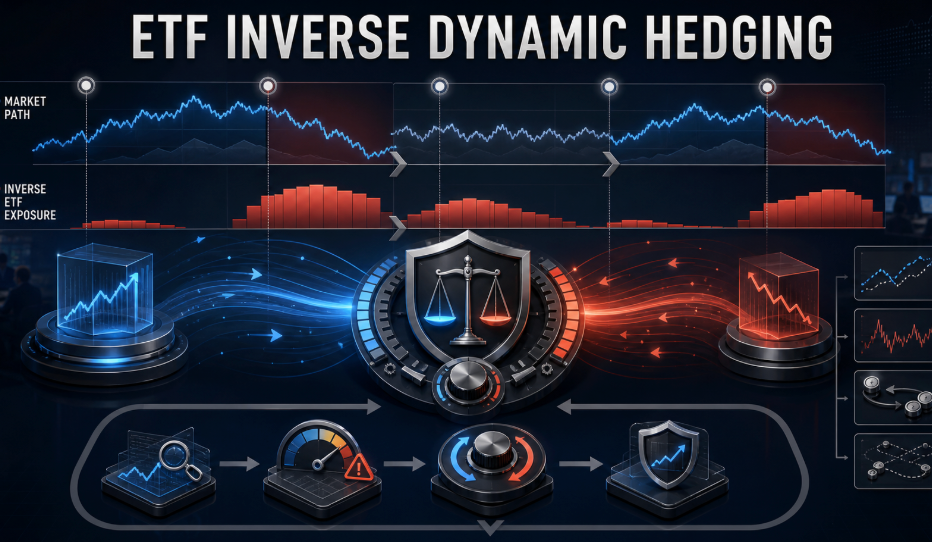
ETF inverse dynamic hedging is a strategy where traders use inverse ETFs to reduce downside exposure while adjusting the hedge size as market conditions change. Instead of holding a fixed hedge, investors may increase or reduce inverse ETF exposure based on volatility, trend signals, portfolio losses, or macro catalysts. In 2026, this strategy is especially relevant as traders face AI-stock volatility, rate uncertainty, and sharp sector rotations.
The approach can reduce drawdowns without requiring an investor to sell every long-term holding. It can also create new risks if the inverse ETF is held too long, adjusted too frequently, or mismatched with the portfolio.
Traders exploring conventional and digital-asset markets can create a Tapbit account to access supported products and risk-management tools. Availability varies, so users should verify current markets before trading.
What Is ETF Inverse Dynamic Hedging?
An inverse ETF generally seeks to deliver the opposite of an underlying index’s daily return. If the tracked index falls 1% in one session, a standard -1x inverse ETF is designed to gain approximately 1% before fees, costs, and tracking differences.
Dynamic hedging changes that inverse position as risk evolves. An investor may hold no hedge during a stable uptrend, add partial protection as volatility rises, and reduce it after conditions improve. The objective is usually to offset part of a temporary decline—not to profit from a permanent market collapse.
How Inverse ETFs Work
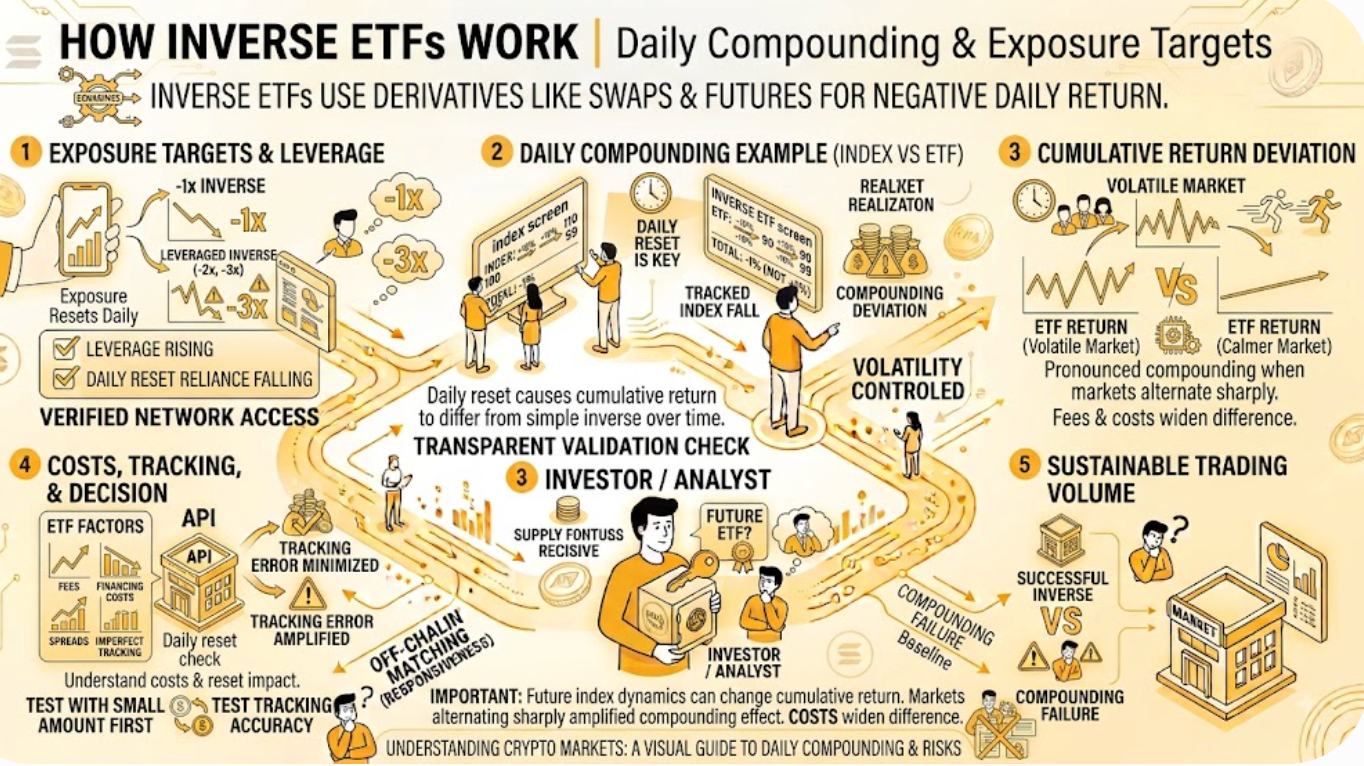
Inverse ETFs commonly use swaps and futures to target negative daily exposure. Some target -1x, while leveraged inverse ETFs may target -2x or -3x.
The daily reset is crucial. Suppose an index starts at 100, rises 10% to 110, and then falls 10% to 99. The index is down 1% overall. A -1x inverse ETF could fall about 10% on day one and gain 10% from its lower level on day two, also leaving it near a 1% loss rather than a 1% gain.
This path dependency becomes more pronounced in volatile sideways markets. Fees, financing, spreads, and tracking differences can widen the gap further.
What Makes the Hedge “Dynamic”?
A fixed hedge maintains the same protection regardless of conditions. A dynamic hedge changes based on signals such as a trend break, rising volatility, a portfolio drawdown, major earnings, a central-bank decision, or changing sector exposure.
For example, an investor might hedge 20% of equity exposure before a major catalyst, increase it to 40% after a confirmed trend break, and remove it if the index recovers. Useful rules specify when protection begins, its maximum size, and what closes the trade. Dynamic does not mean constantly trading.
Example: Hedging a Stock Portfolio With an Inverse ETF
Assume a $100,000 stock portfolio broadly follows a major equity index. The investor wants to offset 30% of near-term market exposure using a -1x inverse ETF:
$100,000 × 30% = $30,000 inverse ETF position
| Portfolio input | Example value |
|---|---|
| Long portfolio value | $100,000 |
| Desired hedge ratio | 30% |
| Inverse ETF exposure | $30,000 |
| Hypothetical index decline | 5% |
| Approximate hedge gain | $1,500 |
If both the index and portfolio fall 5%, the long portfolio might lose about $5,000 while the hedge gains roughly $1,500 before costs. Real portfolios rarely match an index perfectly, so beta, sector concentration, and benchmark mismatch must be considered.
Inverse ETF vs Put Options vs Futures
| Tool | Best For | Main Risk |
|---|---|---|
| Inverse ETF | Simple short-term hedge | Daily reset and decay |
| Put options | Defined downside protection | Premium cost and expiry |
| Futures | Large portfolio hedge | Leverage and margin calls |
| Cash | Lower volatility | Missed upside |
Inverse ETFs trade like shares and can be operationally simpler than derivatives. Put options offer asymmetric protection but lose value through time decay. Futures are precise and capital-efficient, yet leverage creates margin risk. Cash is simplest, although selling may create taxes and cause the investor to miss a rebound.
When Traders Use Dynamic Hedging in 2026
Dynamic hedging may be useful when short-term downside risk rises but the investor wants to retain core positions. Potential situations include indexes near record levels, technology earnings, FOMC meetings, inflation releases, AI-stock corrections, geopolitical shocks, or rapid sector rotation.
The hedge must match the risk. A broad inverse ETF may provide weak protection for a concentrated semiconductor portfolio. Buying protection after a major decline can also backfire if the market rebounds. Rules should therefore be established before volatility surges.
Main Risks: Decay, Timing, and Over-Hedging
Daily resetting is the defining structural risk. In a volatile sideways market, compounding can erode an inverse ETF even if its benchmark finishes near its starting point. Leveraged products magnify this effect.
Timing risk appears when protection is added too late or removed too early. Over-hedging can create net short exposure, causing a market rally to limit gains or produce a combined loss.
- Management fees and derivative financing costs
- Bid-ask spreads and limited liquidity
- Tracking differences and benchmark mismatch
- Tax consequences from frequent trading
- False signals causing repeated entry and exit
A practical plan defines a maximum hedge ratio, review schedule, loss limit, and exit condition before opening the position.
Can Crypto Traders Use Similar Hedging Logic?
Crypto traders can retain a core long position while adding short exposure through perpetual futures, dated futures, options, or reduced exposure. The logic is similar, but the instruments have different risks.
Crypto perpetuals can involve leverage, funding payments, liquidation, exchange exposure, and around-the-clock price movement. Basis risk also matters: shorting Bitcoin may not adequately protect altcoins that fall faster than BTC. The hedge and protected assets must both be monitored.
Conclusion
ETF inverse dynamic hedging can help traders manage downside risk, but it is not a set-and-forget strategy. Inverse ETFs are usually designed for short-term exposure, so traders should monitor volatility, rebalance frequently, and avoid using them as long-term substitutes for proper portfolio risk management.
The approach works best when the hedge matches the portfolio, adjustment rules are defined in advance, and daily-reset effects are understood. Its purpose is to control a specific risk—not eliminate every loss or predict every reversal.
Frequently Asked Questions
What is an inverse ETF?
An inverse ETF aims to produce approximately the opposite of an index’s daily return. Costs and tracking differences can affect the result.
What is dynamic hedging?
Dynamic hedging adjusts the size or composition of protection as prices, volatility, portfolio exposure, or risk signals change.
Can inverse ETFs be held long term?
They can be, but daily resetting and compounding may cause performance to diverge from the simple long-term inverse of the benchmark.
How much of a portfolio should be hedged?
The appropriate ratio depends on portfolio sensitivity, investor objectives, the hedge instrument, and the desired level of protection.
Are inverse ETFs safer than short selling?
They avoid direct stock borrowing and generally limit loss to the amount invested, but they still carry market, liquidity, tracking, compounding, and timing risks.


