

XST crypto is high risk because the ticker identifies several unrelated assets, while the version attracting recent attention—XSolutAI on Solana—has a short trading history and may depend heavily on limited liquidity and speculative AI-token demand. These conditions can produce rapid gains, equally rapid losses, and difficulty exiting at the displayed market price.
That does not prove XST is a scam. It means searches such as “is XST safe?” or “is XST legit?” cannot be answered from the token name or price chart alone. Users should first identify the exact contract and then assess liquidity, ownership, documentation, and trading activity.
XST is not being presented here as available on Tapbit. Readers researching speculative crypto markets can create a Tapbit account through the official website while independently checking whether a particular asset is supported before attempting to trade it.
Which XST Crypto Are You Looking At?
The biggest XST risk begins before a trade is placed: XST is not a unique crypto identity. At least three materially different projects have used the ticker:
| XST asset | Network or ecosystem | Described purpose |
|---|---|---|
| XSolutAI | Solana | AI-themed speculative token |
| Stealth | Independent blockchain | Privacy-focused transaction coin |
| SORA Synthetics | SORA ecosystem | Collateral token for synthetic assets |
Stealth’s official documentation describes XST as a coin launched on its own blockchain in 2014. The SORA documentation, meanwhile, defines its XST as XOR Synthetics, a token used in the SORA synthetic-asset system. Neither description identifies the newer Solana-based XSolutAI token.
A price, supply figure, audit, exchange listing, or development update for one XST should not be applied to another. The safest identifier is the complete contract address or native blockchain asset ID—not the ticker, logo, or project name.
Is XST Safe or a Scam?
Publicly available information does not justify calling every XST asset a scam. The ticker belongs to multiple projects, and legitimacy must be assessed separately for each contract.
For XSolutAI, the more defensible conclusion is that it remains high risk and requires additional verification. A rising price does not demonstrate that the project has functioning AI infrastructure, sustainable demand, secure smart contracts, or a transparent organization.
| Risk area | What to verify | Why it matters |
|---|---|---|
| Identity | Chain and complete contract address | Prevents buying the wrong XST |
| Liquidity | Pool depth and simulated sell impact | Shows whether a position can be exited |
| Ownership | Largest wallets and deployer activity | Reveals concentration and sell pressure |
| Permissions | Mint, freeze, and upgrade authority | Identifies centralized token controls |
| Utility | Working software and verifiable users | Separates a product from a narrative |
Missing information does not automatically prove fraud. It increases uncertainty—and uncertainty should be reflected in position size and risk expectations.
Why XST Liquidity Matters More Than the Displayed Price
A token price shows where the most recent transaction occurred. It does not show how much capital can be sold near that price.
On a decentralized exchange, XST liquidity may be concentrated in one or two pools. If those pools contain relatively little SOL or stablecoin, a modest purchase can push the quoted price sharply higher. A similarly sized sale can then reverse much of the move.
- High slippage: The executed price may be substantially worse than the quote.
- Misleading market capitalization: A large valuation can be calculated even when little capital supports the market.
- Exit risk: A valuable displayed balance may not be sellable without moving the price.
- Manipulation risk: Thin markets require less capital to create impressive rallies.
- Liquidity-provider risk: Trading conditions can deteriorate if concentrated liquidity is removed.
Before buying, investors should simulate both a purchase and a sale of the intended position. A token can appear easy to buy while being much harder to exit.
Why XST Volatility Can Be Extreme
New and thinly traded tokens often react more strongly to order flow than established assets. XST may experience vertical rallies, sudden pullbacks, long periods without meaningful trading, and candles with unusually wide ranges.
That volatility may be driven by social-media attention, AI narratives, concentrated wallet activity, automated trading, or changes in one liquidity pool. It does not necessarily represent a comparable change in the project’s underlying value.
Technical indicators are also less reliable when the price history is short or trading is irregular. Support and resistance levels may reflect only a small number of transactions. A price increase should therefore be evaluated alongside liquidity depth, unique buyers and sellers, transaction size, and holder concentration.
Holder Concentration and Token-Control Risks
The distribution of XST matters because large wallets can influence both price and available liquidity. If the deployer, team-linked wallets, or a small group of holders controls a substantial percentage of supply, a major sale can overwhelm the market.
Investors should examine the percentage held by the largest non-exchange wallets, whether top wallets appear connected, the deployer’s remaining balance, active mint or freeze authority, supply held inside liquidity pools, and any disclosed unlock schedule.
A distribution page is only a starting point. Multiple wallets can belong to the same party, and liquidity-pool or exchange addresses should be distinguished from individual holders.
How to Verify the Correct XST Token
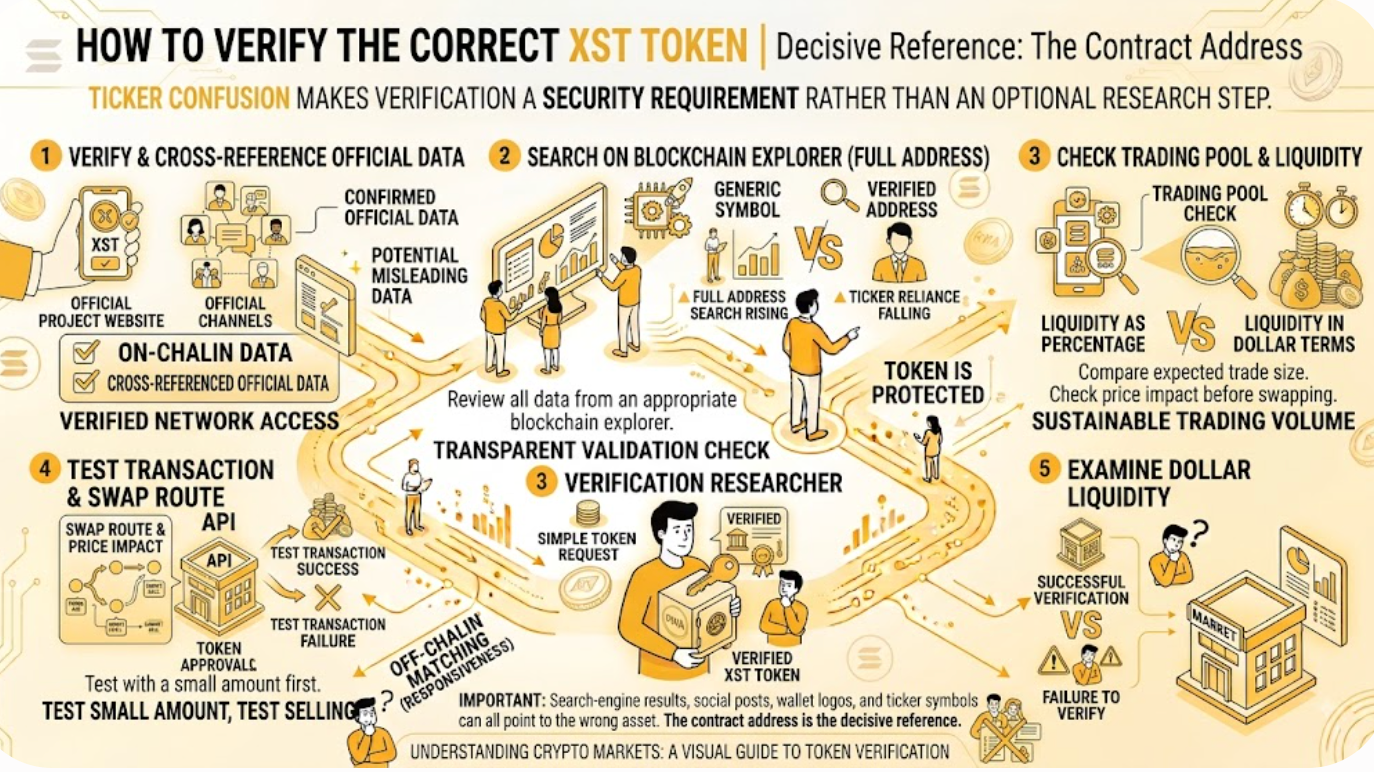
Ticker confusion makes verification a security requirement rather than an optional research step.
- Obtain the contract address from an official project website and compare it across official channels.
- Confirm that the network matches the intended token.
- Search the full address on an appropriate blockchain explorer.
- Review token age, deployer activity, supply, holders, and active authorities.
- Check whether the trading pool uses the same verified contract.
- Examine liquidity in absolute dollar terms, not only as a percentage.
- Review the swap route, price impact, and token approvals.
- Test a small transaction and confirm that the token can also be sold.
Search-engine results, social posts, wallet logos, and ticker symbols can all point to the wrong asset. The contract address is the decisive reference.
Red Flags That Increase XST Risk
No single warning sign proves that an XST token is fraudulent. Several appearing together should lead to greater caution.
- Conflicting contract addresses across promotional pages
- Anonymous or unverifiable team members
- Product claims without a working demonstration
- Partnerships that cannot be confirmed by the other party
- Concentrated holders combined with shallow liquidity
- Sudden price increases without corresponding project developments
- Pressure to buy before an announcement or listing
- Restricted selling, unusual transfer taxes, or excessive slippage
- Undisclosed mint, freeze, or upgrade authority
Claims of guaranteed returns, risk-free AI revenue, or certain exchange listings should be treated as marketing until independently verified.
Conclusion
XST crypto is high risk primarily because “XST” does not refer to one universally identifiable asset. XSolutAI, Stealth, and SORA Synthetics use the same ticker while representing different networks, contracts, and economic models.
For the Solana-based XSolutAI token, limited liquidity, a short price history, potential holder concentration, and speculative AI demand can make the displayed price unreliable as a measure of realizable value. These factors do not automatically establish an XST scam, but they raise the level of verification required.
The correct approach is to identify the exact contract first, measure real exit liquidity, inspect token permissions and holder distribution, and separate verifiable utility from promotional claims.
Frequently Asked Questions
Is XST safe?
XST cannot be considered safe based on its ticker or price alone. Users must identify the exact contract and review its network, liquidity, holders, permissions, and documentation.
Is XST a scam?
There is insufficient basis to label every XST token a scam. Multiple unrelated projects use the ticker. Some versions may still show serious risk factors or lack enough verifiable information to establish legitimacy.
Why are there several XST coins?
Crypto tickers are not globally unique. Separate projects can choose the same symbol on different blockchains, which is why the contract address matters more than the ticker.
What is the main XST liquidity risk?
The displayed price may be supported by a shallow trading pool. A holder may be unable to sell a meaningful position without substantial slippage.
How can I find the correct XSolutAI token?
Compare the complete Solana contract address across the project’s verified website and official channels, then confirm its supply, holders, and trading pools through a Solana blockchain explorer.


