
CXMT has become one of the most searched semiconductor names in Asia because it sits at the intersection of three powerful themes: China’s chip self-sufficiency push, AI infrastructure demand, and the global memory-chip cycle. CXMT stands for ChangXin Memory Technologies, a Chinese DRAM producer that has gained attention from investors following its high-profile IPO and the growing demand for memory used in data centers, smartphones, PCs, and AI systems.
For traders, the search intent around CXMT is not only “what is CXMT?” Many users also want to know whether CXMT can be traded, what the company owns, how its IPO affects valuation, and whether CXMT-linked derivatives reflect the same exposure as real shares. The short answer is that CXMT may be an important semiconductor story, but stock exposure, price-page reference data, and derivatives products should be treated as different market instruments.
Readers who want to follow Tapbit’s CXMT-related market data can use the CXMT derivatives price page. New users can also start from the Tapbit registration page to explore market tools, price pages, and trading access.
What Is CXMT?
CXMT, short for ChangXin Memory Technologies, is a Chinese semiconductor company focused on DRAM memory chips. DRAM is a core component used to store and access temporary data inside electronic devices, servers, AI hardware, and cloud infrastructure. While GPUs often receive most of the attention in AI discussions, memory chips are essential because large models and high-performance workloads require fast data access.

That makes CXMT strategically important. The global DRAM market has long been dominated by Samsung, SK Hynix, and Micron. CXMT is widely viewed as China’s leading domestic DRAM challenger and one of the companies most closely tied to China’s effort to reduce dependence on foreign semiconductor supply chains.
Why the CXMT IPO Matters
The CXMT IPO became a major event because it gave public-market investors a clearer way to price China’s domestic memory-chip story. Semiconductor listings often attract attention, but CXMT is different because memory chips are capital-intensive, technologically complex, and closely connected to national industrial strategy.
A strong IPO debut can show investor enthusiasm, but it can also create valuation pressure. If a stock rises sharply right after listing, future earnings, production capacity, and margin improvement need to support that valuation. For CXMT, investors are watching whether the company can scale production, improve chip quality, and compete more effectively with global DRAM leaders.
CXMT Ownership and Strategic Backing
CXMT’s ownership structure matters because advanced semiconductor manufacturing requires large funding commitments, policy support, and long-term supply-chain coordination. Memory-chip companies need fabs, equipment, R&D teams, materials access, and customer relationships. This is not a low-capital software business.
Investors often view CXMT through the lens of China’s semiconductor policy. Strategic backing can support expansion, but it does not eliminate business risk. The company still needs to compete on technology, yields, pricing, and product reliability.
CXMT Price Today and Tapbit Derivatives Data
The Tapbit CXMT derivatives price page shown in the provided chart listed CXMT around $6.68 on July 28, 2026, with a 10.36% decline and a weekly chart showing a pullback after a sharp short-term spike. This type of price movement suggests that traders are reacting quickly to sentiment, valuation, and derivatives-market positioning.
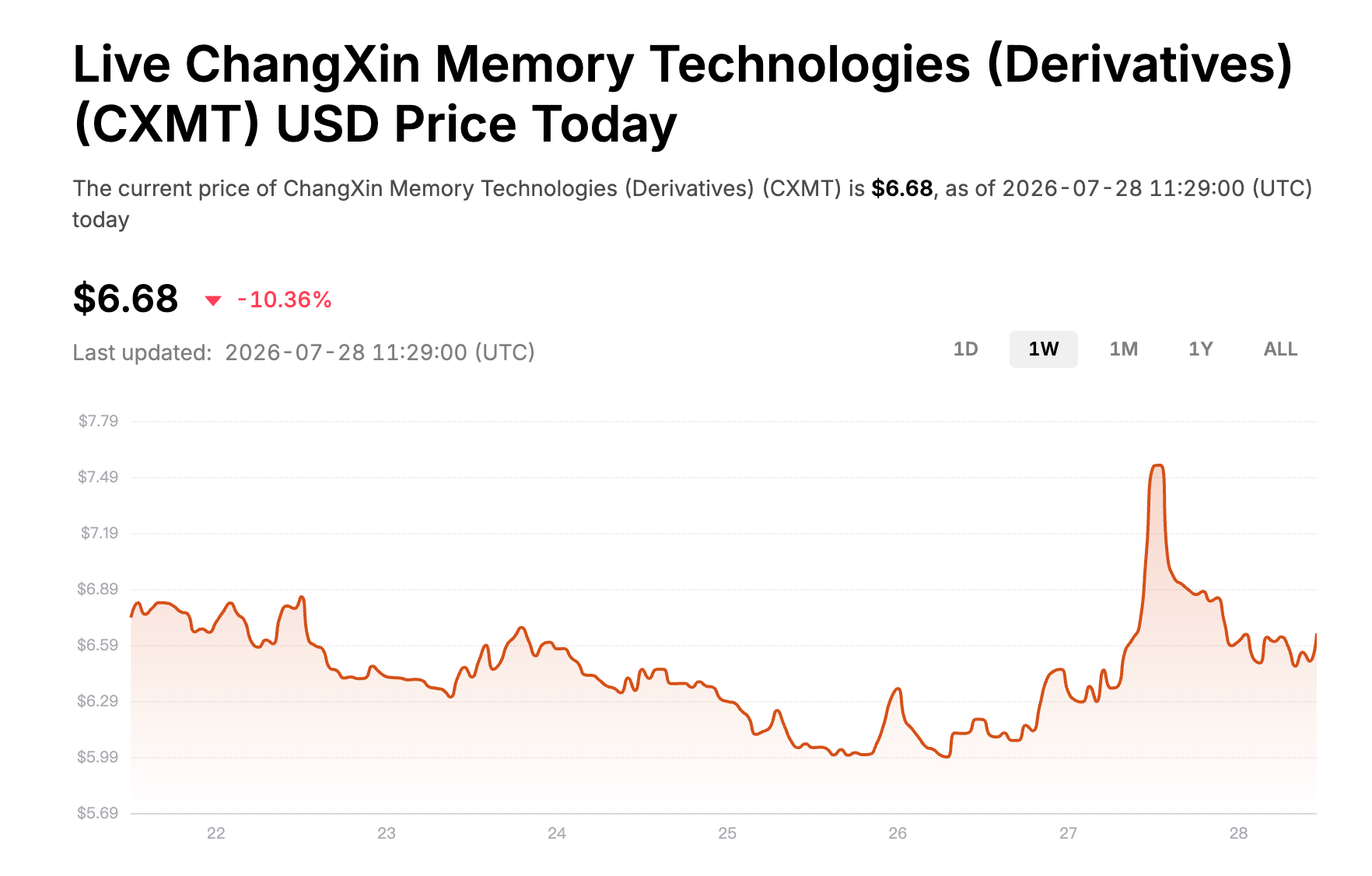
It is important to understand what this data represents. A derivatives price page is not the same as directly buying shares of ChangXin Memory Technologies. It may reflect synthetic exposure, platform-specific pricing, liquidity, or market-making conditions. Traders should check the product details before assuming the price behaves exactly like the underlying stock.
CXMT Derivatives Trading Explained
CXMT derivatives trading generally refers to market products that provide exposure to CXMT-related price movement without necessarily giving users direct ownership of the underlying equity. Depending on the platform and product structure, derivatives may be cash-settled, synthetic, leveraged, or based on reference pricing.
This can be useful for traders who want faster access to thematic markets, but it also introduces extra risks. Users should understand contract specifications, trading hours, index methodology, liquidity, funding rates, and whether the product is officially supported by the platform.
CXMT vs Traditional Stock Ownership
| Exposure Type | What It Means | Main Risk |
|---|---|---|
| CXMT shares | Direct equity exposure through eligible stock markets | Valuation, company performance, market access |
| CXMT derivatives | Price exposure through a derivative product | Liquidity, leverage, pricing, product rules |
| Semiconductor ETFs | Basket exposure to chip companies | Sector risk and tracking differences |
| Tokenized or synthetic assets | Issuer-dependent market exposure | Custody, redemption, regulation, counterparty risk |
Why CXMT Is Linked to AI and Memory Demand
AI infrastructure needs more than GPUs. Data centers require large amounts of memory, storage, networking, and power. DRAM demand can rise when cloud providers and hardware manufacturers increase AI server investment. This is one reason CXMT has attracted attention beyond China’s domestic stock market.
However, investors should not assume that every AI-related semiconductor company will benefit equally. Memory chips are cyclical. Prices can rise during shortages and fall during oversupply. CXMT’s long-term performance will depend on execution, process improvements, customer demand, and the broader DRAM pricing cycle.
Key Risks for CXMT Investors and Traders
The first risk is valuation. A popular IPO can price in a lot of optimism early. If revenue growth, margins, or production progress disappoint, the stock or related derivatives may become volatile.
The second risk is geopolitics. Semiconductor supply chains are heavily affected by export controls, equipment restrictions, and national-security policy. Any new restriction on advanced tools or materials could affect CXMT’s growth path.
The third risk is product structure. A CXMT derivative is not automatically the same as CXMT stock. Traders should verify whether the product is cash-settled, leveraged, platform-specific, or based on a particular index methodology.
Is CXMT a Good Investment?
CXMT may appeal to investors who believe China’s semiconductor industry will continue expanding and that domestic DRAM demand will remain strong. The bull case is built on AI demand, import substitution, local policy support, and the strategic value of memory chips.
The bear case is equally important. CXMT faces established global competitors, heavy capital requirements, valuation pressure after IPO enthusiasm, and uncertainty around advanced manufacturing access. For derivatives traders, short-term volatility can be even more intense because price moves may reflect both company sentiment and product-level liquidity.
Conclusion
CXMT is one of the most important semiconductor names to watch because it connects China’s memory-chip ambitions with AI infrastructure demand and global chip-market competition. Its IPO and market performance have made it a high-interest topic for stock investors and derivatives traders.
Still, CXMT exposure should be understood carefully. Direct shares, derivatives, price-page data, and synthetic trading products are not the same thing. Investors should separate the company story from the trading product, verify product rules, and manage risk before participating.
FAQ
What does CXMT stand for?
CXMT stands for ChangXin Memory Technologies, a Chinese semiconductor company focused mainly on DRAM memory chips.
Is CXMT an AI chip company?
CXMT is better described as a memory-chip company. It is connected to AI demand because AI infrastructure requires large amounts of high-performance memory.
Can I buy CXMT directly?
Direct access depends on market availability, broker eligibility, and local regulations. Some users may instead follow price pages, ETFs, or derivatives products for related exposure.
Are CXMT derivatives the same as CXMT stock?
No. Derivatives provide price exposure through a product structure, but they do not necessarily represent direct ownership of ChangXin Memory Technologies shares.
What is the main risk of CXMT derivatives?
The main risks include liquidity, leverage, pricing differences, platform rules, and volatility tied to semiconductor market sentiment.


