

What Is CRCL Stock?
Circle Internet Group (NYSE: CRCL) is a U.S. financial technology company founded in 2013 and headquartered in New York. Its central product is USDC — a U.S. dollar-denominated stablecoin fully backed 1:1 by cash and short-term U.S. government securities. As of year-end 2025, USDC had approximately $75.3 billion in circulation, making it the world's second-largest dollar stablecoin by market capitalization.
CRCL is a traditional equity — a share of stock listed on the New York Stock Exchange — not a crypto token. Owning CRCL means owning a stake in Circle the corporation: its reserve income, its payments infrastructure, and its future product bets. It is regulated as a public company under SEC rules, and trades like any other NYSE-listed stock.
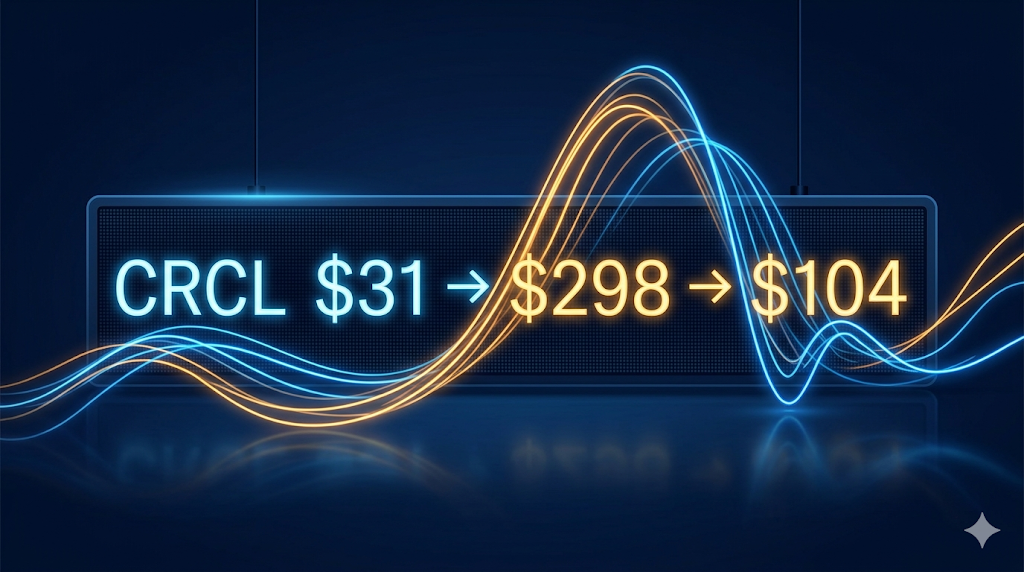
Circle completed its IPO on June 5, 2025, pricing at $31 per share. The stock closed its first trading day above $82 and subsequently surged to an all-time high of $298.99 on June 23, 2025, before declining to a low of $49.90 on February 5, 2026. It has since recovered to the $100–$107 range as of April 2026 — roughly three times the IPO price, but well below its peak. Circle's next earnings report is scheduled for May 11, 2026.
Beyond USDC, Circle issues EURC (a euro-denominated stablecoin), operates the Circle Payments Network (CPN) for cross-border settlement, and is developing Arc — a Layer-1 blockchain designed to bring real-world financial activity on-chain. The company holds regulatory authorizations in the U.S., EU, UK, Singapore, Bermuda, and Abu Dhabi, and employs approximately 1,100 people.
How Circle Makes Money: Two Revenue Engines
Circle's business model has two distinct income streams that investors need to understand separately, because they carry very different risk profiles and growth trajectories.
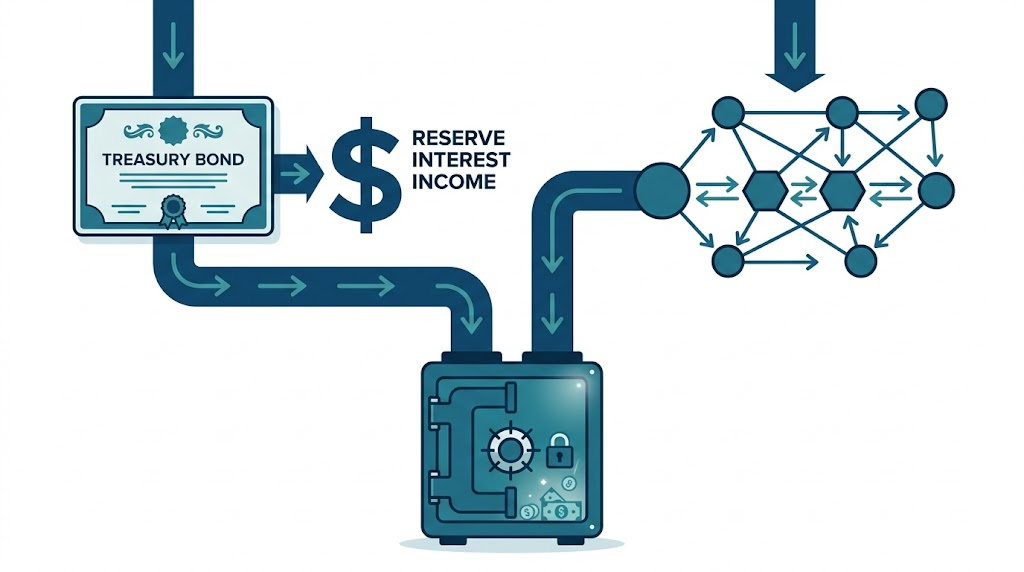
Reserve interest income is the dominant driver today. When users or institutions hold USDC, Circle invests the corresponding dollar reserves in highly liquid assets: approximately 88% is held in the BlackRock-managed Circle Reserve Fund (short-term U.S. Treasuries), with the remainder held as cash at globally systemically important banks. The interest generated on this pool flows directly to Circle's income statement — users who hold USDC do not receive any of it. In a high interest rate environment, this model is highly profitable at scale. It is also directly sensitive to Federal Reserve rate decisions: a 100-basis-point rate cut translates to hundreds of millions of dollars in reduced annual revenue at current USDC supply levels.
Platform and network fees represent Circle's longer-term revenue diversification strategy. The Circle Payments Network, which launched in mid-2025, already processes stablecoin settlements at an annualized rate of approximately $3 billion, with more than 50 partners live and approximately 500 more awaiting onboarding. CPN charges fees for cross-border transfers, foreign exchange settlement via its StableFX product, and developer API access. While still a small portion of total revenue, this line is designed to grow regardless of interest rate movements.
In December 2025, Circle received conditional regulatory approval to establish First National Digital Currency Bank — a regulated trust bank that would give the company greater direct control over its reserves and open institutional banking services if fully approved.
The Regulatory Backdrop: GENIUS Act and CLARITY Act
Stablecoin regulation is the most consequential external variable for investors evaluating CRCL. Two pieces of legislation define the current environment.
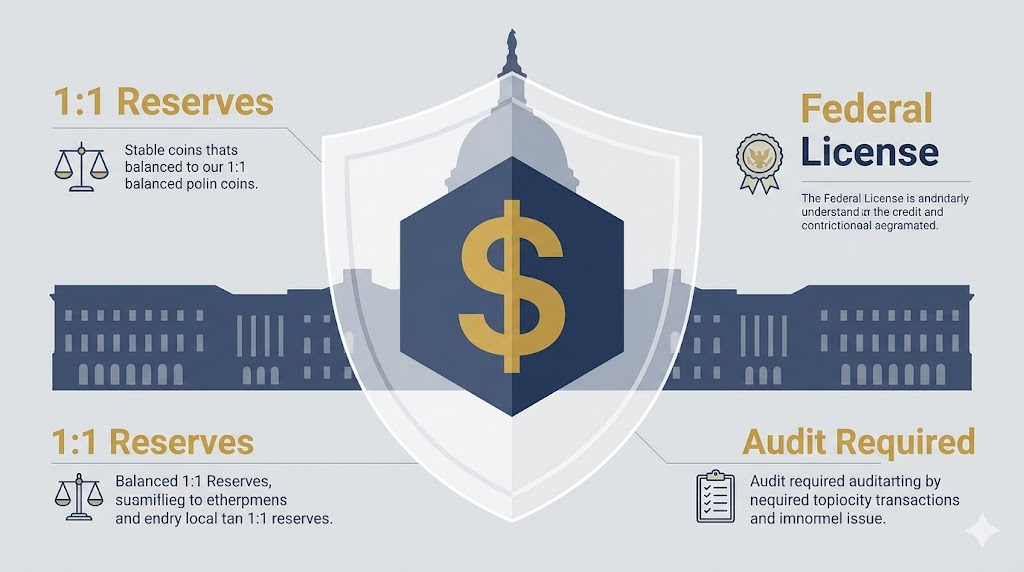
The GENIUS Act was signed into law by President Trump on July 18, 2025, making it the United States' first comprehensive federal stablecoin framework. It mandates 1:1 reserve backing with high-quality liquid assets, requires regular audits and disclosures, and establishes a clear federal licensing pathway. Circle's existing practices — conservative reserves managed by BlackRock, full attestations by a Big Four auditor, and licenses across multiple jurisdictions — already meet these requirements. The GENIUS Act was broadly treated by analysts as confirming Circle's competitive moat rather than disrupting its business.
The CLARITY Act remains in Congress as of April 2026. Its most significant provision for Circle is a proposed prohibition on paying passive yield to retail users who simply hold stablecoins in wallets or on exchanges. This would remove one of the primary acquisition tools used by competing DeFi protocols and centralized yield platforms, while leaving Circle's own reserve interest income intact — because that income accrues to Circle's balance sheet, not to USDC holders. Analysts assign roughly a 60% probability to the CLARITY Act passing in some form during 2026. When early draft provisions surfaced in March 2026, CRCL fell sharply in a single session, illustrating the market's sensitivity to how the final wording shapes Circle's business model.
For a deeper view on how stablecoin legislation intersects with crypto market dynamics, the Congressional Research Service's overview of the GENIUS Act provides useful regulatory context.
Financial Performance: What the Numbers Actually Show
Circle's Q4 2025 results demonstrated strong top-line momentum. Revenue came in at $770 million — up 77% year-on-year and ahead of analyst estimates of approximately $749 million. Adjusted EBITDA reached $167 million, a 412% increase from the prior year period. Earnings per share of $0.43 beat consensus estimates of $0.16 by a wide margin — a 161% positive surprise per TradingView data.
For the trailing twelve months, Circle generated approximately $2.7 billion in total revenue and $542 million in operating cash flow. The company remains net negative on a reported basis, with a TTM net loss of approximately $69.5 million, reflecting ongoing investment in Arc blockchain infrastructure, the CPN payments network, developer tooling, and expanded global licensing. Management has guided for continued revenue growth in fiscal 2026.
USDC's network reach has grown materially: it now operates across 30 public blockchains, and year-end 2025 circulation of $75.3 billion represented 72% year-on-year growth.
On valuation, CRCL trades at a market capitalization of roughly 25–27 billion against TTM revenue of approximately $2.7 billion, implying a price-to-sales multiple of approximately 9–10x. The company's TTM EPS is negative ( -0.44), making traditional P/E metrics less applicable. Analyst price targets reflect the resulting uncertainty — the range runs from $55 on the bear end to $280 on the bull end. The consensus average of approximately $128 implies roughly 20–25% upside from current levels, with 11 analysts recommending Buy and 2 recommending Sell as of April 2026.
For context on how these financials compare to Circle's peers in the digital asset infrastructure space, SEC EDGAR's CRCL filing page provides the complete 10-K with full segment disclosures.
Key Risks Every Investor Should Understand
A balanced view of CRCL requires confronting four structural risks that are not always prominently featured in bullish coverage.
Interest rate sensitivity is the most immediate and quantifiable risk. Circle's dominant revenue stream is reserve interest. If the Federal Reserve cuts rates meaningfully in 2026, that income compresses directly and rapidly. The CPN network is being built partly to reduce this dependency, but it will take several years at current growth rates for platform fees to become a meaningful offset.
Competition is intensifying on two fronts. Tether — by far the largest stablecoin globally — is pursuing Big Four audit partnerships with KPMG and Deloitte, which could attract institutional capital that currently favors USDC for its transparency. Meanwhile, JPMorgan, State Street, and BNY Mellon are developing dollar-denominated "deposit coins" that could compete directly with USDC in institutional payments and settlement markets where Circle is strongest. Newer stablecoins including USDH, CASH, and PYUSD are also gaining traction on platforms like Solana. USDC supply pulled back approximately 9% from its December 2025 peak through early 2026.
Valuation compression is a persistent risk at current levels. CRCL has appreciated roughly 3x from its IPO price in under a year. The current market capitalization implicitly prices in continued USDC supply growth, successful CPN scaling, and a favorable regulatory environment simultaneously. If any of those assumptions proves incorrect or delayed, the premium multiple is exposed.
Regulatory uncertainty cuts both ways. Clearer rules generally benefit compliant operators — but stricter bank-style oversight could impose additional capital requirements or restrict monetization models that Circle has not yet fully deployed. The CLARITY Act's precise wording on "passive" versus "active" yield will matter significantly for how Circle's product roadmap evolves.
Tapbit's Role in the Stablecoin Ecosystem
Tapbit does not offer trading in CRCL stock directly, as CRCL is a traditional equity listed on the NYSE. However, the stablecoin ecosystem that Circle anchors with USDC is deeply connected to crypto markets, and Tapbit provides several tools relevant to traders following this space.
You can view live USDC pricing and stablecoin market data to track the supply dynamics that drive Circle's reserve income — USDC circulation growth is one of the most watched leading indicators for the CRCL bull case. For traders building broader exposure to the crypto infrastructure theme, Tapbit's spot trading markets cover a wide range of digital assets. If you're new to the platform, creating a Tapbit account takes a few minutes, and Tapbit's proof of reserves provides independent verification that user funds are fully backed — an audit standard the crypto industry is increasingly aligning with, partly in response to the same regulatory push that is reshaping Circle's business.
For those who prefer to follow experienced traders rather than manage every position individually, Tapbit's copy trading feature allows you to mirror strategies from verified traders while applying your own risk limits.
Data Sources
-
Circle Internet Group Q4 2025 Earnings Transcript — Investing.com, February 25, 2026
-
Circle Internet Group Annual Report on Form 10-K — SEC EDGAR, March 2026
-
CRCL live price, 52-week range, analyst consensus — Investing.com, TradingView, StockAnalysis.com, April 2026
-
CRCL market capitalization and EPS — StockTitan / Robinhood, April 2026
-
Compass Point downgrade note and GENIUS Act coverage — Decrypt, July 2025
-
Circle IPO pricing and first-day trading — Fortune, June 2025
-
Compass Point upgrade and analyst note — CoinDesk, January 2026
-
CLARITY Act market reaction coverage — CNBC, March 24, 2026
-
CRCL competitive landscape analysis — MEXC Blog, March 2026; AInvest, January 2026
Frequently Asked Questions
What does CRCL stock represent, and is it the same as USDC?
No. CRCL is a share of equity in Circle Internet Group, the company that issues USDC. Owning CRCL means owning a stake in Circle's business — its revenue, its assets, and its liabilities — not USDC tokens themselves. USDC is a stablecoin pegged to the U.S. dollar; CRCL is a conventional NYSE-listed stock subject to SEC disclosure rules.
How is USDC circulation growth connected to Circle's stock performance?
Circle earns interest on the reserve assets backing every USDC in circulation. Larger circulation means a larger reserve pool and more interest income. This is why Q4 2025's 72% year-on-year USDC circulation growth was treated as a positive catalyst for CRCL: it points to materially higher forward revenue if interest rates remain elevated.
What is the practical difference between the GENIUS Act and the CLARITY Act for Circle?
The GENIUS Act (already law) established mandatory reserve backing, auditing standards, and federal licensing for stablecoin issuers — requirements Circle already met. The CLARITY Act (pending) would additionally ban platforms from paying passive yield to retail stablecoin holders. The latter provision would not affect Circle's own reserve interest income, which stays with Circle, but would weaken yield-based competitors, potentially making USDC more attractive in comparison.
Is Circle profitable?
On a trailing twelve-month basis, Circle reports a net loss of approximately $69.5 million. However, Q4 2025 reported standalone net income of $133.4 million, and adjusted EBITDA has grown dramatically. The company generates strong operating cash flow ($542 million TTM). The reported net loss reflects heavy investment in infrastructure, not a deteriorating core business.
What is the single biggest risk to the CRCL investment thesis?
Interest rate cuts. Circle's dominant revenue stream is the interest earned on U.S. Treasury reserves backing USDC. A significant reduction in short-term rates would compress that income directly, and platform fees are not yet large enough to compensate. This is the variable analysts and management cite most often when discussing earnings risk.


