
PayPal Holdings (PYPL) has moved sharply higher after reports that Stripe and private-equity firm Advent International made a joint takeover approach for the payments company. The reported offer values PayPal at more than $53 billion, or about $60.50 per share, according to multiple market reports.
The news quickly turned PayPal into one of the most closely watched U.S. fintech stocks of the week. For traders, the move is not only about PayPal’s latest share price reaction. It also raises a bigger question: how valuable are digital payment networks, consumer wallets, Venmo, and crypto-linked payment infrastructure in the next stage of fintech?
What Happened to PayPal Stock?
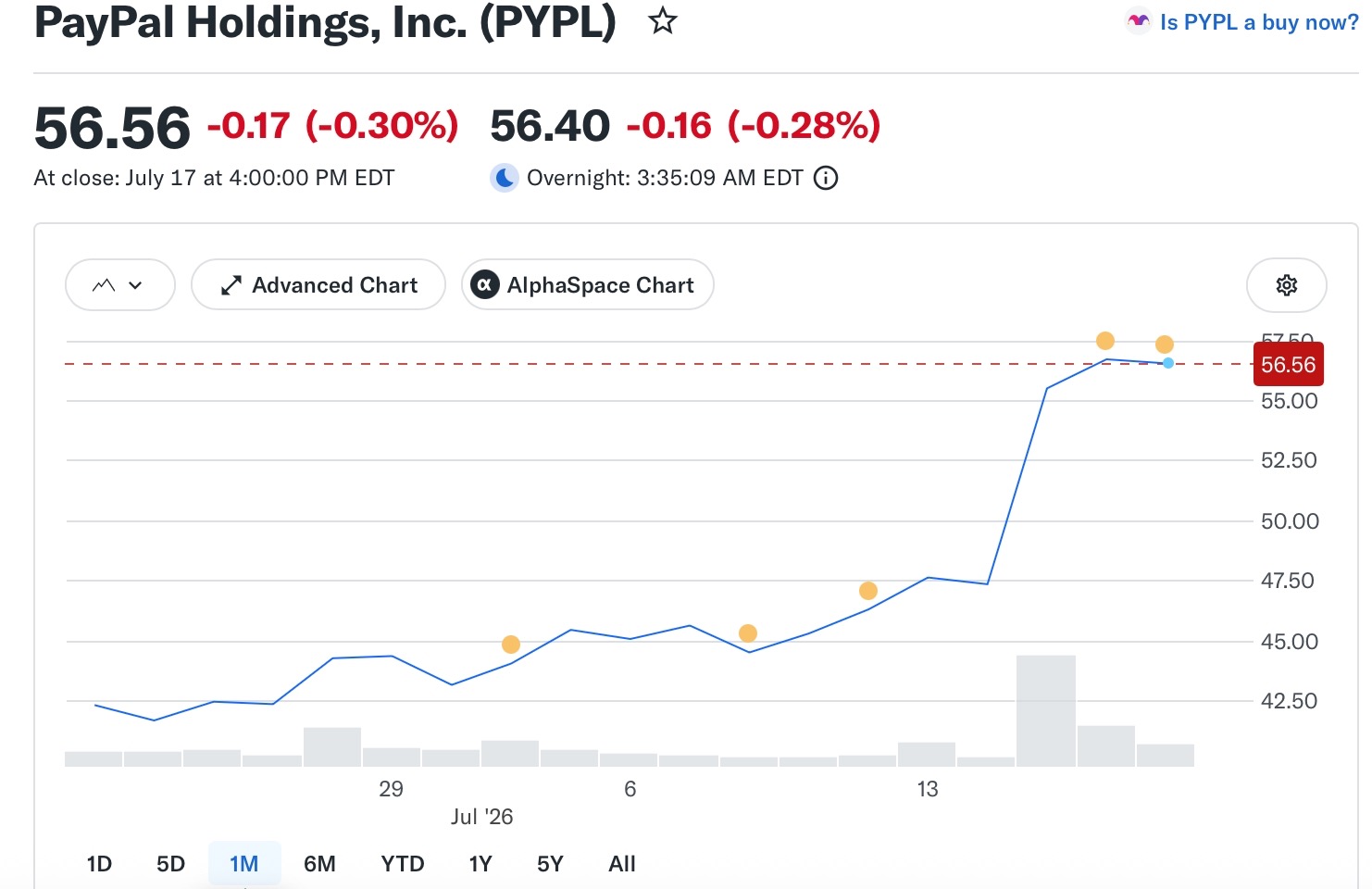
PayPal shares jumped after reports said Stripe and Advent had proposed acquiring the company for roughly $53 billion. The reported price of $60.50 per share represented a significant premium to PayPal’s prior trading level.
That kind of takeover premium can create fast upside in a stock, especially when the target company has already fallen far from its previous highs. PayPal was once one of the market’s best-known pandemic-era growth names, but its valuation has declined heavily since 2021 as growth slowed and competition increased.
The latest rally therefore reflects two forces at once: a possible acquisition premium and a reassessment of PayPal’s underlying assets.
For traders following major U.S. stock and crypto-market narratives, Tapbit provides access to market tools and trading opportunities across different asset themes.
Why Would Stripe Want PayPal?
The strategic logic is fairly clear. Stripe is a major player in online payments, especially on the merchant and developer side. PayPal, by contrast, still has a large consumer-facing brand, a global payment network, Venmo, Braintree, and payment relationships across online commerce.
A deal could give Stripe deeper access to consumer wallets and digital checkout behavior. It could also strengthen Stripe’s position against Apple Pay, Google Pay, Block, Adyen, and other payment competitors.
PayPal’s user base remains one of its most important assets. Even if growth has slowed, PayPal and Venmo still represent familiar consumer payment brands. In a payments market where trust, scale, and merchant acceptance matter, those assets are not easy to rebuild from scratch.
Why PayPal Has Been Under Pressure
The takeover report comes after a difficult period for PayPal.
The company has faced slower branded checkout growth, rising competition in digital wallets, questions around Venmo monetization, and pressure on transaction margins. Earlier in 2026, PayPal also went through a leadership change, with Enrique Lores taking over as CEO.
PayPal’s first-quarter results showed some areas of strength. Revenue rose year over year, total payment volume increased, and Venmo continued to grow. However, Wall Street remained cautious because the company’s profit outlook was weaker than expected and its turnaround plan still needed time to show results.
That is why the latest stock move should be understood carefully. PayPal is not rising simply because all of its business challenges disappeared. The stock is rising because investors are now pricing in the possibility that a buyer may see more value in PayPal than the public market had recently assigned to it.
Why Venmo Matters
Venmo is one of the key reasons investors still pay attention to PayPal.
The app has strong brand recognition in the United States, especially among younger users. It is widely used for peer-to-peer payments and has long been viewed as a potential bridge between social payments, consumer finance, and merchant checkout.
The challenge is profitability. Venmo has scale, but turning that scale into durable profit has not always been straightforward. Any buyer looking at PayPal would likely need to decide whether Venmo is best kept inside a larger payments platform, expanded into more consumer finance products, or eventually separated.
That uncertainty is also part of the opportunity. If a new owner could improve Venmo’s monetization, the asset may be worth more than what current market sentiment suggests.
The Crypto and Stablecoin Angle
PayPal is also relevant to crypto markets because of its PayPal USD stablecoin, known as PYUSD, and its broader payment services and crypto initiatives.
Traditional payment companies have become more interested in stablecoins because they may reduce settlement friction, support faster transfers, and create new payment rails. Stripe has also shown interest in stablecoin infrastructure, which makes the reported PayPal approach especially interesting for crypto-focused traders.
This does not mean PayPal is suddenly a pure crypto stock. It is still primarily a payments and fintech company. But the overlap between consumer wallets, stablecoins, merchant payments, and digital settlement is becoming harder to ignore.
For users tracking crypto and market narratives, they can log in to Tapbit to follow active market moves and compare related trading themes.
Is the Offer Too Low?
One reason the story has gained attention is that some investors believe the reported offer may undervalue PayPal.
PayPal shares remain far below their 2021 peak. The company still produces meaningful cash flow, has recognizable consumer brands, and owns important payment infrastructure. That makes the $60.50-per-share reported offer look attractive compared with recent trading levels, but less impressive compared with PayPal’s historical valuation.
This is why the stock may remain volatile. If investors believe the reported bid is only an opening offer, they may price in the possibility of a higher bid. If the deal fails or PayPal rejects the offer without a stronger alternative, the stock could give back part of its rally.
What Traders Should Watch Next
The most important thing to watch is confirmation.
At this stage, the takeover story is based on reports. Traders should look for official statements from PayPal, Stripe, Advent, or regulatory filings. Until then, the market is trading on deal speculation rather than a completed transaction.
The second key factor is PayPal’s next earnings update. Investors will want to know whether the company’s turnaround is gaining traction, especially in branded checkout, Venmo, cost savings, and payment services.
The third factor is whether other bidders emerge. Large fintech assets can attract strategic buyers, private-equity groups, or companies interested in specific PayPal divisions. Even the possibility of a breakup or partial asset sale could influence investor expectations.
Key Risks for PayPal Stock
The first risk is deal failure. If Stripe and Advent do not proceed, or if PayPal rejects the reported offer, the stock could fall.
The second risk is valuation. A fast rally can pull future upside into the present. Traders buying after a sharp move may face a worse risk-reward balance if the market has already priced in a higher probability of a deal.
The third risk is business execution. PayPal still faces strong competition from Apple Pay, Google Pay, Stripe, Block, Adyen, and other payment platforms. A takeover offer does not remove those competitive pressures.
The fourth risk is regulatory review. A large fintech acquisition involving major payment networks could attract attention from regulators, especially if it affects competition in digital payments.
The fifth risk is broader market sentiment. Fintech stocks can be sensitive to interest rates, consumer spending, credit conditions, and technology-sector risk appetite.
Bottom Line
PayPal stock is rising because the market is reacting to a reported $53 billion takeover approach from Stripe and Advent International. The possible deal has forced investors to revalue PayPal’s consumer payment network, Venmo, Braintree, global checkout business, and crypto-linked payment exposure.
The story is compelling, but it is still not risk-free. The bid has not become a completed transaction, PayPal’s turnaround is still in progress, and the company remains exposed to intense competition across the payments industry.
For traders, PayPal is now more than a simple fintech turnaround story. It has become a live test of how the market values digital wallets, stablecoin infrastructure, and payment networks in the next phase of financial technology.
New users can register on Tapbit to explore market opportunities and follow fast-moving narratives across stocks, crypto, and digital assets.
Frequently Asked Questions (FAQ)
Why is PayPal stock rising?
PayPal stock is rising because of reports that Stripe and private-equity firm Advent International made a joint takeover approach for PayPal. The reported offer values the company at more than $53 billion, or about $60.50 per share. Traders reacted to the possibility that PayPal could be acquired at a premium to its recent trading price.
Who is trying to buy PayPal?
Reports say Stripe and Advent International are behind the takeover approach. Stripe is a major online payments company, while Advent is a private-equity firm. As of now, the reported deal has not been confirmed as a completed transaction.
How much is the reported PayPal takeover offer?
The reported offer is about $60.50 per share, valuing PayPal at more than $53 billion. This represented a large premium to PayPal’s stock price before the news, which is one reason PYPL moved sharply higher.


