
Circle Q2 earnings produced a mixed message for investors. Circle Internet Group reported roughly $701.3 million in revenue and reserve income, about 7% higher than a year earlier, but below the market’s consensus estimate. At the same time, earnings were stronger than expected and USDC circulation reached approximately $73.3 billion.
CRCL was quoted near $77.84 on Circle’s investor-relations page after the release. The reaction shows why the stock cannot be evaluated only through stablecoin adoption. Circle also depends on reserve yields, distribution agreements, operating expenses and the pace at which new products become meaningful revenue sources.
What Did Circle Report in Q2 2026?
The central Q2 numbers were:
- Revenue and reserve income of about $701.3 million.
- Year-over-year growth of roughly 7%.
- USDC circulation of about $73.3 billion.
- USDC on-chain transaction volume up approximately 151% year over year.
- Quarterly profit above market expectations.
Readers looking for Circle’s earlier valuation background can review Tapbit Learn’s previous CRCL stock analysis.
Why Did CRCL Struggle Despite the Profit Beat?
Stocks react to the gap between results and expectations, not simply whether a company made money. Circle’s revenue miss suggested that stronger USDC activity was not converting into revenue as quickly as investors had hoped.
Reserve yield also matters. Circle earns a large share of its income from the assets backing USDC, particularly cash and short-duration government securities. When benchmark rates decline, each dollar of reserves can generate less income even if USDC circulation expands.
How Is USDC Adoption Changing?
USDC circulation rose to about $73.3 billion, indicating continued institutional and on-chain use. Transaction volume grew much faster than supply, which can signal that the same stablecoin units are being used more frequently across exchanges, payments, DeFi and treasury operations.
However, stablecoin activity does not automatically translate into shareholder profit. Circle shares reserve economics with distribution partners and incurs costs to operate compliance, payments and blockchain infrastructure.
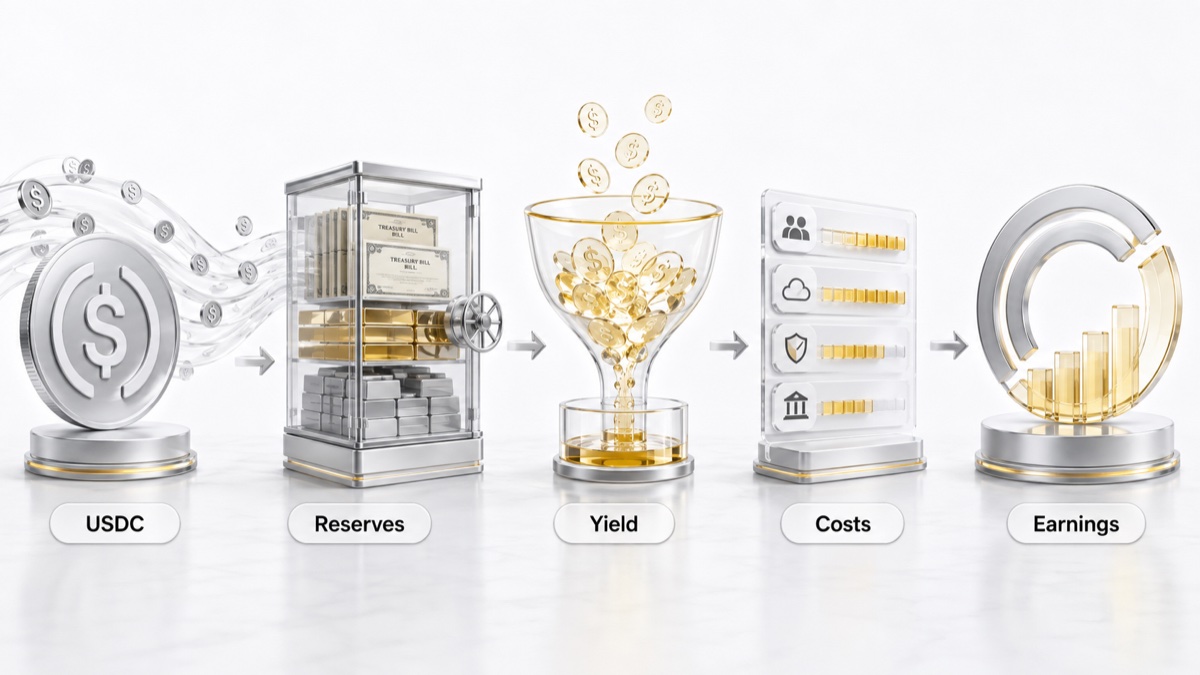
Why Reserve Yield Matters to Circle Revenue
Circle’s business has a built-in sensitivity to interest rates:
- Higher USDC supply increases the reserve base.
- Higher short-term rates increase income generated by that reserve base.
- Lower rates can reduce revenue per USDC even if circulation grows.
- Distribution costs determine how much reserve income Circle retains.
This is why stablecoin regulation and monetary policy both matter to CRCL. Reserve, redemption and custody rules affect institutional trust, while rates affect near-term profitability.
How to Read USDC Growth More Carefully
USDC circulation is an important operating signal, but the headline supply figure does not fully describe Circle’s economics. Investors should ask where the new USDC is being used, how long balances remain outstanding and whether growth comes from payments, exchange liquidity, institutional settlement or temporary trading demand. Two quarters with the same ending supply can produce different revenue outcomes if reserve yields and user behavior differ.
Minting and redemption activity also matters. Strong gross issuance can look impressive while net circulation grows slowly because users redeem almost as quickly as they mint. Persistent net growth is more valuable because it expands the average reserve base across the quarter. That average balance, rather than the final day’s figure alone, is closer to the amount on which Circle can earn reserve income.
Distribution costs are the other side of the equation. Circle may gain scale through major partners, but part of the reserve income is shared under commercial arrangements. A healthy quarter therefore requires more than rising USDC supply: the company must retain enough economics after partner payments, compliance costs and operating investment. This is why CRCL can react negatively even when stablecoin adoption reaches a new high.
Can Circle Become Less Dependent on Interest Income?
Circle Payments Network
Payment infrastructure can generate transaction-based revenue and make USDC more useful for global settlement. The key metric is not only announced partnerships but recurring paid volume.
Arc and Blockchain Infrastructure
Arc is positioned as enterprise-grade infrastructure. If developers and financial institutions build on it, Circle may gain fee and service revenue that is less directly tied to Treasury yields.
Subscriptions and Services
Circle also needs growth from APIs, compliance services, institutional accounts and other software-like products. These categories could improve revenue diversification, but they remain smaller than reserve income.
CRCL Outlook: Bull, Base and Bear Cases
Bull Case
USDC supply continues growing, reserve yields decline more slowly than feared and non-interest products begin contributing. CRCL holds the post-earnings area and reclaims the first resistance zone on improving estimates.
Base Case
USDC adoption remains healthy, but lower rates and distribution costs keep revenue growth moderate. The stock trades in a broad range while investors wait for proof of operating leverage.
Bear Case
Reserve yields fall faster, USDC growth slows or competition raises distribution costs. The bearish case is confirmed if CRCL loses post-earnings support while analysts reduce forward revenue forecasts.
How to Trade CRCL-USDT on Tapbit
Tapbit users can access Circle-related price exposure through CRCL-USDT stock-linked perpetual futures. The contract is a derivative, not direct ownership of Circle shares, and it does not provide shareholder voting rights or dividends.
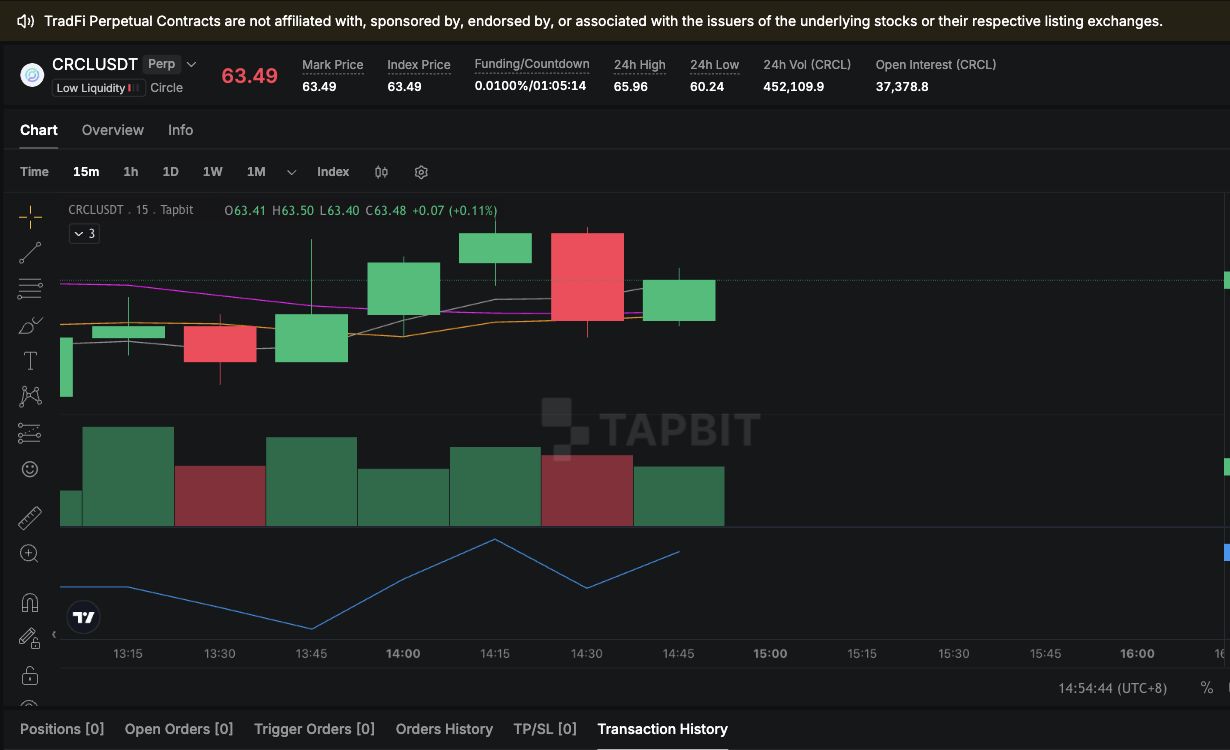
- Register or log in. Create an account or sign in and prepare a futures balance.
- Open CRCL-USDT. Check the contract name, mark price, index price, funding rate and countdown.
- Set the order. Choose Limit, Market or Trigger Order, set quantity and leverage, then select Open Long or Open Short.
- Manage risk. Add TP/SL and monitor margin, funding and liquidation risk around earnings and rate announcements.
Users interested in the stablecoin itself can separately review USDC-USDT spot. Holding USDC is not equivalent to owning CRCL or trading CRCL-USDT.
What Investors Should Watch Next
- USDC circulation and net minting.
- Average reserve yield.
- Distribution and transaction costs.
- Adoption of Circle Payments Network and Arc.
- Federal Reserve policy and the GENIUS Act stablecoin market framework.
FAQ
What was Circle’s Q2 revenue?
Circle reported approximately $701.3 million in revenue and reserve income.
How much USDC was in circulation?
USDC circulation reached roughly $73.3 billion at quarter-end.
Why can lower rates hurt Circle?
Lower short-term rates reduce the income generated by assets backing USDC.
Does CRCL-USDT provide Circle shares?
No. It is a stock-linked perpetual futures derivative.


