
Stablecoin regulation means the legal and supervisory rules that apply to stablecoin issuers, reserves, redemption rights, custody, and customer checks. These rules matter because stablecoins are designed to hold a stable value, usually near one U.S. dollar, but stability depends on more than a token’s name.
A stablecoin can be useful for trading, payments, and settlement only when users trust that it can be redeemed and that its reserves are managed safely. That is why stablecoin regulation is now a major topic for banks, crypto firms, regulators, and traders.
Quick context table:
| Rule Area | What It Controls | Why Traders Care |
|---|---|---|
| Reserves | Assets backing the stablecoin. | Reserve quality affects confidence. |
| Redemption | How users can convert tokens back to fiat. | Weak redemption can raise depeg risk. |
| Custody | Where reserve assets are held. | Custody rules affect issuer trust. |
| Compliance | AML, KYC, audits, and reporting. | Compliance shapes market access. |
What Does Stablecoin Regulation Mean?
The points below break the topic into the main signals readers should review before drawing a conclusion.
Issuer rules
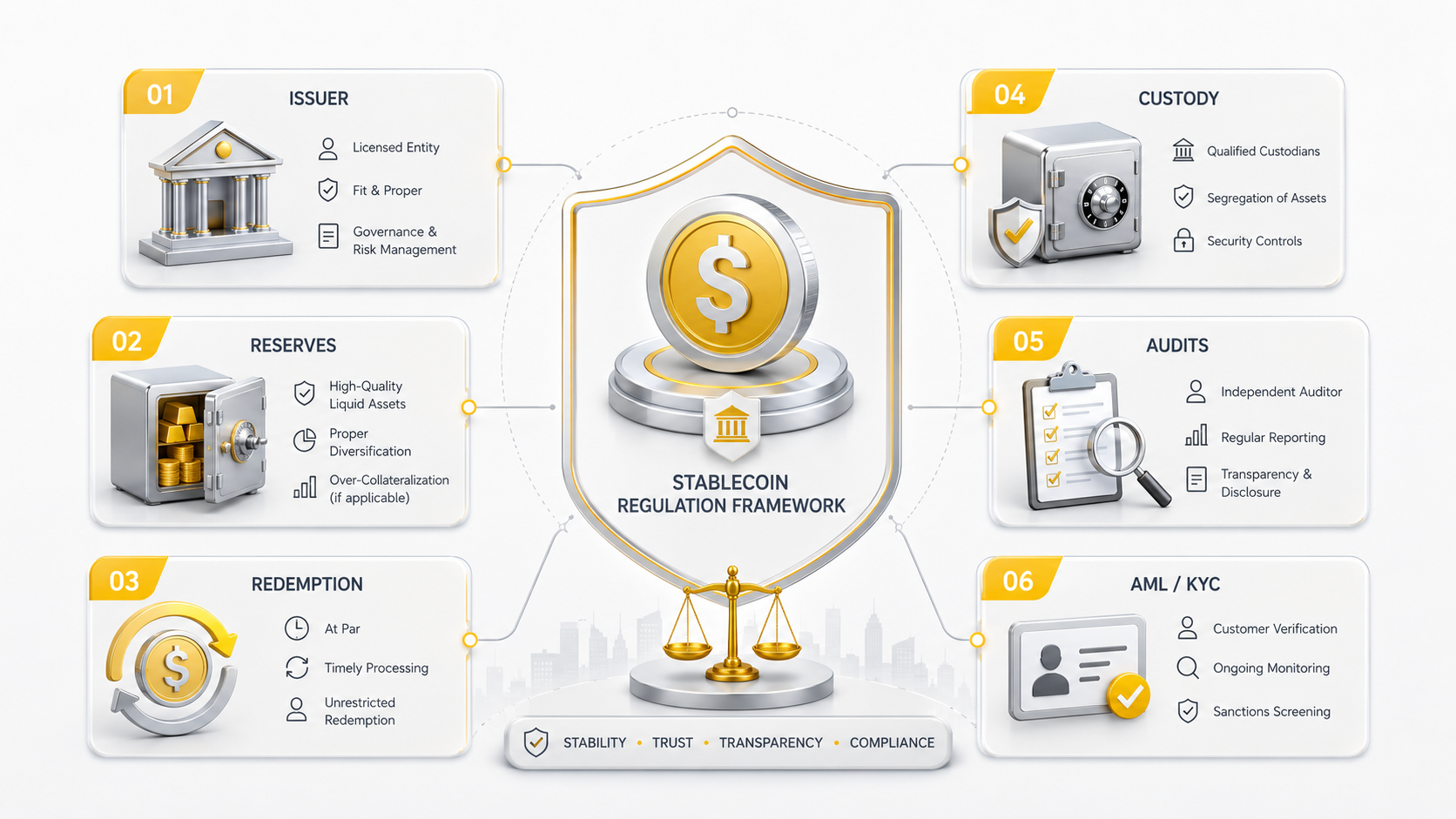
Issuer rules define who can create and manage a stablecoin. Some jurisdictions may require stablecoin issuers to register, obtain a license, or operate through a regulated bank or trust structure.
Issuer rules are important because a stablecoin is only as reliable as the institution managing its reserves and redemption process.
Reserve rules
Reserve rules define what assets can back the stablecoin. Regulators may require reserves to be held in cash, short-term government securities, deposits, or other approved assets.
The quality of reserves matters. A stablecoin backed by liquid, transparent assets is usually easier to trust than one backed by risky or hard-to-value assets.
Redemption rules
Redemption rules define whether users can exchange the stablecoin for fiat currency, how quickly redemption must happen, and whether redemption should occur at par value.
Without clear redemption rules, a stablecoin may trade below its intended value during stress.
Why Stablecoin Regulation Exists
The drivers below work together, so the cleaner view comes from comparing momentum, liquidity, and risk conditions rather than one headline alone.
Run risk
Stablecoins can face run risk. If users fear reserves are weak or redemptions may fail, they may rush to redeem at the same time. That can put pressure on the issuer and the broader market.
Reserve transparency
Regulation can require issuers to disclose reserves, publish attestations, and separate customer assets from company assets. This helps users judge whether the stablecoin is properly backed.
Consumer protection
Stablecoin users need clear rules about redemption, fees, disclosures, custody, and dispute resolution. Without protection, users may not understand what rights they have when a stablecoin depegs or an issuer faces stress.
Main Areas of Stablecoin Regulation
The points below break the topic into the main signals readers should review before drawing a conclusion.
1:1 reserves
Many stablecoin rules focus on whether tokens are backed one-to-one by high-quality assets. A clear reserve rule helps reduce uncertainty.
Segregated accounts
Segregated accounts can help separate reserves from the issuer’s operating funds. This matters if the issuer becomes insolvent or faces legal claims.
Audits and disclosures
Audits and regular disclosures help users assess whether reserves exist and whether they match the number of tokens in circulation.
AML/KYC compliance
Recent U.S. proposals have focused on customer identification programs for certain payment stablecoin issuers. This shows that stablecoin regulation is not only about reserves; it also includes financial-crime compliance.
Redemption at par
Redemption at par means users can redeem the stablecoin for the reference asset, usually one dollar per token. Clear redemption rules are central to stablecoin trust.
Stablecoin Regulation in Major Markets
The points below break the topic into the main signals readers should review before drawing a conclusion.
United States
The United States has been debating stablecoin frameworks covering reserve custody, issuer supervision, customer identification, and financial-crime rules. Agencies have proposed rules that would require certain payment stablecoin issuers to maintain effective customer identification programs.
Japan
Japan has built a more formal legal structure for stablecoins, with rules involving trust structures, banks, and regulated issuers. This makes Japan an important market to watch as bank-linked stablecoin projects develop.
Europe
Europe has focused on crypto-asset regulation through a broad framework that covers issuers and service providers. For stablecoins, reserve, disclosure, and authorization requirements are especially important.
Global policy coordination
Stablecoins operate across borders, but regulation is still national or regional. That creates a challenge: a stablecoin may be issued under one framework and used by people in many others.
Stablecoin Regulation and USDC / Tether
The points below break the topic into the main signals readers should review before drawing a conclusion.
Reserve quality
USDC and Tether are often discussed because they are major stablecoins with large market roles. Traders should compare reserve composition, transparency, and redemption processes rather than assuming all stablecoins are equal.
Disclosure standards
Disclosure standards influence trust. More frequent and clearer reserve reporting can reduce uncertainty. Weak or unclear disclosures can increase depeg risk.
Redemption confidence
A stablecoin’s value depends on confidence. If users believe they can redeem reliably, the peg is easier to maintain. If confidence drops, the market may sell the token below its intended value.
Why Stablecoin Rules Matter for Traders
The drivers below work together, so the cleaner view comes from comparing momentum, liquidity, and risk conditions rather than one headline alone.
Liquidity
Stablecoins are used as trading pairs, collateral, and settlement assets. Better regulation can strengthen liquidity by increasing trust.
Depeg risk
Regulation cannot remove all depeg risk, but it can reduce some causes of panic by improving reserve rules and redemption clarity.
Exchange settlement
When exchanges and traders rely on stablecoins, stablecoin failure can affect wider market settlement. That is why stablecoin regulation matters even to users who mainly trade BTC, ETH, XRP, DOGE, or other assets.
Users should verify stablecoin risks before relying on any dollar-pegged token. Traders who want to review a supported stablecoin pair can check the USDC-USDT spot market, compare liquidity and recent movement, and then create an account when ready to check available spot or futures markets. They can also use broader BTC spot or BTC futures markets as general starting points before deciding which supported pair fits their strategy.
For more context, readers can compare this topic with GENIUS Act stablecoin markets, MiCA regulation, and crypto market structure bill.
FAQ
The points below break the topic into the main signals readers should review before drawing a conclusion.
What does stablecoin regulation mean?
Stablecoin regulation means rules for stablecoin issuers, reserves, redemption rights, custody, disclosures, and compliance.
Why do stablecoins need regulation?
They need regulation because users rely on them for trading, payments, and settlement, and weak reserves or unclear redemption rules can create market stress.
Does stablecoin regulation make stablecoins risk-free?
No. Regulation can reduce some risks, but stablecoins can still face liquidity, operational, legal, and depeg risks.
How does stablecoin regulation affect USDC and Tether?
It can affect reserve disclosures, redemption expectations, customer checks, issuer supervision, and how these assets are used in regulated markets.
What should traders check before using a stablecoin?
Traders should check reserves, redemption rules, issuer transparency, exchange support, and depeg history.


