

Retail markets often misread the tape when it comes to Bitcoin mining logistics. Right now, what looks like a standard post-halving squeeze is actually a structural exodus.
In the first quarter of 2026, publicly listed North American mining operations liquidated more than 32,000 BTC. To put that volume in context, this single-quarter dump dwarfs the sheer panic selling we saw during the Terra-Luna and 3AC collapses in mid-2022.
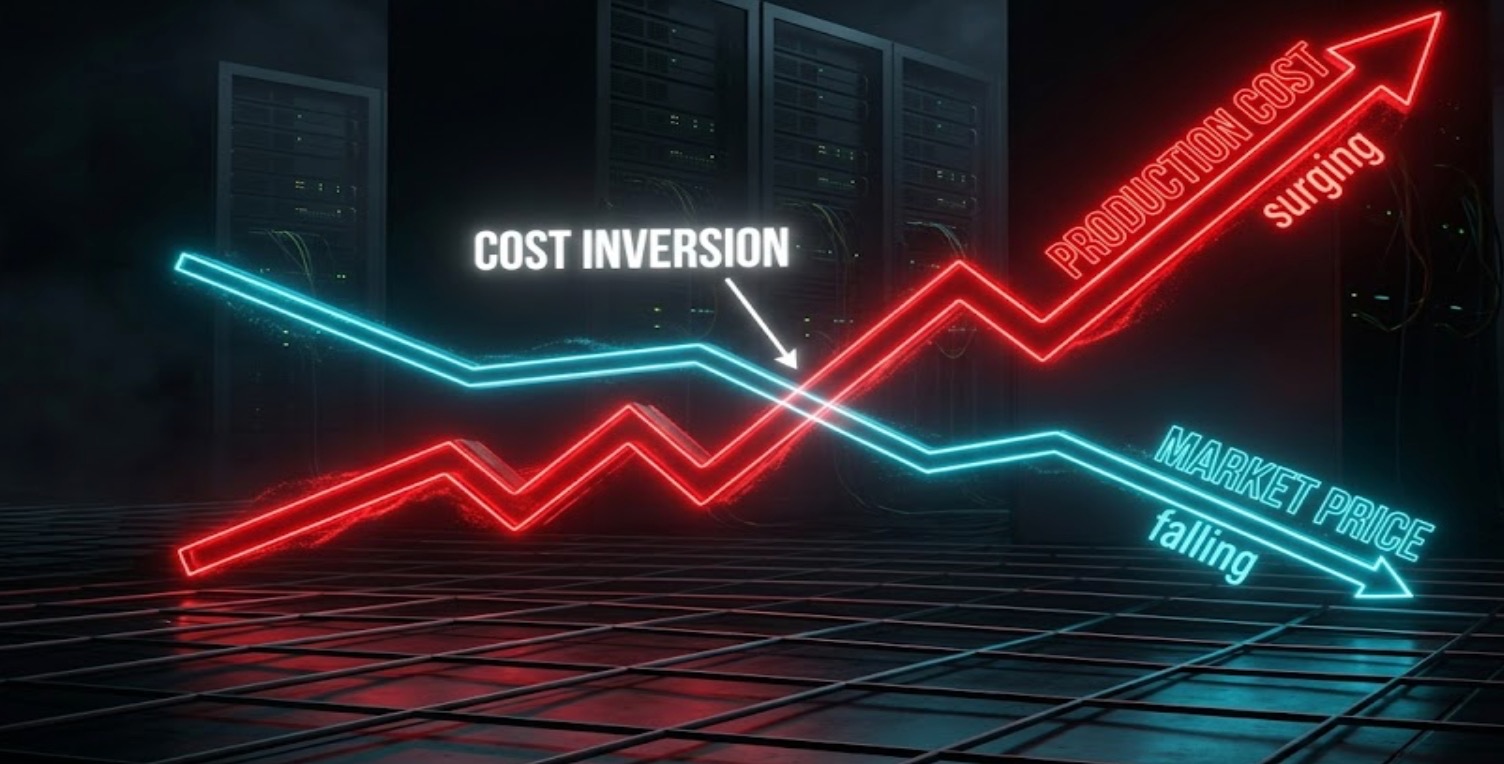
But the 2022 capitulation was driven by a collapsing spot price. Today, BTC is hovering comfortably in the $70k–$75k range. So why the unprecedented sell-off? Our read on the underlying unit economics is straightforward: miners are bleeding cash. They are trapped in a cost inversion, and they are executing a multi-billion-dollar pivot away from the Bitcoin network toward Artificial Intelligence (AI) to survive Wall Street's scrutiny.
Here is the hard data driving the institutional mining capitulation of 2026.
The Unit Economics Are Broken
You cannot understand miner behavior without tracking Hashprice—the daily revenue generated per petahash of computational power. Due to the lingering effects of the 2024 block reward halving and a relentless, upward-grinding network difficulty, the math for legacy rigs no longer works.
-
Hashprice at Historic Lows: In Q1 2026, Hashprice cratered to between $28 and $35/PH/day, breaking post-halving records for unprofitability.
-
The $80K Breakeven Trap: According to recent institutional modeling, the weighted average cash cost for a public miner to produce a single BTC has spiked to roughly $79,995.
When spot BTC sits at $75,000 and your production cost is $80,000, you are running a negative gross margin business. Roughly 20% of the global network is currently operating underwater. The 32,000 BTC unloaded in Q1 wasn't traders taking profits; it was treasuries being forced to liquidate balance sheets just to keep the lights on and service massive CapEx debt.
The HPC Bailout: Selling Power to Silicon Valley
Faced with a broken BTC mining model, mining CEOs are realizing their most valuable assets are no longer ASICs. Their actual moat is secured, multi-megawatt power contracts and enterprise-grade cooling facilities.
Instead of burning electricity to mine BTC at a loss, they are leasing their power grids to Silicon Valley’s AI hyperscalers. According to a recent CoinShares brief, AI computing workloads generate up to 25 times more revenue per kilowatt-hour than Bitcoin mining.
Capital markets are aggressively backing this transition:
-
The $9.7B IREN Deal: The blueprint for this pivot was IREN, which successfully locked in a staggering $9.7 billion AI cloud contract with Microsoft to supply 200 MW of IT load for NVIDIA GB300 clusters.
-
Revenue Flip: Current projections estimate that by the end of 2026, up to 70% of the total revenue generated by public "mining" companies will actually come from High-Performance Computing (HPC) and AI hosting.
The "De-Crypto" Rebrand

If you want to see how permanently the landscape is shifting, look at corporate SEC filings. To capture the massive valuation multiples associated with AI data centers—and to shed the stigma of crypto volatility—major players are literally erasing Bitcoin from their branding.
-
Bitfarms officially completed a comprehensive rebrand on April 1, 2026, renaming itself Keel Infrastructure Corp. The company now pitches itself to Wall Street strictly as a North American energy and data center operator.
-
Cipher Mining pulled a similar maneuver earlier this year, restructuring as Cipher Digital Inc. and signaling its intent to strip away pure mining assets to cater to enterprise AI clients.
The Tapbit Trading View
For spot BTC and equities traders, the Q1 capitulation tells two distinct stories.
In the short term, the forced liquidation of 32,000 BTC created a heavy supply ceiling, acting as friction against Bitcoin's attempts to clear $77,000. However, the macro view is highly constructive. As inefficient miners exit the network or pivot entirely to Microsoft and Amazon server racks, the chronic, structural selling pressure from the production side will dry up.
The Bitcoin supply is transferring from high-cost, distressed producers into the hands of long-term ETF allocators. Once this inventory flush is complete, the lack of miner-driven supply will lay a much healthier foundation for BTC's next leg up. To position your portfolio for this macro shift and trade the coming supply shock with deep liquidity, explore Tapbit. Register for an institutional-grade account today, or log in to your trading terminal to execute your strategy.
Frequently Asked Questions (FAQ)
If BTC is trading above $70,000, how are miners losing money?
It comes down to network difficulty and the 2024 halving. While nominal BTC prices are high, the amount of BTC a single machine can mine has plummeted, while electricity and hardware costs have soared. The average cost for public companies to produce one coin is now roughly $80,000, creating a negative margin environment for older fleets.
What is Hashprice?
Hashprice is the core metric of mining profitability. It measures the daily expected revenue per unit of hashing power (USD per Petahash per day). When Hashprice drops below a company's electricity breakeven point—as it did in Q1 2026 when it hit the $28-$35 range—machines are turned off, or miners operate at a loss.
Why are Wall Street investors rewarding miners for leaving Bitcoin?
Valuation arbitrage. A company branded as a "crypto miner" traditionally trades at a low multiple due to the inherent volatility of Bitcoin. However, if that same company rebrands as an "AI Data Center Infrastructure Provider" with guaranteed, multi-year revenue contracts from tech giants, Wall Street assigns it a much higher tech/infrastructure valuation multiple.


